

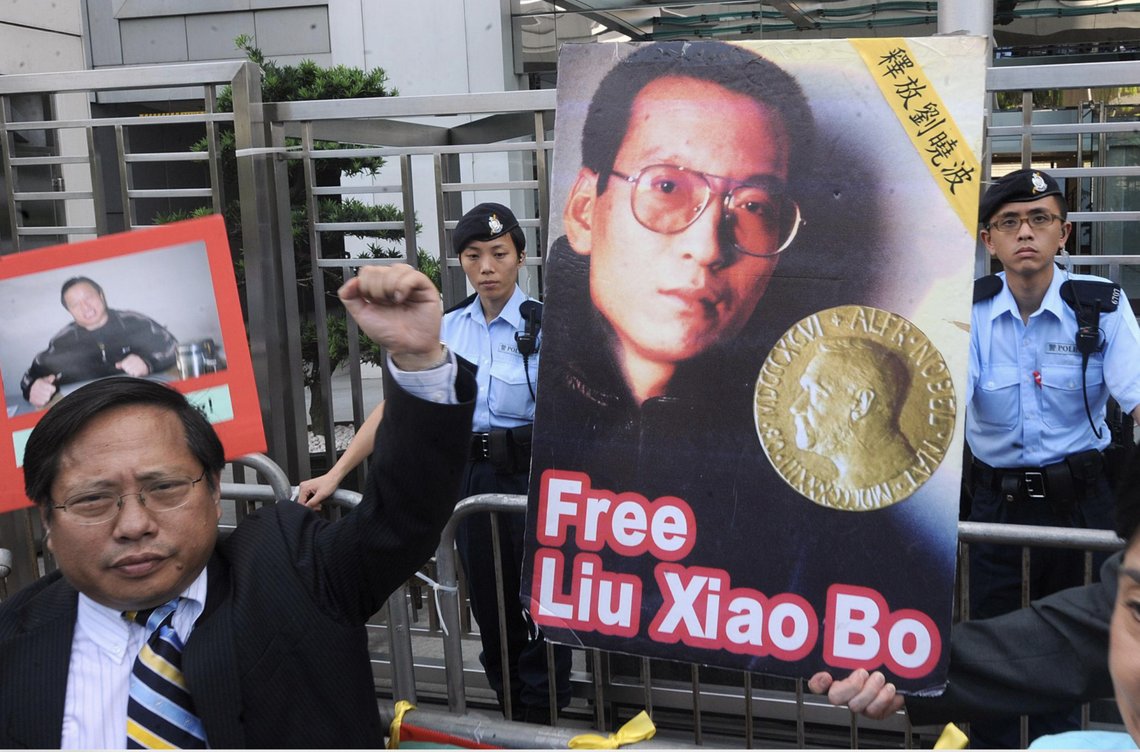


As Foreign Minister, Jonas Gahr Støre put pressure on Thorbjørn Jagland, the chair of the Nobel Committee, to ensure that the committee did not award the Peace Prize to the Chinese dissident Liu Xiaobo. Jagland wrote about this in his book, which was published in 2021.
In the book *Years of Peace and Strife*, which was launched this week, Jagland describes several incidents in which he believes he was subjected to pressure from the then Foreign Minister Støre prior to the announcement of the Peace Prize in 2010.
Støre flatly denied the allegations, but his vehement denial arouses suspicion.
Støre asserts that the Nobel Committee is an independent body that makes its decisions behind closed doors.
“There is absolutely no way for the government to exert influence,” he states.
Anyone familiar with the Norwegian system knows that this categorical denial is not necessarily true. Jagland himself has described the moment when he met Støre outside the UN building and Støre learnt that Liu Xiaobo was on the list. Støre reacted; he knew this would not be well received in Beijing.
Jagland also refers to an incident during the high-level week of the UN General Assembly. According to Jagland, Støre said at the time that China had warned that negotiations on a free trade agreement would come to a halt if a Chinese dissident were to be awarded the Peace Prize.
“It came to a head when Foreign Minister Jonas Gahr Støre, during a reception at Oslo City Hall, put his arm around me and said: ‘You’re not planning to ruin our relationship with this great country, are you?’. I said nothing, but reacted strongly inside,” he writes, amongst other things.
Some will recognise the description of Støre’s behaviour.
The price cost Norway several years in the Chinese ‘freezer’.
The kind of support for dissidents that we are familiar with from the Soviet era was much more difficult to muster when it came to China.
This was not unique to Norway. Not long after the Tiananmen Square massacre in 1989, Bush’s National Security Adviser Brent Scowcroft travelled to Beijing and gave assurances that relations would soon be normalised.
But Støre insists on maintaining the moral high ground. He cannot admit that he is taking the wrong path and exerting undue pressure.
The façade must remain spotless!
Støre does not dare to say that Jagland is lying, but confines himself to saying that he experienced the situations differently from how Jagland portrays them.
Støre denies that he put pressure on the Nobel Committee prior to the award to Liu Xiaobo


