

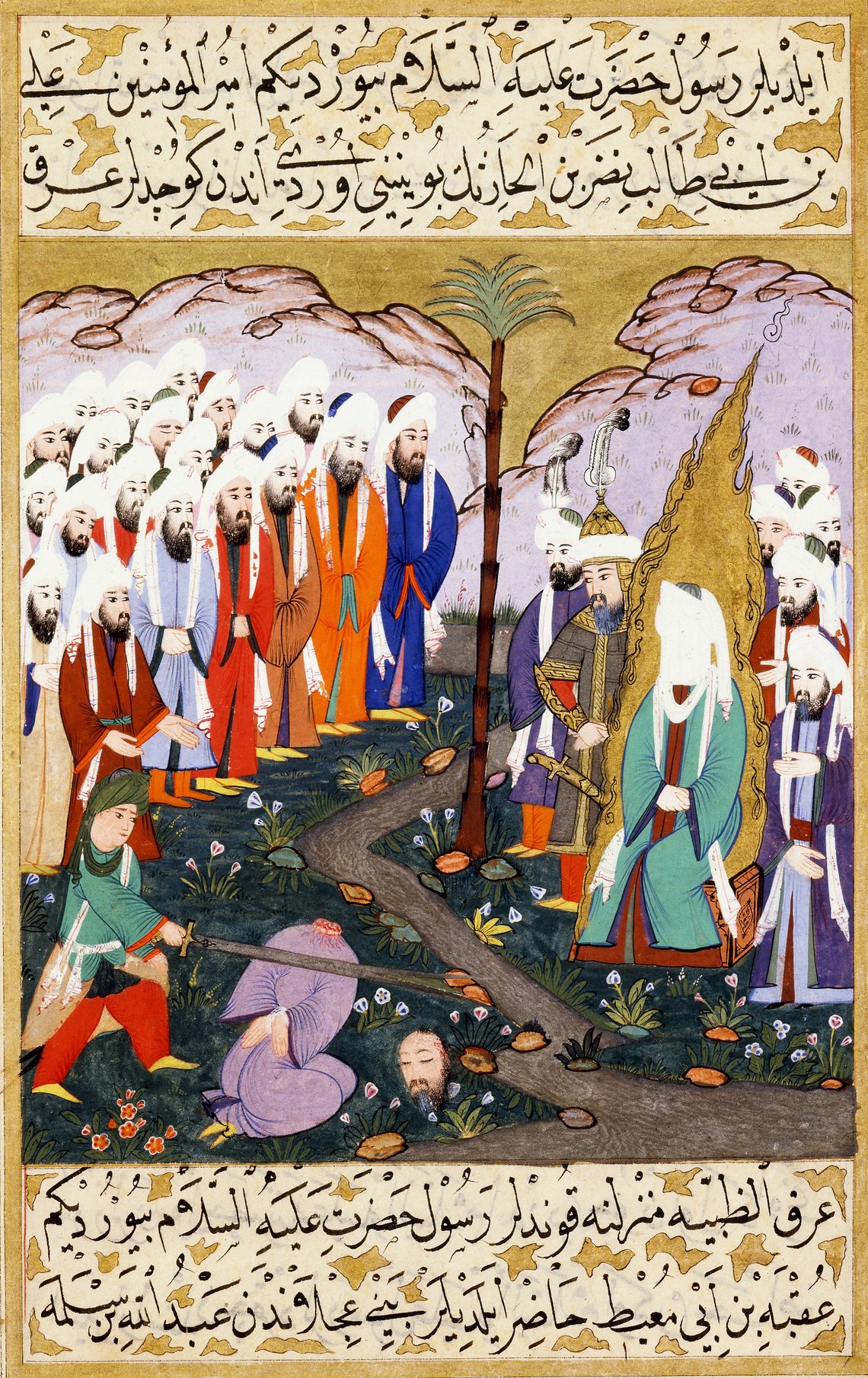
 ʿAlī beheading Nadr ibn al-Harith in the presence of the Prophet Muhammad, from the Siyar-i Nebi (Life of the Prophet), Ottoman miniature, Istanbul c. 1594. The David Collection, Copenhagen (acc. no. 5/1985), public domain.
There are many interpretations of the conflict between Islam and Judaism, as well as between Israel and the Islamic world. Some explanations focus on colonialism, nationalism, economics, or geopolitics. What I hope to achieve here is to present a theological explanation for modern antisemitism in the Islamic world, rooted in Islamic history and doctrine itself.
The issue begins with the life of Muhammad. According to Islam, Muhammad is the final prophet, the perfect example for humanity, and the model all Muslims are expected to follow. Before Muhammad’s migration to Medina in 622 AD, the city already had a significant Jewish population. Several Jewish tribes were economically and politically influential. The Banu Qurayza were skilled in agriculture and wealthy. The Banu Nadir were powerful and politically connected. The Banu Qaynuqa controlled much of the marketplace in Medina. North of Medina was the Jewish stronghold of Khaybar, another prosperous Jewish centre. Muhammed was welcomed in Medina by some Jews. And five years after Muhammed came there was not a Jew left in Medina. How did this happen?
When Muhammad arrived in Medina after facing opposition in Mecca, he began preaching that he was the final prophet sent by God. He called upon the Jews to accept him and convert to Islam. However, the Jewish tribes largely rejected his claims. According to the Islamic narrative, the Jews could not find evidence of Muhammad in their Scriptures, and unlike earlier biblical prophets, Muhammad did not present miracles that convinced them of his prophethood. The Qur’an itself became the primary proof offered in support of his mission. And the Jews did not find this to be persuasive.
As tensions grew, Muhammad’s attitude towards the Jews hardened. Muhammed accused the Jews of the following:
1. Allah cursed the Jewish people because of their transgressions (Surah 5:78).
2. Allah transformed them into monkeys and pigs as punishment for their wrongdoing (Surah 7:166).
3. Allah condemned the Jews for killing the prophets (Surah 2:91).
4. Islam is the final revelation, and therefore Jews and Christians must convert.
5. Jews corrupted the books of God (Surah 2:75; Surah 5:13).
6. Jews are described as among the greatest enemies of Islam (Surah 5:82).
7. Jews will only approve of Muslims if Muslims convert to Judaism (Surah 2:120).
8. Jews are accused of causing wars and corruption on earth (Surah 5:64).
9. The Qur’an condemns Jews and Christians for saying they are children of God (Surah 5:18).
10. Jews are cursed because they accused Allah of having a weak hand (Surah 5:64).
11. Jews are described as loving the present life more than eternity (Surah 2:96).
12. Jews are accused of killing the Messiah (Surah 4:157).
Conflict eventually moved beyond theology and into open confrontation. According to Islamic sources, after an alleged assassination attempt by members of the Banu Nadir tribe, Muhammad besieged them and destroyed their date palm groves, crippling their economy. The tribe surrendered and was expelled from Medina. Their land and possessions were redistributed among the Muslims. Shortly afterwards, during the Battle of the Trench in 627 AD, the Banu Qurayza were accused of siding with Muhammad’s enemies in Mecca. After the siege ended, Muhammad turned against the tribe. Islamic historical accounts describe the execution of the men and the enslavement of the women and children.
The final major Jewish stronghold in the region was Khaybar. In 628 AD, Muhammad and his followers attacked and conquered it after fierce fighting. Its wealth was seized, and its population subdued. According to Islamic tradition, Muhammad later declared that there could not be two religions in Arabia, which eventually contributed to the removal of Jewish communities from the Arabian Peninsula. By the end of Muhammad’s life, Judaism and Jews had largely disappeared from Medina, and Islam had become dominant.
A famous hadith in Sahih al-Bukhari summarizes this militant dimension of early Islam:
“I have been commanded to fight the people until they testify that there is no god but Allah and that Muhammad is the Messenger of Allah.”
Despite these conflicts, Jews later in history lived under Muslim rule more securely than under Christian rule during parts of the Middle Ages. They were treated as dhimmi, meaning protected but subordinate non-Muslims who paid special taxes and faced legal restrictions. Discrimination existed, but Jewish communities nevertheless survived and sometimes prospered in Muslim societies. Other societies also became relatively tolerant towards Jews during certain periods, including Poland in the 16th and 17th centuries, the Netherlands during the Dutch Golden Age, Spain before the expulsion of the Jews in 1492, and eventually the United States.
The modern conflict intensified with the rise of Zionism and the growth of the Jewish population in Palestine during the late 19th and early 20th centuries. As Jewish immigration increased, opposition within the Arab and Islamic world also intensified. During the 1930s and 1940s, some Arab leaders openly sympathized with Nazi Germany. Haj Amin al-Husseini, the Grand Mufti of Jerusalem, became one of Hitler’s most vocal supporters in the Middle East. Anti-Jewish propaganda spread widely throughout the region, and Arabic translations of Mein Kampf became influential in some circles.
Since the establishment of Israel in 1948, the conflict has taken on an even deeper symbolic significance. Israel’s survival and success challenge traditional Islamic assumptions about religious superiority. In Islamic theology, Islam is understood as God’s final and greatest revelation, while Muslims are viewed as the community chosen to guide humanity. Yet Israel — a tiny Jewish state surrounded by much larger Muslim populations — has become technologically, militarily, and economically successful and superior. Israel repeatedly defeated surrounding Arab states despite being vastly outnumbered.
This creates a profound theological and psychological tension. If Islam represents the final and perfect revelation from God, why do Jews appear more successful in practice? Why has the Islamic world, despite its size and resources, often lagged behind technologically and economically while Israel has advanced rapidly? To some observers, this creates a crisis of legitimacy of Islam itself.
A similar comparison can be drawn between China and Taiwan. Taiwan is vastly smaller than China in both territory and population, yet it has become a center of advanced technology, prosperity, and political freedom. Taiwan’s existence is the greatest proof that Communism in China does not work nearly as well as Taiwanese freedom. Taiwan’s very existence and what it represents is a living threat to China. In the same way, Israel’s existence appears to challenge the assumption that Islamic doctrine is true and that Muslims are the chosen people. The American scholar Thomas Sowell says “People will forgive you for being wrong, but they will never forgive you for being right — especially if events prove you right while proving them wrong.”
From this perspective, two possible conclusions emerge. One is to conclude that Jewish civilization and values may in fact possess strengths that have allowed Jews to flourish despite centuries of persecution. The other is to react the way Muhammad himself reacted to Jewish rejection: through conflict and confrontation. In this interpretation, hostility towards Israel becomes more than a territorial dispute. Israel itself becomes a living contradiction to Islamic claims of religious and civilizational supremacy. Destroying Israel, therefore, becomes symbolically important because it would appear to vindicate Islam’s superiority in the eyes of its supporters.
The dispute over Israel, and attempts to understand it, are often difficult for secular Westerners who do not fully understand the role of religion in the Middle East. Many Muslims are deeply aware of their own religious history and continue to think and act within a theological framework shaped by the teachings of Islam and Muhammad’s conflict with the Jews. In this sense, the struggle between Muhammad and the Jewish tribes in Medina remains symbolically and theologically relevant even 1,400 years later. Understanding these theological motivations is therefore essential for anyone who genuinely wants to understand or solve the conflict.


