

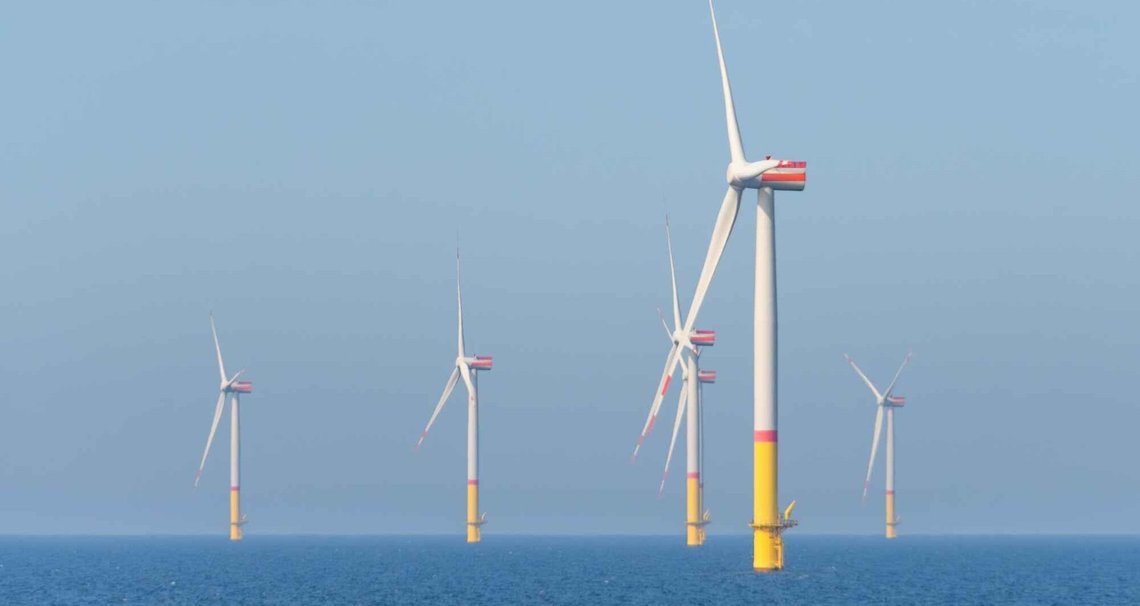
Politicians and the media always portray the ‘green transition’ as an inevitable given, and point out that Denmark is powered by wind turbines. That is completely wrong. Half of Denmark’s energy supply comes from fossil fuels, and its electricity supply is entirely dependent on neighbouring countries. Even after 30 years of wind power development, Danish politicians believe they will soon be self-sufficient in electricity – they just need to build even more wind farms, because the wind turbine sellers say that’s a good idea.
One of the factors behind the ‘energy transition’ is that wind power is to produce green hydrogen as the fuel of the future. Civil engineer Søren Kjærsgård has recently debunked this misconception in *Den Korte Avis*, where he presents figures and data that refute Danish politicians’ belief in a fossil-free future. Despite the intensive expansion of wind power, Denmark is still not self-sufficient in electricity and is far from having the capacity for a ‘hydrogen adventure’.
Self-deception does not negate the facts and figures
In 2025, average electricity consumption in Denmark stood at 4,856 MW and net imports at 846 MW, which corresponds to as much as 17 per cent of electricity consumption. The adopted policy is to use more wind power for electrolysis, to produce green hydrogen to replace diesel and petrol, but the authorities have recently abandoned the agreed climate targets relating to this. And this is hardly surprising, as time is running out and everyone realises that the climate targets will not be met now.
The Danish authorities have therefore had to “adjust” their climate targets and have adopted an electrolysis capacity of 2.7 GW by 2030. Unfortunately, the market for ‘green hydrogen’ is characterised by considerable uncertainty and a lack of customers, and hydrogen projects across Europe are being delayed or cancelled for several reasons. One is regulation: there is a lack of approvals, infrastructure and access to resources. The second is the price of ‘green hydrogen’. But the most important reason is that hydrogen is extremely dangerous, explosive, unpredictable, corrosive and far too inefficient ever to become the fuel of the future. It is a pipe dream.
Denmark proves that offshore wind is economic madness
Kjærsgård presents a calculation that is also of interest to Norway: Offshore wind turbines cost approximately 25 billion kroner per nominal GW. In the first half of 2026, Danish offshore wind, with an installed capacity of 2.6 gigawatts, delivered on average just 1.16 gigawatts, or 44 per cent of installed capacity. This in turn means that, in reality, offshore wind cost Denmark 135 billion per gigawatt produced. Bear that figure in mind!
Here, Kjærsgård compares the figures with Finland’s newest nuclear reactor, which has a capacity of 1.5 gigawatts and cost 83 billion kroner to build – equivalent to 56 billion per gigawatt – because nuclear power stations deliver almost as much as their installed capacity, and they supply electricity constantly, in a controllable and predictable manner. These are genuine power stations.
Kjærsgård’s figures are empirical data proving that nuclear power is far cheaper than wind power. What is not included in the calculation is lifespan: after an estimated 15 years of spreading oil and microplastics everywhere, offshore wind turbines are worn out and must be dismantled and replaced with new ones. A modern nuclear power station has a lifespan of at least 50 years, without emitting anything at all. That makes the figures for wind power look even worse.
Kjærsgård also presents figures that undermine the belief in hydrogen as the energy carrier of the future, and one thing is certain: no country in the world can cope with power stations that supply electricity intermittently for just 44 per cent of the year. And no industry can survive with production facilities that deliver the product for only 11 hours a day. It is collective self-deception based on psychology – not facts based on technology.


