

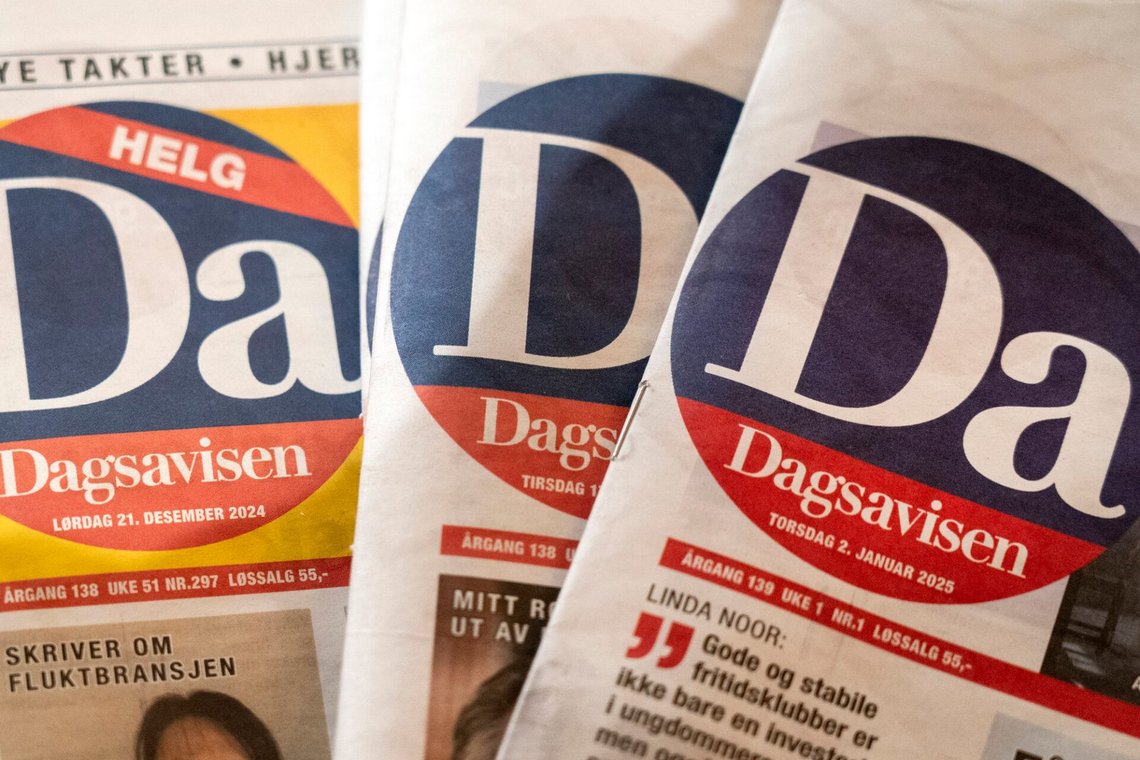
Dagsavisen gets almost everything wrong in its editorial about Hans Rustad and the Norwegian Editors’ Association.
The only thing the newspaper gets right is that membership is not a human right. No. It is something far more important: it is the proof of whether the association actually means what it says about media diversity.
For that is precisely why Rustad still wants to remain a member. Expel him, and the Norwegian Editors’ Association will be left without a single dissenting voice. A guild without a single critic is not a professional community.
Then it becomes an echo chamber with statutes.
Dagsavisen writes that the association has ‘conditions for joining’. Correct. And one of them, had the newspaper read its own principles carefully enough, ought to have been that a community which claims to safeguard media diversity actually tolerates the one voice that disagrees with the others in the room. If the Norwegian Editors’ Association wants diversity, it must tolerate Document. And it must tolerate Document wanting to work to change some of the association’s rules from within. That is not an attack on the community. It is taking a professional community seriously.
The claim about the Code of Ethics is simply nonsense
Dagsavisen writes that Rustad ‘seems little interested’ in following the Code of Ethics of the Norwegian Press (Vær Varsom-plakaten, VVP). That is a claim without foundation, and the editorial writer could have checked it himself.
Yes, Document has been found in breach by the Norwegian Press Complaints Commission (PFU) a fair number of times. We do not deny that, and we never have. But we publish the rulings against us, as we are required to do. We do not do so in an obscure notice, as other editorial offices often content themselves with doing. We give the cases their own prominent place, presenting the ruling in full, so that readers themselves can form an opinion about what we were found in breach over.
That is precisely what the VVP requires of an editorial office that takes criticism seriously.
Put into perspective: Over the past ten years, NRK tops the statistics for adverse rulings, with 33. TV 2 and Finansavisen follow with 21 each. Document is nowhere near the top of that list.
Nor is Dagsavisen without a history of its own here. In 2023, the newspaper itself had two individual adverse rulings from the PFU, and was also included in a collective adverse ruling together with seven other newspapers over a racism story from the Norway Cup that they had all republished from the same source. It was, incidentally, Document that reported on that ruling when it was issued.
Counting Document’s adverse rulings without mentioning that both NRK and Dagsavisen itself have their own history, and that it was Document that covered it, is not journalism. It is selective bookkeeping.
Bevar Norge is not Document
Dagsavisen writes that Document has ‘established a large number of local branches’, and that this has ‘since last year’ been known as Bevar Norge, which allegedly ‘receives extensive editorial coverage’. This is misleading and something Dagsavisen itself could have checked.
Bevar Norge was founded in November last year precisely because Document acted on the VVP’s requirement to separate editorial work from activism. What had previously been informal local branches were brought together in a separate, independent organisation with its own board, independent of Document. The only connection that remains is that some of us occasionally give talks at their meetings, just as we would for any other association that asked. That is not ‘editorial coverage’. It is that we took seriously the distinction Dagsavisen calls for, while Dagsavisen has not bothered to check whether we actually did so.
Who is actually seeking the truth?
Dagsavisen writes that there are ‘few signs’ that Document engages in truth-seeking, relevant, factual and comprehensive journalism. We would argue the opposite.
If anyone is actually seeking the truth in Norwegian public discourse, it is Document. We are the editorial office that consistently draws attention to the violence committed by immigrants in Norwegian society, a subject that large parts of the rest of the media industry prefer to pretend does not exist. That is not populist. It is covering what others choose not to cover.
Dagsavisen concludes by saying that it ‘will defend Rustad’s absolute right to express himself’, but believes that he ‘does not belong’ in the association of which he is critical. It is a fine phrase to hide behind. The reality is that Dagsavisen wants freedom of expression for everyone who already agrees with them, and a separate set of rules for the one person who does not.
On Friday, the board of the Norwegian Editors’ Association will decide whether it dares to stand by its own principle of diversity, or whether it is merely adorned with the concept of diversity.


