

Innlandet Labour Party links the age limit for social media to ‘xenophobia and racism’ in children’s feeds. In the government’s own legislative proposal, the words are absent.
For some time, the Labour Party has been working intensively to ban social media for people under the age of 15. The justification has been harmful content on social media. But now Innlandet Labour Party is lifting the veil and revealing more about the rationale.
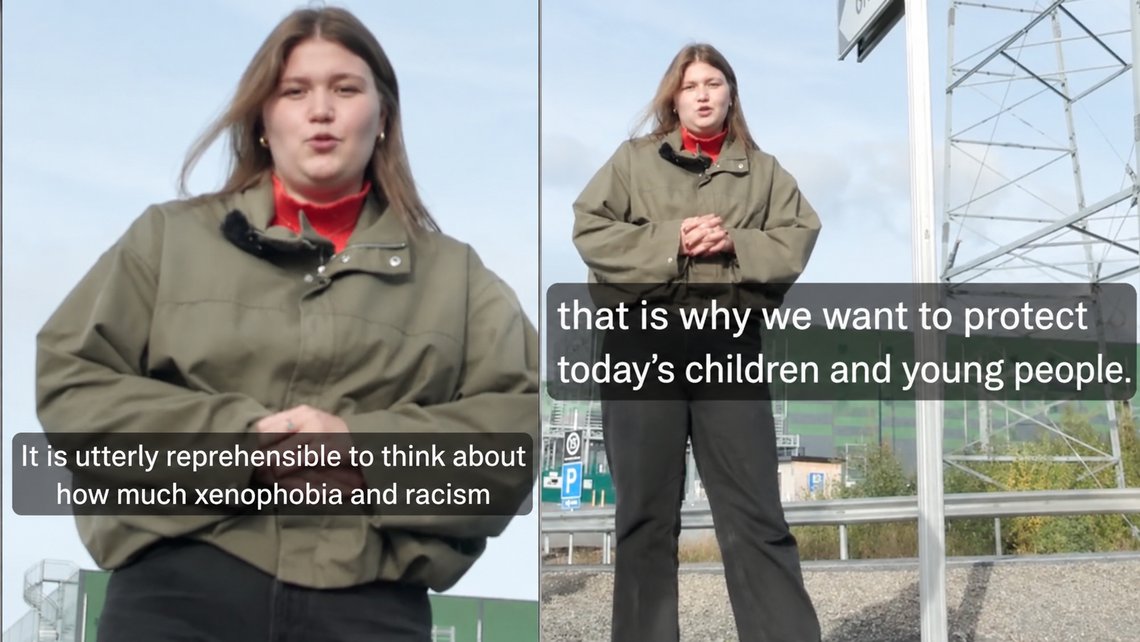
In a video published on Facebook on Monday, Sunniva Ludvigsen, leader of the Workers’ Youth League (AUF) in Innlandet, explains why the party wants to keep children off social media.
‘It is utterly reprehensible how much xenophobia and racism children and young people are getting in their social media feeds,’ Ludvigsen says.
‘That is why we in the Labour Party are working extremely hard for a minimum age of 15 for social media,’ the county party’s post states.
This is a different justification from the one the government has used for almost two years.
When Jonas Gahr Støre announced the age limit on 23 October 2024, it was about children’s health and the power of the tech giants.
‘Children must be protected from harmful content on social media. This is big tech giants pitted against small children’s brains,’ Støre said.
In the consultation paper the following year, the ministry presented three alternative purpose clauses. The most comprehensive mentions ‘bullying, harassment, harmful influence, mental disorders and crime’. Racism and xenophobia do not appear in any of them.
When the legislation was submitted for EEA consultation on 8 May this year, the line was the same.
‘We want a childhood in which children are allowed to be children. Where play, friendship and everyday life are not taken over by algorithms and screens,’ Minister of Children and Families Lene Vågslid stated.
Then Minister of Digitalisation Karianne Tung described the legislation as ‘a genuine standard for online safety’.
Neither of them has linked the age limit to political content.
Following criticism from EEA quarters, the legislative proposal has been substantially curtailed. The sanctions against the platforms are gone, and the requirement for age verification has been removed. The limit will now apply to social media defined as ‘harmful’, and it will be for the supervisory authority to determine which ones.
Professor Stian Øby Johansen has pointed out that the supervisory authority can ‘determine whether a social medium is harmful’, but cannot order rectification or impose fines.
The Norwegian National Human Rights Institution (NIM) warned as early as October 2025 about the proposal’s consequences for freedom of expression. NIM referred to the Constitution’s prohibition on prior censorship and to the fact that the measure affects both children’s and adults’ freedom of expression and freedom of information.
Innlandet Labour Party writes of an age limit of 15. The government’s current proposal is 1 January of the year in which the child turns 16. The legislation is scheduled to be presented to the Storting by the end of 2026 and can enter into force no earlier than 2027.


