

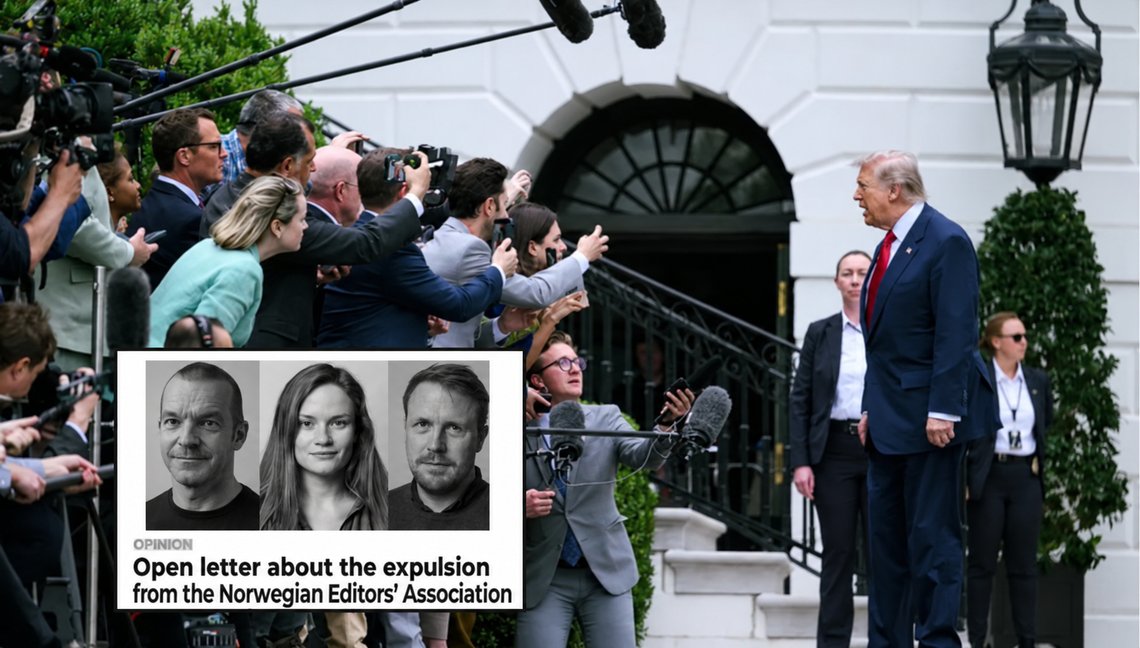
Here comes part two of ‘Morgenbladet under scrutiny’.
In part one, we examined culture editor Bernhard Ellefsen’s wild conspiracy theories about former border chief Greg Bovino and his Gestapo jacket.
In part two, we look at how the newspaper accuses Trump of suppressing both freedom of speech and freedom of the press.
They throw stones in glass houses
What they accuse the president of is the same thing that Morgenbladet, other media outlets and politicians do to Hans Rustad and Document. And, of course, to everyone who disagrees with Morgenbladet.
We must not forget the witch-hunt against Hege Storhaug and the women of Rights. Nor the witch-hunt against the ordinary man and woman in the street who thinks differently, something that became tragically apparent during the Covid pandemic.
The article in question also happens to have been penned by culture editor Bernhard Ellefsen, and was written after the cancellation of Jimmy Kimmel.
Ellefsen is, as is well known, one of the three aggrieved editors who have resigned from the Norwegian Editors’ Association in protest. The other two are Bjarne Riiser Gundersen and Ingeborg Misje Bergem.
The sour and censorship-minded editors
Enormous media corporations become politically vulnerable when the autocrats make their moves. Concentration of media ownership is an obvious threat to freedom of the press, Ellefsen writes in the introduction.
The caption beneath Kimmel’s photograph reads: ‘Fragile press freedom: The cancellation of Jimmy Kimmel shows how thin-skinned Trump is and what means he now has at his disposal to retaliate.’
I could really have stopped the commentary here, and you would understand the point. For this introduction already exposes the hypocrisy of Morgenbladet and the entire media establishment in Norway. Let us use Ellefsen’s own words against him:
The enormous concentration of media ownership in Norway is an obvious threat to freedom of the press. They become even more vulnerable when left-wing autocrats who determine the discourse make their moves.
The cancellation of Hans Rustad and Document shows how thin-skinned they are, and what means they have at their disposal to strike back at Document and everyone who does not follow the establishment’s narrative and consensus.
But let us nevertheless take a closer look at Ellefsen’s commentary, which shows that their mantra of being truth-seeking, relevant, factual and comprehensive is nothing but empty words.
In the commentary, Ellefsen reveals that he considers the late-night comedians’ relentless and malicious smear campaigns against Trump and half the country both funny and within the bounds of freedom of speech.
He praises both Kimmel’s and Stephen Colbert’s ‘genuinely funny’ comedic skills and their harsh criticism of Donald Trump. Even jokes about Charlie Kirk shortly after he was killed in cold blood are fine.
President Trump is just as sour and just as censorship-minded as before – even though Disney and the television channel ABC for the time being appear to have sided with their own late-night star, Ellefsen writes, among other things.
Sour and censorship-minded, indeed, says the sour and censorship-minded culture editor of Morgenbladet. Talk about ‘the pot calling the kettle black’.
One law for the sanctimonious
In the open letter, they place great emphasis on the alleged smear campaigns that Hans Rustad and we at Document conduct:
In the five years that have passed since then, Rustad’s and Document’s editorial smear campaigns against institutions and individuals have increased in intensity, frequency and scope.
Bjarne Riiser Gundersen, Ingeborg Misje Bergem and Ellefsen also write:
As recently as this week, Filter documented how the Document editor personally spreads dangerous conspiracy theories about, among others, Muslims and Norwegian politicians, and claims that the Norwegian people are being ‘raped’ by traditional media – all without any trace of documentation, simultaneous right of reply or other normal journalistic quality assurance.
(NB: Spelling error by Morgenbladet; the Norwegian people are being raped by traditional media. Newspeak, perhaps?)
So which is it, Ellefsen? Why are several decades of deliberate smear campaigns against a president and half the country entirely acceptable in America, while media outlets, Muslims and politicians in Norway must be shielded from every form of deserved criticism and ridicule.
Besides, we need no documentation to say that the Norwegian people are being ‘raped’ by traditional media. It can mean so many things, including to suppress, devastate, violate and abuse.
As I see it from here, on the other side of the Atlantic, they do all these things. Just think how many lives the Norwegian media have destroyed, through public shaming, defamation and malicious tactics. The latest example that comes to mind is Hårek Hansen.
Colbert is genuinely unfunny
For years, Colbert and Kimmel have conducted a relentless political smear campaign against Trump and conservatives. They are not genuinely funny, as Ellefsen claims, but malicious, and primarily target those with whom they politically disagree.
Steven Colbert, whom Ellefsen calls ‘the legendary (and genuinely funny) comedian’, had only one conservative guest on his pathetic show during its final three years, and that was Liz Cheney, Trump-hater and Republican in Name Only. Ninety-nine per cent of the guests were therefore liberals.
Imagine if NRK had only liberal guests and politicians on its programmes 99 per cent of the time.
Wait! They do.
My bad.
I call the show pathetic, yes. Even though he actually was funny once, especially when he made fun of the butter crisis in Norway.
But in 2015, when Trump came down the escalator with his beautiful wife, Melania, and announced that he was running for president, the liberal world came unhinged and has not recovered since.
On the contrary, they get worse with every passing year.
Kimmel and Colbert have both expressed that losing viewers does not affect them. CBS insiders say that Colbert’s show was making a loss of $40 million a year. Jimmy Kimmel Live!, The Late Show and The Tonight Show with Seth Meyers had experienced a decline in viewership of between 70 and 80 per cent since 2015.
A study by the Media Research Center showed that 87 per cent of Stephen Colbert’s jokes during the last three years were aimed at conservatives, with 3,639 jokes about Donald Trump, compared with 339 about Joe Biden and only 21 about Kamala Harris. Another study showed that the biggest late-night shows had 90 liberal guests for every conservative guest in the second half of 2025.
So good riddance to the once legendary late-night comedians.
But talk about coming unhinged!
While they whine about Rustad having called Jonas Gahr Støre a traitor (taken out of context), he has no problem labelling Trump.
– As the shrewd autocrat and Viktor Orbán pupil that he is, Trump has installed a loyal man as head of the narrow but important body, the Federal Communications Commission, which happens to rule on such enormous transactions.
Ellefsen also quotes an NYT journalist who described Trump as ‘a marginal self-promoting buffoon in the jokescape of eighties and nineties New York’, in a solemn and memorable article about the shock following the 2016 election.
Charlie Kirk can be joked about
If we are to understand Ellefsen and the other editors’ open letter correctly, they feel strongly that words have consequences, particularly when it comes to hate campaigns against individuals. In his text, however, Ellefsen downplays Kimmel’s comments about Charlie Kirk:
– Comedian Jimmy Kimmel was cancelled for barely a week following his allegedly inappropriate comments about the murder of Charlie Kirk …
– This head [of the FCC] was quick to say that he thought Kimmel should be fired for his (neither tasteless nor funny) jokes about the Kirk murder and to threaten sanctions if that did not happen.
Once again, Ellefsen demonstrates the hypocrisy that is so obvious in the Norwegian media, politics and academia. They decide who may be subjected to smear campaigns, criticism and ridicule.
Hans Rustad and we at Document allegedly spread dangerous conspiracy theories about Norwegian politicians, traditional media and Muslims.
While it is neither tasteless nor inappropriate to make despicable remarks about the assassination of Charlie Kirk, who was murdered in cold blood, in a killing that was probably inspired by hateful smear campaigns against conservative voices.
An obvious threat to freedom of the press
The three largest newspaper groups in Norway – Amedia, Schibsted and Polaris Media – controlled 74.5 per cent of the total circulation of Norwegian newspapers in 2024. Morgenbladet is owned by Mentor Medier, which also owns Vårt Land and Dagsavisen.
Nevertheless, Ellefsen warns that Trump and the consolidation of the media in the United States are a lesson for other democracies, including Norway:
– In a media landscape where ownership interests are as consolidated and as large as in the American television market, editorial freedom and freedom of the press clearly become very fragile things, Ellefsen writes.
These media corporations, which acquire such large financial interests, become politically vulnerable when the autocrats make their moves, Ellefsen writes. The conclusion would seem simple: Concentration of media ownership is an obvious threat to freedom of the press.
Is he really so blind that he cannot see that this problem already exists in Norway? Although Mentor Medier is not one of the large ones, he himself is part of the powerful media establishment that wants to muzzle Document, an obvious threat to freedom of the press.
And while we are talking about money: The reason the media do the government’s bidding is that they depend on the state for funding and other benefits, while politicians benefit from having an obedient press.
But of course Ellefsen and his like-minded colleagues do not see this obvious game. Let us instead go after Trump and Document, they say.
Just get over it, Mr. President
Trump’s war against journalists and media institutions is being fought on many fronts, Ellefsen continues, referring, among other things, to the president’s lawsuit against The New York Times:
– But comedians appear to irritate him in a peculiarly intense way. He does not like being made fun of. Even though he ought to be used to it.
We repeat: – He does not like being made fun of. Even though he ought to be used to it.
Ellefsen thus believes that because Trump is constantly made fun of, he ought to be used to it. So just get over it, Mr. President, in other words.
Meanwhile, in the culture editor’s own backyard, no one is allowed to criticise or make fun of politicians, Muslims and mainstream media.
And apparently Document seems to irritate them in a peculiarly intense way. We shall continue to do precisely that.
Ellefsen in a tinfoil hat
And he really does not like it, Ellefsen continues.
After all, he has permanent residence inside Trump’s head, so he knows everything Trump thinks.
Then the editor who accuses Rustad and Document of spreading conspiracy theories comes up with a conspiracy theory of his own:
– Some have even claimed that it was Obama’s ‘roast’ of him at the traditional (and now, of course, discontinued) White House Correspondents’ Dinner in 2011 that sent Trump on the vengeful political career that has now reached its zenith.
In other words: Trump was so offended at being made fun of in 2011 that it allegedly shunted him onto a vengeful political career that ended in the White House.
Not only does he repeat an absurd urban legend about the Obama roast; at the same time, he describes Trump’s political career as ‘vengeful’.
But he ought to be used to it – so there we are.
Ellefsen goes cherry-picking
Ellefsen then demonstrates his lack of knowledge about Trump, or else he is cherry-picking out of season. Quite possibly both. And once again he ridicules the president and calls him ‘weird’:
At the time, Trump was a weird conspiracy theorist who primarily made himself heard in public with claims that Obama was not born in the United States. Which the then president duly made fun of. To the current president’s profound indignation.
The only thing that was weird about Trump at the time was his comb-over.
But Trump had been in the public eye for several decades before the Obama roast in 2011, so this is yet another fable from Ellefsen, who, together with his colleagues, claims that they are so truth-seeking and factual.
In any event, it was his frustration with how Washington works, or rather does not work, that sent Trump on his political career. He saw a system that was stuck, and there was no real leadership in Washington D.C.
There were too many problems and not enough solutions, and too many people who talked instead of actually doing something.
He won in 2016 because what appealed to the forgotten voters was that he fought the elitist media and politicians; he fought both the Democrats and the Republican establishment. And he beat all three.
This is what Trump campaign adviser David Bossie said after the 2016 election to the ultra-liberal news channel PBS.
Again, it is worth mentioning that in Morgenbladet’s open letter they accuse Document of making claims about people and institutions without sufficient documentation or normal journalistic standards.
That they themselves do not employ honest journalistic standards appears to escape them.
Has he been living under a rock?
Finally, Ellefsen writes that much is complicated about the conditions for freedom of the press and freedom of speech in the United States right now. And much about those conditions could quickly spread to Europe.
One really wonders whether he has been living under a rock for the past few decades.
As if it were not already here, and as we see in full bloom these days, in the form of the witch-hunt against Document. Not just Morgenbladet, but the whole cabal.
Again, Ellefsen says that Trump hates being joked about, that he has gained control over the regulatory authorities in the American media landscape, and that the media companies have grown so large and made themselves so financially dependent on political goodwill that the president can put power behind his thin-skinnedness.
He concludes with praise for Kimmel, who, according to him, delivered a fairly strong opening monologue in his first programme after the controversy.
I watched that monologue and wished I had kept the sick bag from my last flight. Crybaby snowflake Kimmel can, as they say in the United States, dish it out but he can’t take it. The same applies in Norway.
They can smear and ridicule Document, but they themselves cannot tolerate anything in return.
The powerful, the hypocritical and the thin-skinned
Kimmel said that his show was not important, but that the right to make such shows is. It is more fragile than his comeback would suggest, Ellefsen writes in conclusion.
It is true that Kimmel’s show is no longer important. He conducts a systematic smear campaign against Trump and half the country, and is not even funny.
But Document is important, and so are our readers. When the mainstream media treat us disrespectfully, they are also disrespectful towards our readers. We have just as much right to exist and engage in news reporting as the most powerful media outlets in Norway.
We will nevertheless stand upright and not bow down, even if the powerful, hypocritical and thin-skinned media companies and politicians do everything they can to stop us.
And yes, we will probably continue to irritate them in a peculiarly intense way.
In the next ‘Morgenbladet under scrutiny’, we look at articles written by Ingeborg Misje Bergem, editor of ideas and debate at Morgenbladet.
Among other things, she has written an article that is a targeted, despicable smear campaign against Trump voters as a group, without documenting the claims she makes about them.
I have read many dreadful articles about Trump supporters in the Norwegian media, but this particular one by Bergem really takes the biscuit.
Ikke Vær Varsom-plakaten: Morgenbladets konspirasjonsteori om ICE-sjefens Gestapo-frakk


