

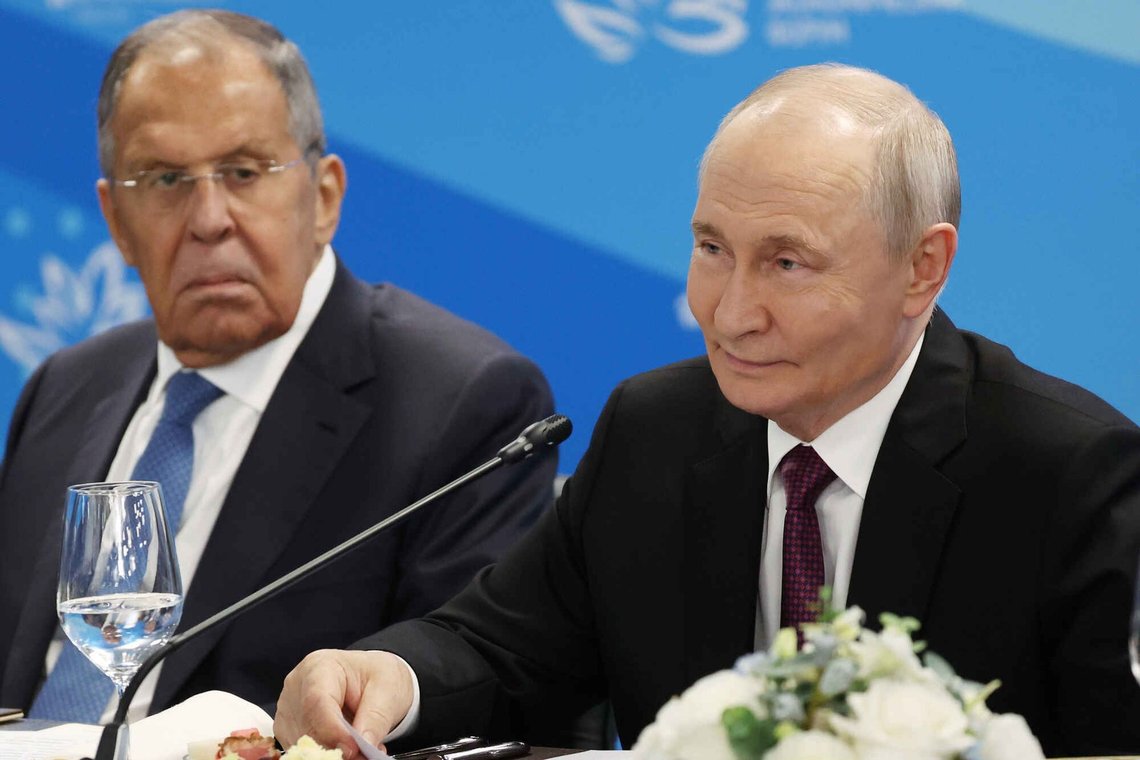


Sergei Lavrov strongly rejects the German accusations concerning the drone attacks on Leipzig Airport in August, and warns of the consequences.
Russia’s powerful Foreign Minister claims that Chancellor Friedrich Merz is ‘in practice declaring war’, writes Die Welt. Germany claims that Russia was behind the drone attack on Leipzig Airport, an accusation supported by the EU.
At an event in Hannover-Langenhagen on Sunday, Merz said that the conclusions had been drawn. At the same time, he issued ‘a very clear warning to Russia’.
‘Anyone who attacks us must know: We are determined to defend our constitutional state, our democracy, our open society and also the integrity of our territory.’
This prompted Lavrov to react, and according to the Russian state news agency TASS, the Russian Foreign Minister is said to have stated later the same day:
‘All these statements by Merz about making Germany the leading military power in Europe again – they are now being put into practice. He is in practice declaring war on us.’
On 1 September, following an investigation since the incident at Leipzig Airport in early August, the German government held Russia responsible for the attempted drone attack. Since then, diplomacy has contributed to increasing tensions between Berlin and the Kremlin.
The Russian Consulate General in Germany and the cultural centre ‘The Russian House’ in Berlin were ordered closed by Merz’s government. The Kremlin responded by closing the German-run Goethe-Institutes in Moscow, St Petersburg and Yekaterinburg.
There is much that is strange about this drone episode. One of the drones hovered motionless in the air, close to two Antonov aircraft full of ammunition for Ukraine. A bus driver who spotted the drone is said to have forced it down to the ground.
Closer examination showed that the drone contained 800 grams of PETN and Semtex explosives. But fortunately, the detonator was defective.
Two other aircraft in the air above the airport are also said to have been struck by something suspected of being drones, but these did not explode either.
One is left with some questions. Is it possible that the detonator was defective in all the drones? Can a drone really hover motionless in the air?
https://www.document.news/news-brief/2026/08/a-close-call-in-leipzig
EU foreign policy chief Kaja Kallas summoned Russia’s most senior diplomatic envoy to the Union. Kallas believes that much indicated that the attack was ‘a state-sponsored terrorist attack’.
Several European NATO countries are in many ways already active parties to the war. Among other things, EU countries have acted as arms suppliers and have allowed Ukrainian weapons to be produced on European soil. In addition, several countries are providing instructors for Ukrainian troops, who receive their training in EU countries.
At the same time, several EU countries, led by the United Kingdom and France, are working intensively to build up a ‘coalition of the willing’. The plan, which is to send European NATO troops into Ukraine after a possible ceasefire, is strongly rejected by Lavrov.
Norway contributes enormous sums to Ukraine’s war effort against Russia. In addition, the police on Svalbard have placed the Russian ship Professor Molchanov under arrest in the port of Barentsburg, following a request from the Ukrainian state-owned oil and gas company Naftogaz.
This led to an order from Nord-Troms and Senja District Court for the police on Svalbard to seize the Russian ship.
https://www.document.news/news/2026/09/svalbard-drawn-into-the-dispute-between-ukraine-and-russia
Although several EU countries have acted rather aggressively in connection with the war in Ukraine, it seems unlikely that a country such as Germany actually wants a real war with Russia and is therefore making false accusations.
There is, however, a conceivable possibility that operators with links to Ukraine could be behind it, but there is neither evidence nor serious indications to substantiate such speculation.
The German government and other Western states have long accused Russia of waging a hybrid war against them, in the form of disinformation campaigns, attacks and even assassinations carried out on Russian orders.
Russia invaded Ukraine on 24 February 2022. Since then, Germany and other European states have supported Ukraine in its defence against the Russian invasion forces taking part in what Putin consistently calls ‘a special military operation’.
Merz also has problems at home. He leads a government consisting of the CDU/CSU Union parties as well as the Social Democratic SPD, which are experiencing declining support in the opinion polls.
Today, it appears that the CDU in particular has suffered a disastrous result in the state election in Saxony-Anhalt. In the latest poll, the CDU and SPD have support of only 26.9 per cent, largely because the CDU has more than halved, from 37.1 to 18.2 per cent.
The main enemy, Alternative für Deutschland, has more than doubled its support, from 20.8 to 44.4 per cent of the vote. The AfD may receive enough votes to form its very first state government, and if BSW should manage to clear the electoral threshold around which it is hovering, party leader Sarah Wagenknecht is an avowed opponent of the so-called firewall that prevents all other parties from cooperating with the AfD.
If the AfD later also gains power in the federal government, relations between Germany and Russia will probably change significantly.
https://www.document.news/news/2026/09/afd-by-far-the-largest-party-in-saxony-anhalt-on-the-verge-of-an-outright-majority


