

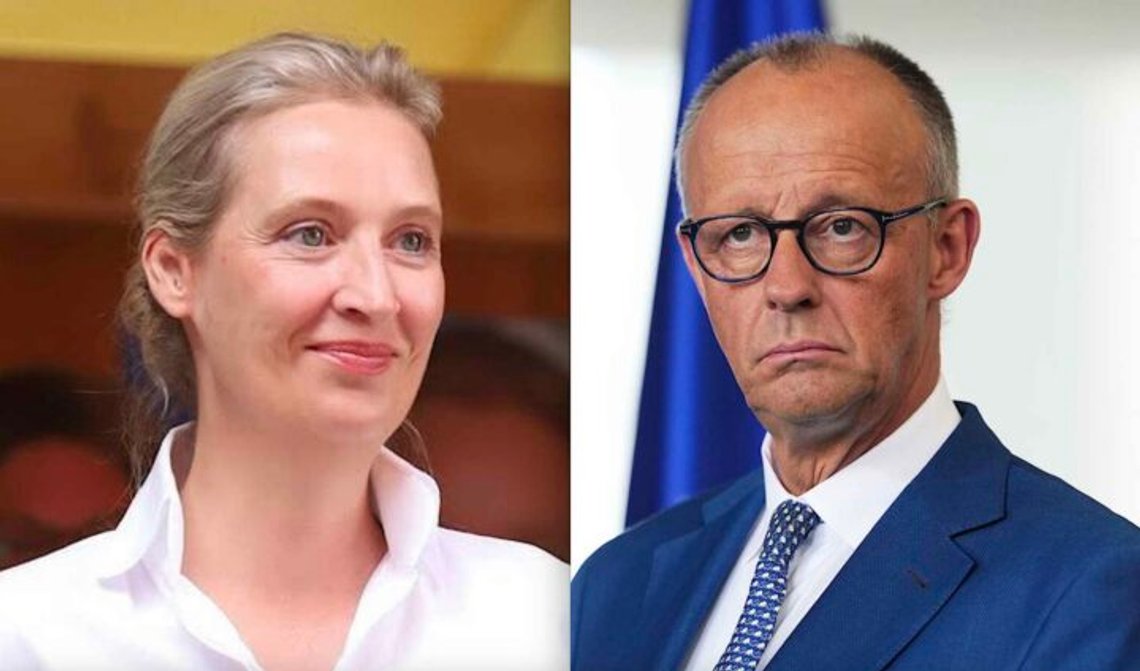


The defeat in the state election in Saxony-Anhalt is the worst for the CDU in several decades, according to Friedrich Merz. ‘The result has shaken us and must have consequences,’ the German Chancellor said when he finally spoke publicly after consulting with the party on Monday.
‘We are all deeply shocked,’ Merz said, according to Die Welt.
‘We had not expected this in this way.’
Nevertheless, he acknowledged: ‘We have to accept it; those are the rules of our democracy. But yesterday brought about a change not only in Saxony-Anhalt, but throughout Germany.’
And further: ‘When almost 60 per cent of voters vote for political parties that call into question the democratic institutions of our country, that is an election result that we cannot simply dismiss as an ordinary matter. It affects us. Me personally, too. This is the biggest electoral defeat the CDU has suffered in several decades. It must have consequences.’
It is unclear what consequences Merz believes the voters’ distrust of the institutions should have. Apparently, it is a matter of continuing as before, but becoming better at explaining to people that what the government is doing is sensible.
Merz is shaken and unwavering at the same time:
Merz nevertheless emphasised the need for fundamental reforms in Germany. It is ‘about nothing less than the future of our country and the opportunities of our children and grandchildren’. We ‘must not put this at risk’, the CDU leader stressed. ‘That is why my determination to continue on the course of reform is unwavering.’ The reforms must, however, be explained better to the population.
The CDU leader said in Berlin that he would try to raise the matter with the SPD party leadership over the next few days. ‘We must discuss how we are now to continue the reform course that has been initiated in the federal government.’
The Chancellor asks himself what people are actually thinking:
He naturally asks himself the question, Merz continued, ‘how things could have gone this far. I am also looking for the causes here in Germany. I am also looking at myself. What fears exist among the population that we may possibly have underestimated?’ In this context, he spoke of right-wing populism and ‘in some cases extreme right-wing populism’. There is a desire for change.
Merz also issued admonitions to the AfD, which he says must find compromises.
With regard to a possible AfD-led government in Magdeburg, Merz said that he wanted to ‘assure everyone in our country that our institutions are robust and stable’. The Basic Law protects and guarantees this order, and ‘the federal government that I lead will ensure that the Basic Law is enforced’. This message is also directed ‘to our friends in Europe and throughout the world. We know that Germany has a special responsibility because of its history.’
If the AfD does not respect the Basic Law, the federal government will intervene, Merz warned, reminding his audience that there is much that a state does not decide for itself:
‘Even a state such as Saxony-Anhalt is obliged to act in accordance with the federal government when it comes to the essential parts of the policies determined by the federal government.’ This applies, for example, to ‘the entirety of immigration and foreigners policy’, Merz said. ‘There can certainly be some room for manoeuvre in its implementation,’ he said. ‘But the main lines of this policy are determined in Berlin and not in Magdeburg.’


