

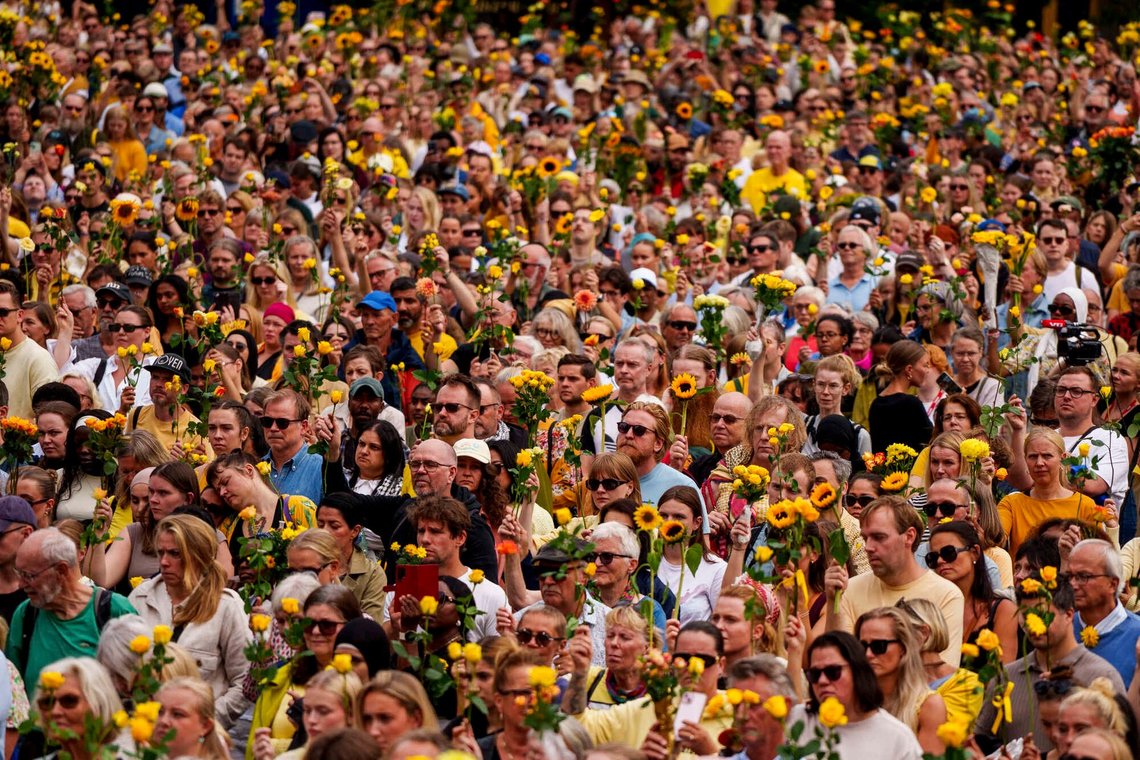


For the left, the murder of Tamima Nibras Juhar is proof that far-right extremism is one of the greatest threats in Norway in our time. The circumstances surrounding the murder and the background of the murderer, however, have been overshadowed by the political focus.
On the night of 24 August 2025, Tamima Nibras Juhar (34) was murdered while working a night shift at a supported-living home at Kampen in Oslo, operated under the auspices of the child welfare services.
The murder was extremely brutal and was committed by 18-year-old Djordje Wilms, who had come to Norway from Serbia in 2013 at the age of six.
He was receiving aftercare from the child welfare services and was a resident at the home where Juhar worked. He is said to have himself stated a racist motive for the murder.
Juhar, who was employed by the private child welfare company Gemt AS, was alone at work on the night she was murdered. This was despite several reports of concern about Wilms, and the fact that in June of the same year he had threatened to kill a child welfare employee, a case that was resolved through the National Mediation Service (Konfliktrådet).
Wilms had spent virtually his entire time in Norway in the care of the child welfare services. The year before he ended up at the supported-living home at Kampen, he had been arrested by the police at his foster home after assaulting his foster father and threatening his foster parents with a knife and an axe.
He also came to the attention of the Norwegian Police Security Service (PST) because of extremist statements online. He is said to have been radicalised by videos on YouTube and the Telegram platform. According to the court, from the age of 15 he had already expressed admiration for Adolf Hitler and Vladimir Putin, and voiced a desire to become a dictator.
On 30 June this year, Djordje Wilms was sentenced to 19 years of preventive detention. The judgment has been appealed.
Became an election campaign issue
Tamima was buried on 29 August 2025. Then Minister of Labour and Social Inclusion Tonje Brenna spoke on behalf of the government. Finance Minister Jens Stoltenberg and Member of the Storting Kamzy Gunaratnam (Ap) were also present.
On Sunday, 31 August, there was a mass gathering at Youngstorget (the central square of the Labour movement). From there, a rose march followed roughly the same route as the May Day march usually takes. Speeches were given to an estimated 30,000 people in attendance. All national media outlets were present.
Gunaratnam drew parallels with the murder of Benjamin Hermansen in 2001 and the terror attacks of 22 July 2011.
 Oslo, 31 August 2025
Prime Minister Jonas Gahr Støre during the rose march for Tamima Nibras Juhar, who was murdered at Kampen. Speeches from Youngstorget.
Photo: Javad Parsa / NTB
Prime Minister Jonas Gahr Støre spoke:
“We have once again seen in our country what far-right ideology can lead to. And we must say it out loud again, even though it hurts. This was a politically motivated murder. When extreme attitudes lead to extreme actions. When extremist opinions lead to racist statements. When words and hate speech online lead to the use of murder weapons and take lives. Then we must use the right word. Then it is terror.”
A week later, on 7 September, there was a parliamentary election. The left scraped home a narrow victory after having been in a poor position in the opinion polls.
Skjervø wants a memorial
On 10 September 2025, three days after the parliamentary election, the conservative American activist Charlie Kirk was shot and killed while giving a speech. Some openly gloated, such as the leader of Rød Ungdom, Amrit Kaur, who had to resign after expressing undisguised delight over the murder on social media.
The following day, this was the subject of NRK’s Debatten. There, AUF leader Gaute Skjervø said that he feared “what the Trump movement would use the murder for”. Subjekt editor Danby Choi reacted to Skjervø’s statement and called it distasteful to make political capital out of a tragic murder by speculating about what Trump would do.
 Gaute Børstad Skjervø feared what the Trump movement would use the murder of Charlie Kirk for, but wished the murder of Tamima Juhar had received more attention during the election campaign.
Photo: Javad Parsa / NTB
Document contacted outgoing AUF leader Gaute Skjervø through his secretary and asked the following questions by email:
– What do you think today about the fear you expressed on Debatten on 11 September last year, and Danby Choi’s reaction to your statement?
– Did the Labour Party use the murder of Tamima politically?
– If not, can you see that it could be perceived that way?
Wilms’ age, foreign citizenship, family tragedy and upbringing in the care of the child welfare services are circumstances that have been overshadowed by the portrayal of him as far-right.
– Do you think the gathering at Youngstorget on 31 August last year would have been different if these circumstances had been better known?
– At this year’s memorial gathering for Tamima, a proposal was made to erect a statue of her, as was done for Benjamin Hermansen, who was murdered by neo-Nazis in 2001. Do you think that is a good idea?
– The far-right murder of Tamima Juhar proves one of the greatest problems in Norway in our time: the threats posed by far-right extremism. In my lifetime alone, this ideology has killed 77 people on Utøya and in Oslo, hounded Arve Beheim Karlsen to his death, and stabbed Benjamin Hermansen and Tamima Juhar to death, Skjervø replies, adding:
– I would support an initiative to erect a memorial to her, whether in the form of a bust or other physical ways in which Norway can continue to remember her legacy.
“Immigrant-persecution police ICE”
Regarding his fear of what the “Trump movement” would use Kirk’s murder for, Skjervø replied:
– As regards the cowardly murder of Charlie Kirk, I condemned it in the strongest possible terms and immediately addressed it as a cancer on society. I have myself experienced political violence and believe that it undermines our democracy, regardless of whom it affects. I have watched with concern as the Trump regime has radicalised itself. There were good reasons to fear how MAGA would react to the murder of Charlie Kirk. Since then, the Trump regime has become more extreme and, among other things, allowed its immigrant-persecution police ICE to kill innocent counter-protesters in the street. I reject that just as much on principle as I condemn the murder of Charlie Kirk, or the far-right and extremist Islamist murders in Norway in modern times.
One of the questions, however, remained unanswered: the question of whether the Labour Party used the murder of Tamima politically, or whether it could be perceived as having done so. When Document reminded him of this, we received the following reply:
– I strongly reject claims that it is wrong to talk about far-right extremism. On the contrary, I wish the racist murder had received much more attention both during the election campaign and afterwards.
Neglect and violence
The murderer Djordje Wilms came to Norway as an immigrant from Serbia in 2013, at the age of six, together with his family. They settled at Veitvet in Oslo. He was originally born in Germany in 2007 and has a brother. His parents are from the former Yugoslavia, probably Serbia, and met in Germany.
The father is said to have subjected the mother and children to violence. The child welfare services in Germany were involved as early as when Djordje was two years old. Between 2009 and 2013, the family had returned to Serbia, before subsequently emigrating to Norway.
The domestic violence continued in Norway. It emerged in court that the father rewarded Djordje and his brother for being violent towards their mother. The mother sought refuge at a crisis centre, and in 2015 the children were placed in emergency institutional care. Djordje was eight years old at the time.
In 2016, he was placed in a foster home in Hedalen in Valdres. The radicalisation is said to have taken place in his bedroom while he was in foster care and under the care of the child welfare services.
In February 2024, aged 16, he struck his foster father, threatened his foster mother and armed himself with a knife and an axe in the farmyard. The police were called, and Wilms was arrested. Neither Wilms himself nor the foster parents wanted him to move back. By then, he had lived there since he was nine years old.
He was initially placed at the emergency youth unit in Oslo in February 2024. A month later, he was moved to the enhanced bedsit/supported-living programme operated by Gemt AS at Kampen. The programme was voluntary aftercare for young people who had been in the care of the child welfare services.
PST received tips and assessed him internally (February 2024, January 2025, April 2025, late summer 2025), that is, shortly before he turned 18 and committed the murder. The background was his online activities and statements.
Gets no answers
Document has tried to find out how it was possible for the slight woman Tamima Nibras Juhar to be alone on a night shift with a client who was both unstable and had a known history of violence.
We contacted Bufdir, which has overall responsibility for the child welfare services (Barnevernet).
We were referred to Gemt AS.
– The placement with Gemt AS was commissioned by Bjerke borough in Oslo municipality. Bufdir oversees Bufetat’s regions and the measures there, but not Oslo municipality, writes senior communications adviser Marit Dorothea Bjørnstad at Bufdir.
– Hello, thank you for your email. I see that you are requesting a comment on working conditions. This must be directed to Gemt AS. Beyond this, we have no further comments on information that emerged during the trial, replies Lise Schellenberg, departmental director for childhood and adolescence in Bjerke borough.
Gemt AS does not respond to Document’s enquiries, either by telephone or by email.
Gemt AS was established in 2000. The company describes itself:
Despite this expertise, Tamima Nibras Juhar was left alone on duty with an obviously unstable client with a known history of violence.
The murder of Tamima is not entirely unlike the “Vollen murder” in 2014, which can be summarised as follows:
On the night of 28 October 2014, a 15-year-old resident murdered social worker Anna Kristin Gillebo Backlund (30) at the Små Enheter institution in Vollen in Asker. She was the only night-shift worker who was awake. The victim was strangled and stabbed 21 times. The perpetrator, who was later diagnosed with schizophrenia, was initially sentenced to preventive detention, and subsequently to compulsory mental health care.


