

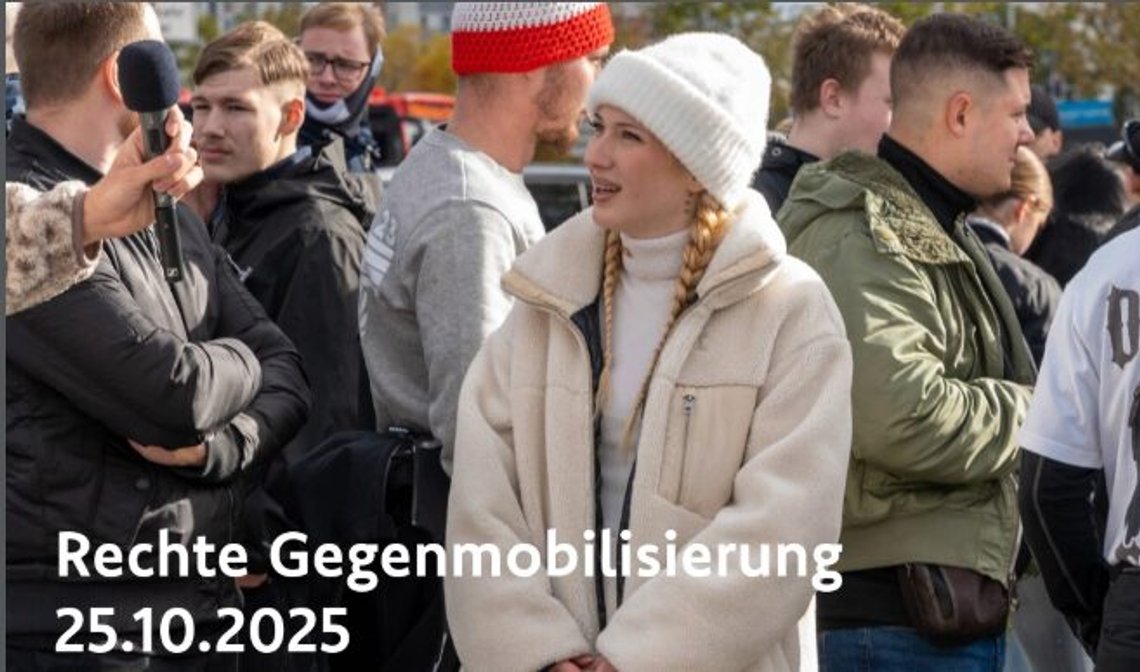


More and more young Germans are turning to the right. The AfD is gaining ground among first-time voters, and radical youth groups are growing.
Just as in Norway, Germany is being hit by a distinct rightward wind, particularly among young men.
Die Welt consistently describes the new groupings attracting young people as “the extreme right”, and asks the question: Why are they so successful in winning the sympathies of young people?
For a party such as Die Heimat, it is reasonable to use terms such as far-right. Until June 2023, the party was called Nationaldemokratische Partei Deutschlands. That is not terribly far removed from National Socialism, which is what the Nazis called their party.
Die Heimat stands for völkisch nationalism, revanchism, far-right extremism and neo-Nazi currents. The party has very little political support and lacks representation in national and regional parliaments.
In January 2024, Germany’s Federal Constitutional Court (Bundesverfassungsgericht) decided to exclude the party from state funding and tax concessions for a period of six years, without banning the party itself.
Political enemies of Alternative für Deutschland (AfD) attempted at the time to link the AfD and Die Heimat. This collapsed under the weight of its own absurdity: Die Heimat was (and is) a tiny party with clear neo-Nazi characteristics, while the AfD is Germany’s largest party, which has no anti-democratic points in its party programme.
Some Germans who belonged to right-wing groups in their youth have subsequently joined the AfD as adults. One of these is Daniel Fiß, who is now in his thirties. Fiß was previously involved in the Young Nationalists, and later the Identitarian Movement.
Today, he is helping to organise the AfD’s election campaign in Mecklenburg-Vorpommern. His goal is political power, writes Die Welt.
Is not absolutely everyone who becomes involved in politics seeking political power? What else is the point of political activity?
Moreover, the AfD is by far the largest party in Mecklenburg-Vorpommern, with support of 35–36 per cent, ahead of the German Social Democrats, the SPD, which currently holds power and the state’s Minister-President Manuela Schwesig. The SPD has support of 27–29 per cent. The governing CDU is all the way down at just under 10 per cent.
The state holds elections on 20 September, two weeks after the state election in Saxony-Anhalt, where the AfD under Ulrich Siegmund’s leadership has a good chance of securing an outright majority. The party will not achieve that in Mecklenburg-Vorpommern, and since all other German parties flatly reject any form of cooperation with the AfD, the party will not attain real power in the state.
Mecklenburg-Vorpommern lies in what was formerly East Germany. Student representatives in East Germany are warning of a decline in democratic values, writes Die Welt. Parties such as Die Grünen (the Greens) are considered to have “democratic values”.
Elections in today’s Germany appear to be shifting the balance of power towards what those with traditional, socially acceptable political views describe as the extremes. Young Germans are contributing strongly to this trend.
In the 2021 federal election, voters aged 18–24 primarily voted for the Greens and FDP (Free Democratic Party). Four years later, Die Linke (the Left Party) and the AfD led in this age group.
Young people are attracted by activity on social media and avoid boring television debates. On Instagram and TikTok, young women pose with “white power” gestures, while young men appear masked, nationalist and as though they are ready for battle.
Then they draw inspiration from everyday life, in schools marked by all the problems that mass immigration has brought about, as well as individual incidents that make an impression.
One example is Lilly Baginski (23). She grew up in a small town south of Ludwigshafen, with a conservative mother and a more left-wing father. In other words, a relatively balanced home politically speaking. She herself was never interested in politics.
Baginski began training as a nurse. She thus found herself right at the centre of all the restrictions associated with COVID-19, which she strongly disliked.
“I didn’t like the system, the way orders were sent down from above, and our freedom was restricted,” she says now.
Of course, it was young people who paid the highest price for the political repression we experienced during those nightmare years.
Then she discovered other things that troubled her, such as the fact that in her neighbourhood in Ludwigshafen there is no longer a German restaurant where she can eat a lunch consisting of German food.
“Maybe a bakery, but right next door there is an Arab bakery.”
She is critical of mass migration.
“The more you go out and experience or read, the more it troubles you,” she says.
And she is not alone: 38 per cent of young people in Saxony, Saxony-Anhalt and Thuringia cite migration as their greatest concern. Only fear of war is more widespread.
Then something happened that Baginski today describes as a decisive moment. She was in Mannheim on 31 May 2024, when an Afghan man stabbed the well-known critic of Islam Michael Stürzenberger in Mannheim’s market square.
Baginski had considered attending Stürzenberger’s demonstration. But she never got the chance. The attacker seriously injured Stürzenberger. Police officer Rouven Laur died in an attempt to stop the attacker.
Whereas Baginski previously dressed in jeans, today she wears a dress or skirt, with her hair braided in the classic old-fashioned German style. She is concerned with traditional family values, national pride and “remigration”. This is apparently considered far-right in today’s Europe.
Generation Rechts https://t.co/jkeFtAh0V4 pic.twitter.com/eJ3DW5cPIy
— WELT (@welt) August 30, 2026
Of course, there are several aspects of this youth movement that warrant criticism. A teacher in the Burg Spreewald region of the former East Germany says that he is confronted daily with far-right symbols, writings and song titles. Pupils come to school wearing combat boots, with shaved heads and bomber jackets.
Such things should be challenged, and one should also react when Die Heimat says that it wants to take back everything Germany lost at the end of the Second World War.
But no one shows any willingness to react to the Gaza supporters, the pro-Palestinian Jew-haters who praise Hamas and hate Israel.
People who wave Palestinian flags while incessantly shouting “From the river to the sea” are generally left in peace without politically correct Germans raising an eyebrow. We can see the same thing across large parts of Western Europe.
In other words, there is no problem with extremism, as long as one is an extremist in the “right” way, and concentrates on declarations that in practice amount to a call for Holocaust 2.0.


