




The Swedish Social Democratic Party (Socialdemokraterna) and The Left Party (Vänsterpartiet) overwhelmingly dominate among voters who say they are Muslims. According to a new Novus poll, the two parties receive more than 80 per cent of the Muslim vote. At the same time, support for the Tidö parties is very weak – with one exception: Sverigedemokraterna.
Socialdemokraterna receives 61.6 per cent and Vänsterpartiet 18.7 per cent among Muslims who responded to the questions in Novus’ voter barometer. Together, they thus account for just over 80 per cent of support. If Miljöpartiet’s 4.9 per cent is also included, support for the three left-wing parties reaches 85 per cent.
At the same time, support for the governing parties is remarkably low. Moderaterna receives 2.1 per cent, Kristdemokraterna 1.5 per cent and Liberalerna just 0.2 per cent. Together, the three parties therefore reach 3.8 per cent.
Sverigedemokraterna, by contrast, stands out among the Tidö parties, with 10.4 per cent.
Left-wing dominance is nothing new
Henrik Ekengren Oscarsson, an electoral researcher and professor of political science at the University of Gothenburg, believes that the strong left-wing dominance can primarily be explained by socio-economic factors.
– Historically, the poor, the unemployed and the socially disadvantaged have gravitated towards the left. And that is the case all over the world, he says in an interview with Fokus.
At the same time, he believes that Novus’ figures are high compared with previous research. In the Swedish National Election Studies Programme’s 2021 report, Socialdemokraterna received 58.7 per cent and Vänsterpartiet 8.3 per cent among people who identified themselves as Muslims.
The same pattern is also evident among voters born outside Sweden, the Nordic countries and the EU. In the Novus poll, Socialdemokraterna receives 43 per cent and Vänsterpartiet just under 18 per cent.
But the picture is not unequivocal.
Sverigedemokraterna’s support of 10.4 per cent among Muslim voters shows that an immigrant background or Muslim identity does not automatically entail support for a generous migration policy.
– There are people born outside Europe, many with a Muslim identity, who also do not believe that Sweden should increase its intake of refugees, and who would like a stricter migration policy, says Ekengren Oscarsson.
He also points out that many voters with an immigrant background live in areas where crime and insecurity are part of everyday life.
The parties seek the Muslim vote
At the same time, the parties appear to be working actively to reach voters with foreign backgrounds.
Socialdemokraterna has long had a strong presence in many areas with large immigrant populations. Ahead of this year’s election, the party has also produced election material in other languages and directed specific messages at voters with immigrant backgrounds.
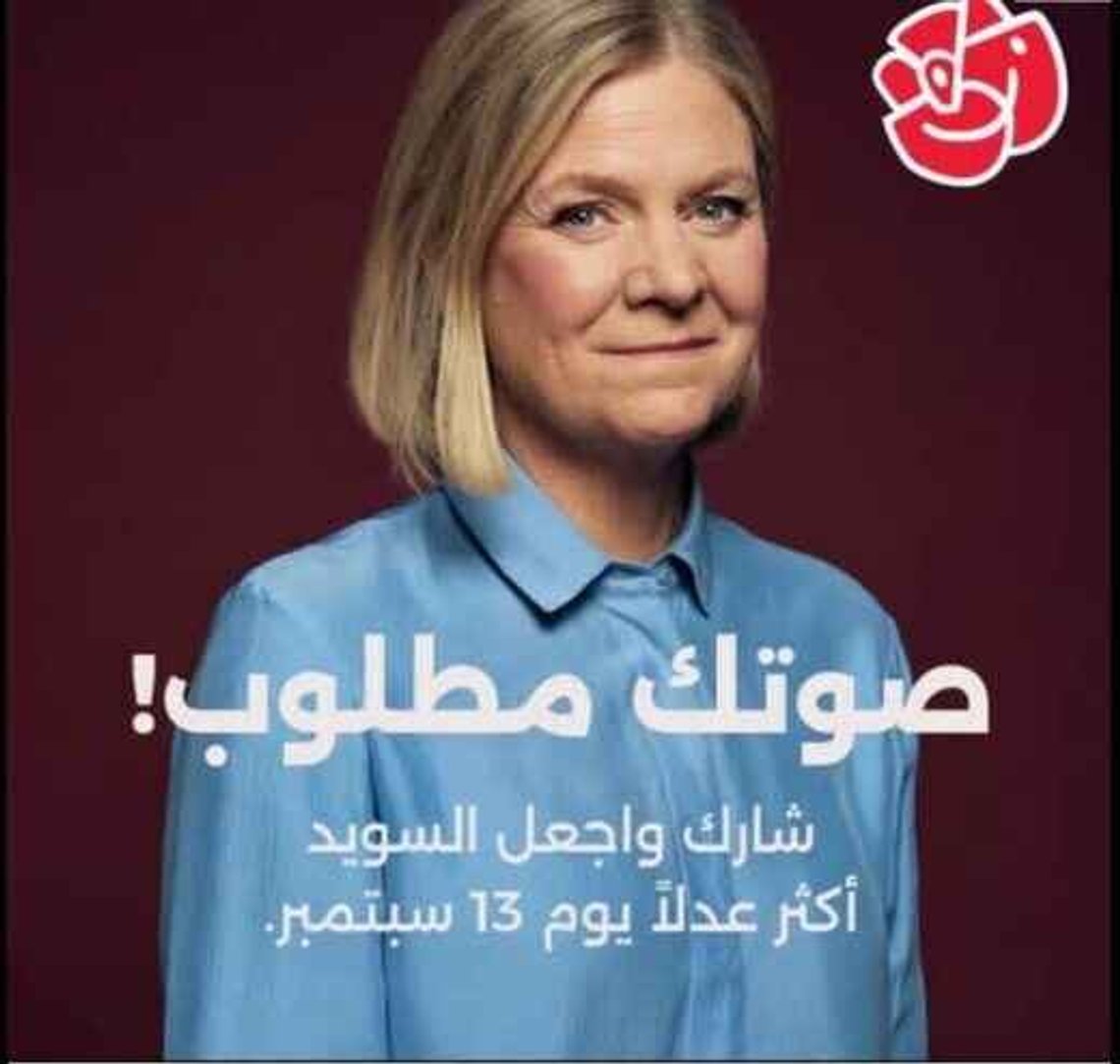
Photo: Screenshot Facebook/Socialdemokraterna
In Sörmland, for example, Socialdemokraterna has launched an Arabic-language election page where, in addition to issues concerning the economy, healthcare and crime, particular emphasis is placed on combating racism and Islamophobia, greater security and inclusion, as well as easier family reunification in humanitarian cases.
Centerpartiet politician Yousef Hussin in Västmanland goes even further and is running an election campaign in seven languages. In Arabic, he describes himself as ‘one of you’ and highlights, among other things, faster asylum processing, easier family reunification and faster citizenship procedures.
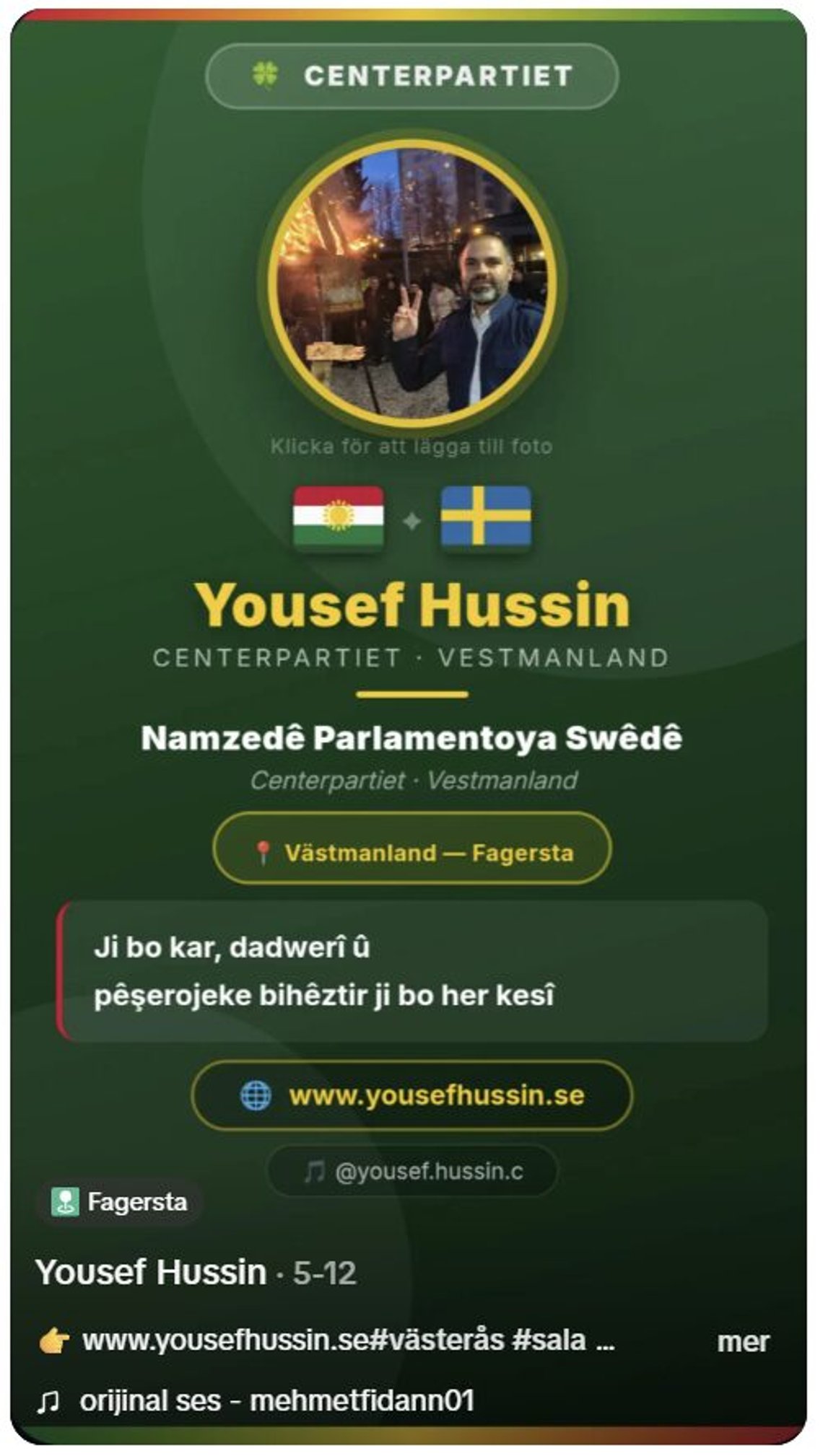
Photo: Screenshot TikTok/Yousef Hussin
The election campaign crosses borders
In some cases, the election campaign is also directed at people outside Sweden. Socialdemokraterna politician Blerta Hoti Singh, a municipal commissioner in Gothenburg and a candidate in the municipal election, recently appeared on Kosovo’s public-service broadcaster in Albanian. There, she spoke about the Swedish election and urged viewers to vote for Socialdemokraterna.
The Islamist-fascist Partiet Nyans has devoted considerable effort to reaching voters who are in Turkey, including through an advertising campaign featuring party leader Mikail Yüksel.
In the town of Kulu, where the majority of the 20,000 inhabitants have connections to Sweden and which is colloquially known as the ‘Swedish town’, large election posters for the municipal elections in Huddinge and Haninge can currently be seen. At the bottom of the posters, it states in Turkish that the party needs 1,200 votes in each municipality to gain representation on the municipal council.
– It could be decisive for us; quite a lot of people who live in Huddinge and Haninge are staying in that town right now, Mikail Yüksel, leader of Nyans, tells the newspaper Mitti.
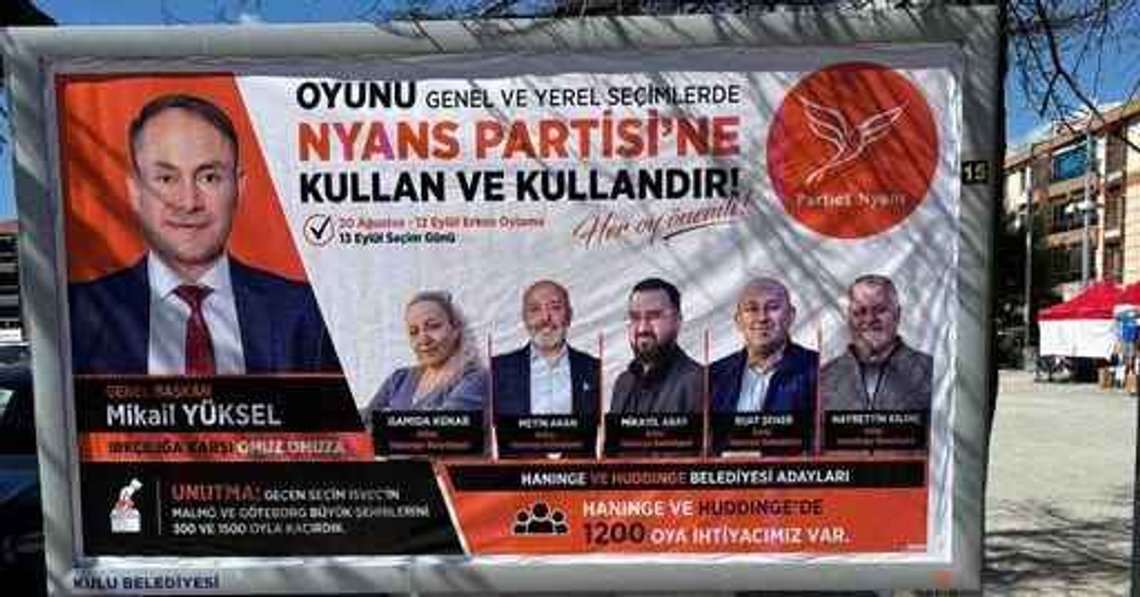
Photo: Partiet Nyans campaigns in Turkey. Photo: Screenshot Facebook
Somalis in Sweden are meanwhile informing eligible compatriots – including those physically present in Somalia – that they should vote for Vänsterpartiet politician Ilyas Hassan because he will combat ‘the growing Swedish racism against Somalis’.
On his election posters, Hassan presents himself with the words: ‘Support me with your vote so that I can defend us in the Riksdag.’
Only in Somali.
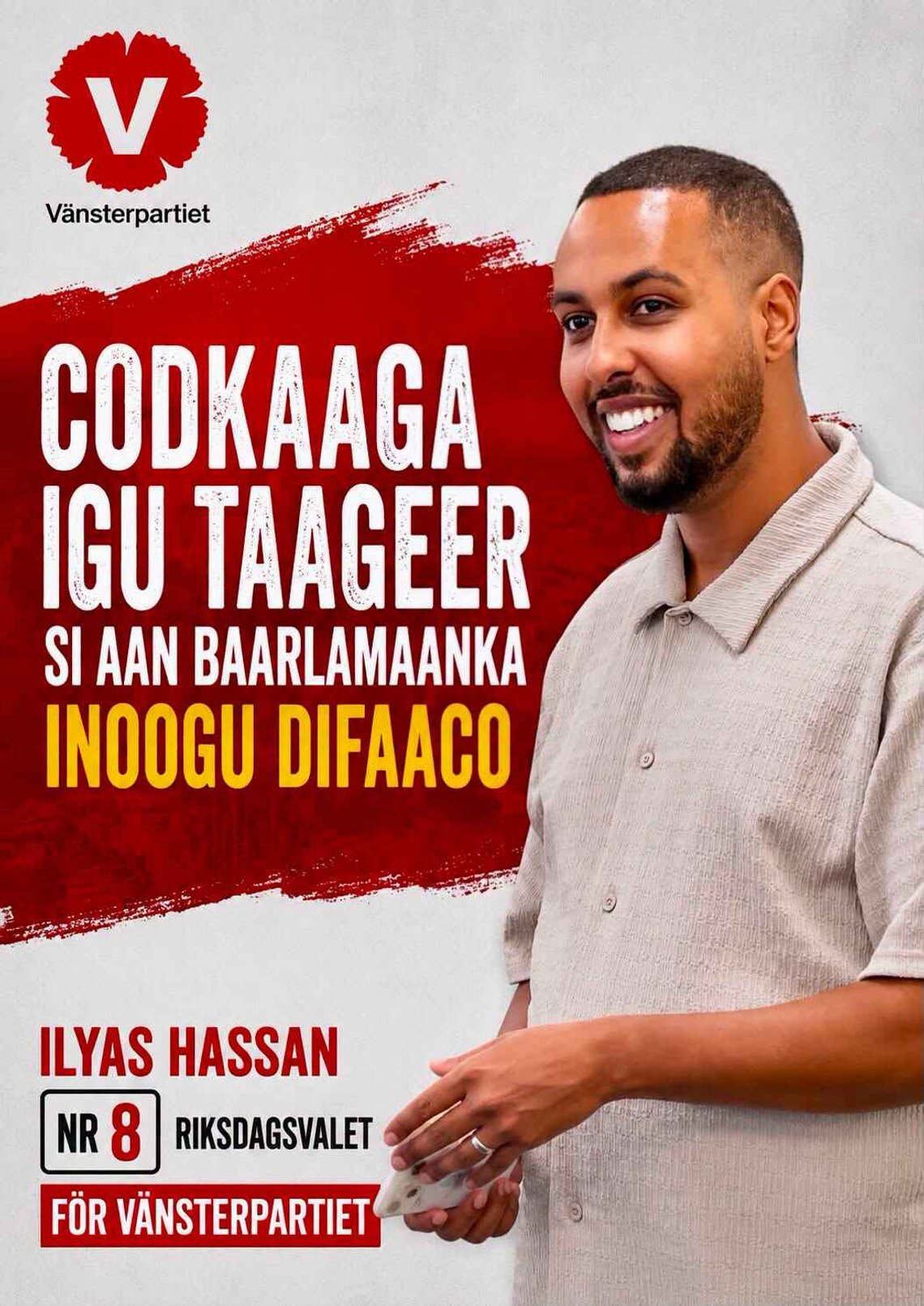
Photo: Screenshot Facebook/Ilyas Hassan
Hassan’s view of Sweden as racist follows Vänsterpartiet’s template. The election material includes, among other things, posts in Arabic highlighting immigrants’ vulnerability and Swedish racism, which is criticised for further intensifying polarisation and reinforcing immigrants’ perception of themselves as victims and Swedes as racists.
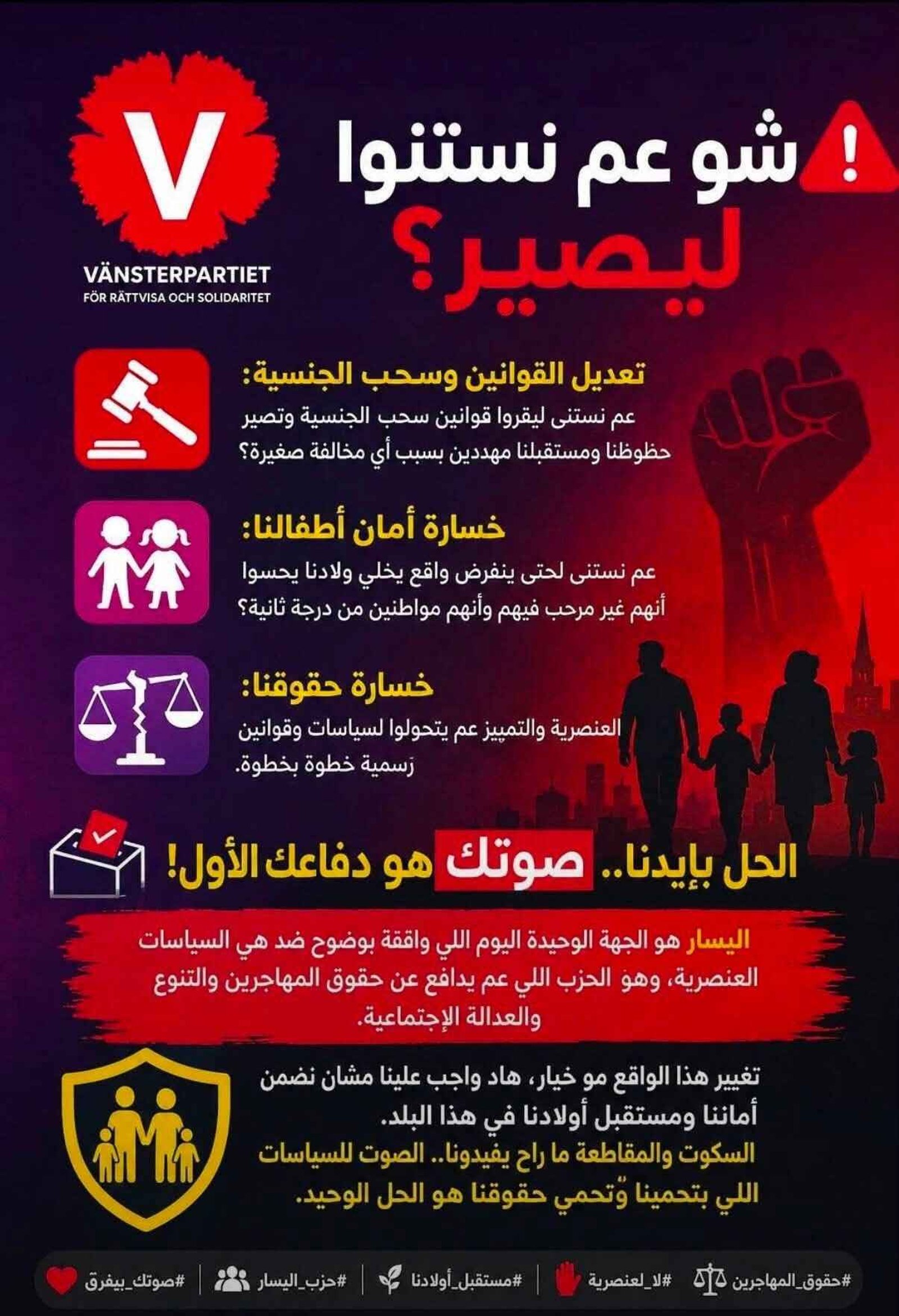
Photo: Left Party (Vänsterpartiet) election poster, together with an AI-translated version produced using ChatGPT.
Photo: Vänsterpartiet’s election poster, together with an AI-translated version produced using ChatGPT
Immigration as an electoral strategy
As early as 1999, there was a more concrete form of electoral strategy. At that time, the Social Democratic Broderskapsrörelsen, today Tro och Solidaritet, entered into a written cooperation agreement with Sveriges Muslimska Råd (SMR). The agreement included, among other things, objectives to increase Muslim representation on Socialdemokraterna’s electoral lists and a commitment to ‘actively promote Muslims’ for political office.
It also involved advancing issues identified by SMR. These included demands that Sweden recognise Muslim holidays, the introduction of state-run imam training, a requirement for (at least) one mosque in every municipality and opportunities to take time off work to attend Friday prayers.
In an evaluation conducted after the 1998 election, the cooperation was described as ‘very successful’, and it was specifically highlighted that SMR had helped persuade many Muslims to vote for Socialdemokraterna.
There is therefore nothing new about Socialdemokraterna seeking to build political networks with Muslim organisations. What was remarkable about the 1999 agreement was how explicitly it linked political representation and influence with the mobilisation of a particular group of voters.
In this way, the agreement provides important historical background to today’s very strong support for S among Muslim voters.
The strong support for Socialdemokraterna now measured among Muslim voters has therefore given renewed life to speculation about whether the party might have a political vested interest in high levels of immigration from Muslim countries.


