

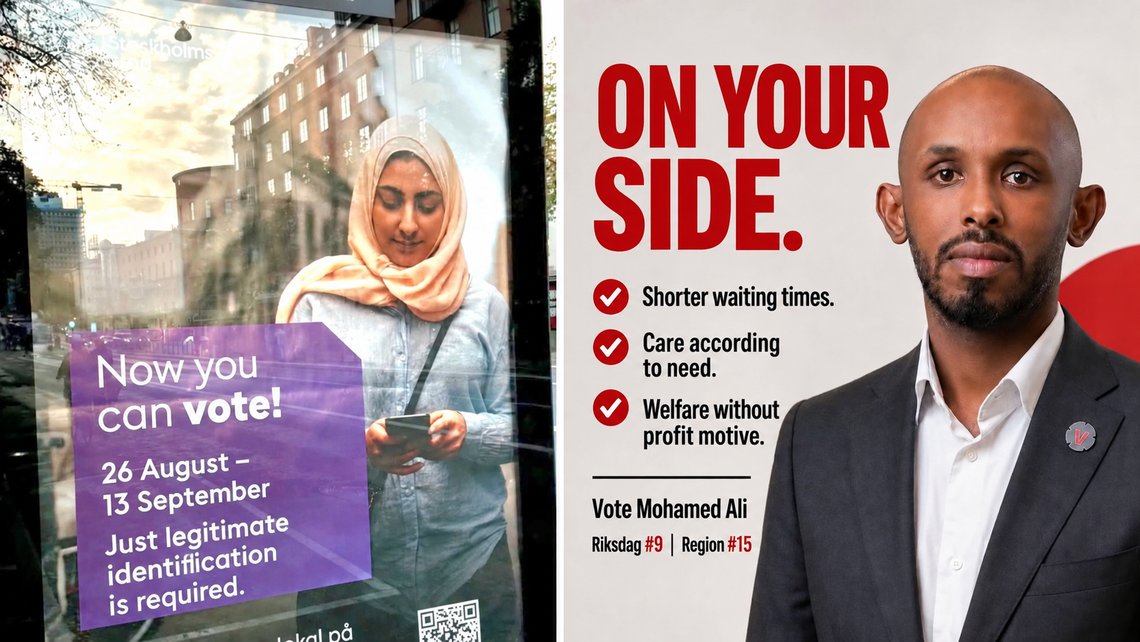
Personal votes propelled the unknown Left Party (Vänsterpartiet) politician Mohamed Abdukardir Ali, 30, straight into the Riksdag. Two years ago, he was denied Swedish citizenship. The National Anti-Corruption Unit (Riksenheten mot korruption) is investigating suspected electoral fraud in Borlänge in Dalarna, where Ali is based. Several Swedish newspapers write that there could be a re-run of the election.
Several Somalis have been elected to the Swedish Riksdag in this year’s election after receiving countless personal votes. They have been ‘voted in by preference’ (kryssats in). One of them is Mohamed Abdukardir Ali. He has been a member of the Left Party for only just over a year, and is brand new both as a politician and as a Swedish citizen, after having been refused citizenship only two years ago.
Denied citizenship in 2024
Two years ago, Mohamed Abdukardir Ali was denied Swedish citizenship. According to the Swedish Migration Agency (Migrationsverket), he had substantial debts and did not meet the requirement of an honourable way of life. Now Mohamed Abdukardir Ali, who is completely unknown in political circles, has been elected as a member of the Riksdag for the Left Party.
‘I am myself surprised by the support I have received, because I have not had any campaign or election material of my own,’ he told Expressen on Sunday.
Police investigate electoral fraud
On Monday, suspicions of electoral fraud are being investigated. According to a police report, people are alleged to have been transported from so-called areas of social exclusion and given ballot papers on which candidates had already been marked. ‘The suspected offence concerns improper conduct in connection with the election,’ prosecutor Oskar Edvardsson of the National Anti-Corruption Unit told Expressen.
The newspaper also reports that, during advance voting, police were already conducting surveillance of a car and several people with links to Mohamed Abdukardir Ali. This was initiated following an anonymous tip-off about suspected electoral fraud in Borlänge. The tip-off came on 1 September, but the case was closed due to lack of evidence. It has now been reopened.
Allegedly lived with gang criminal
On Monday evening, information also emerged that Mohamed Abdukardir Ali is alleged to have lived for several years with a gang criminal. At the time, police searched their shared home and found drugs, plastic bags and scales. The flatmate was also engaged in extensive money laundering, Expressen writes.
Following a series of news reports over the past couple of days about Somali and Muslim election campaigns and preferential voting in general, and about Mohamed Abdukardir Ali in particular. But leading members of the Left Party did not have much to say about their politically unknown party colleague Mohamed Abdukardir Ali when he was recently elected to the Riksdag.
‘I do not really know who he is,’ said the group leader in Borlänge, Matts Hammarqvist.
Could be a re-run of the election
Other politicians from various parties are reacting strongly to the suspicions of electoral fraud, and several newspapers are now writing that there could be a re-run of the election.
223,000 Swedes could be allowed to vote again in this year’s parliamentary election. This follows suspected electoral fraud in Dalarna. ‘Then there could be a re-run,’ political scientist Andreas Johansson Heinö tells Aftonbladet. Which adds that something like this could take time to carry out.
If the suspicions of electoral fraud are correct, they could lead to a re-run of the election. ‘It is the atomic bomb in the arsenal,’ Hans Ekström (S) of the Election Review Board (Valprövningsnämnden) tells Expressen.
Many wondered both before and after this year’s election in Sweden whether immigrants may have decided the result, partly because there are now so many of them. Those questions are now resurfacing.
The allegations contribute to the sensitive question of how immigrant groups vote. Mohamed Abdukardir Ali has a Somali background and appears to have recruited votes within this group, Svenska Dagbladet writes. And continues:
The clans vote for their own
‘There are those who see a risk that Sweden will develop clan voting, where loyalty to an ethnic group and trust in its representatives are something fundamentally different from how Swedish parties usually function. Others argue that voters in so-called vulnerable areas are rational. They are poor and vote on the basis of their class interests. Or they are afraid of possible deportations and vote for the parties they perceive as the clearest opponents of this.
Amineh Kakabaveh wrote on Facebook about the new Left Party member’s rapid and unexpected entry into the Riksdag: ‘One can almost understand if the Social Democrats are concerned about Sweden’s security and hesitate to let the Left Party into the government.’
Vänsterpartiets nye liste i svenske Sävsjö: Syv av åtte har arabiske navn


