
 Helena Edlund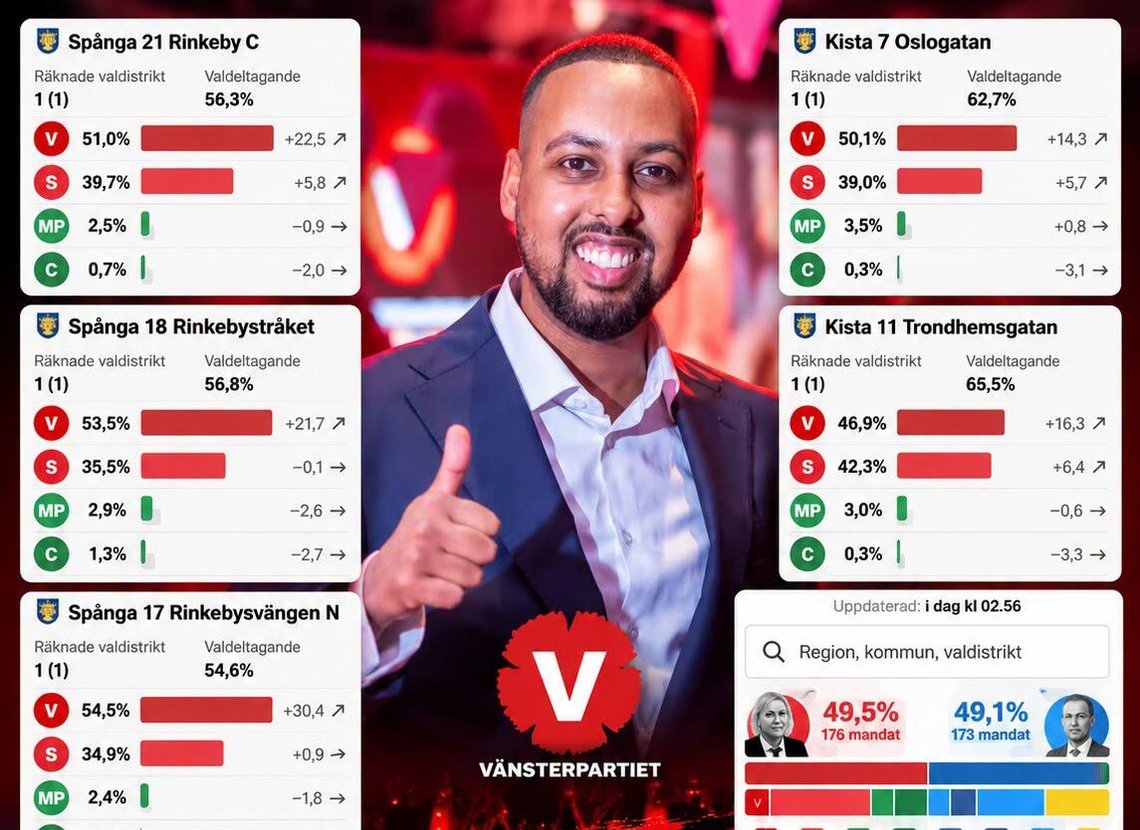
When the Sweden Democrats (SD) entered the Riksdag in 2010, Sweden wanted to know everything: Who were the voters? Why did they vote the way they did? What ideas drove them? What would it do to democracy? Today, Sweden has witnessed a powerful mobilization of Muslim voters, which has resulted in gains for a party whose representatives have praised terrorism and want to eradicate Jews. Back then, there were many questions. Now, there is a strange silence.
When the result of the 2010 election was presented, a murmur went through Sweden: the Sweden Democrats had cleared the four-percent threshold and taken their seats in the Riksdag.
Within a few hours, the first analyses of the party’s success appeared, and enormous attention was devoted to the question of why it had happened, which voters had voted for the party, which ideas lay behind the support, and what consequences the new political force might have.
The reactions were immediate. Anti-racists organized demonstrations, politicians promised educational initiatives in schools, and the media asked whether such a racist, xenophobic and generally hated party should even be allowed to exist. Could it not simply be banned? Of course, in the name of holy Tolerance and Inclusion.
Today, there is extensive academic research and media analysis of the event.
Terror and antisemitism attract new voters
In Sunday’s parliamentary election, the Left Party increased from 6.75 percent in the previous election to (at the time of writing) 8.3 percent.
In the Spånga 21/Rinkeby Centrum electoral district, for example, the party increased by 22.5 percent and ended up at a staggering 51 percent. Had the residents of Hjulsta, Tensta, Rinkeby, Kista, Husby, and Akalla decided the outcome, neither the Christian Democrats, the Centre Party, the Liberals, nor the Green Party would have cleared the four-percent threshold.
The Left Party, on the other hand, would have become the largest party in the Riksdag — despite the months leading up to the election being marred by scandals involving antisemitism and the glorification of terrorism, in which the party was shown to be represented by Hamas sympathizers who do not speak Swedish and who advocate for the genocide of Jews.
Or precisely because of that.
It ought to send a political shockwave through the nation.
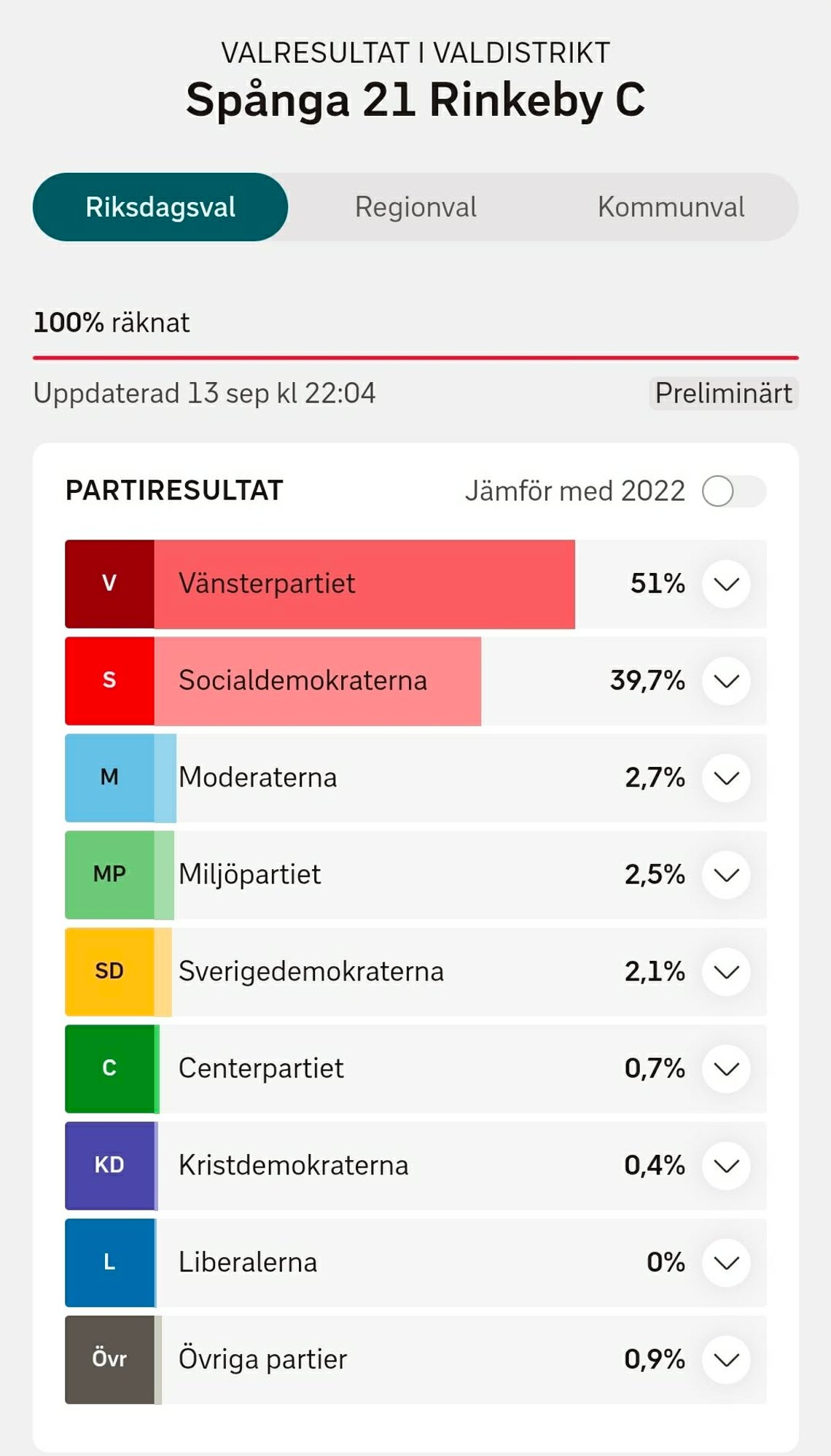
Photo: Screenshot SVT Nyheter
“North Korean numbers”
Former SVT reporter Joakim Lamotte writes on Facebook:
“In Rosengård Centrum, the opposition receives a near-North Korean 97.6 percent of the vote. The Social Democrats and the Left Party alone receive 95.2 percent. It is therefore difficult to get much closer to a political monopoly in a Swedish electoral district.
The same pattern can be found in several places. In Örtagården Ö, also in Rosengård, the opposition receives 95.9 percent. In Rinkebysvängen N in Stockholm, the figure is 92.1 percent, and in Hammarkullen C in Gothenburg, 91.9 percent.”
But it is not only about how people vote in the areas with the highest concentration of immigrants, but also that they vote. According to the Swedish Election Authority, advance voting in vulnerable areas increased by around 79 percent, while in particularly vulnerable areas it increased by a staggering 93 percent.
This is considered a great success. To get residents to the polling stations, they have received help from taxpayer-funded election coaches, “election mothers,” election guides, voting guides and election information officers – of course in Arabic, Somali or [fill in the blank] because the target group does not speak Swedish, and, equally of course, recruited from among individuals whose hearts are on the left.
So that it is done correctly.
Muslim votes decided the election
But imams and other religious leaders have played the decisive role. Those who previously claimed that devout Muslims should not vote in democratic elections because democracy is incompatible with Islam have now urged Muslims to vote in order to exert influence.
This is not opinion-shaping, but identity politics and electoral influence in its most concrete form.
And they have succeeded.
It was, de facto, the Muslims who decided the Swedish election.
The preliminary election result on Tuesday was 176 seats for the red-green opposition and 173 for the Tidö parties. Figures from the ValU election survey show that if only ethnic Swedes and European immigrants had been allowed to vote, Tidö would have won with 181 seats against 168.
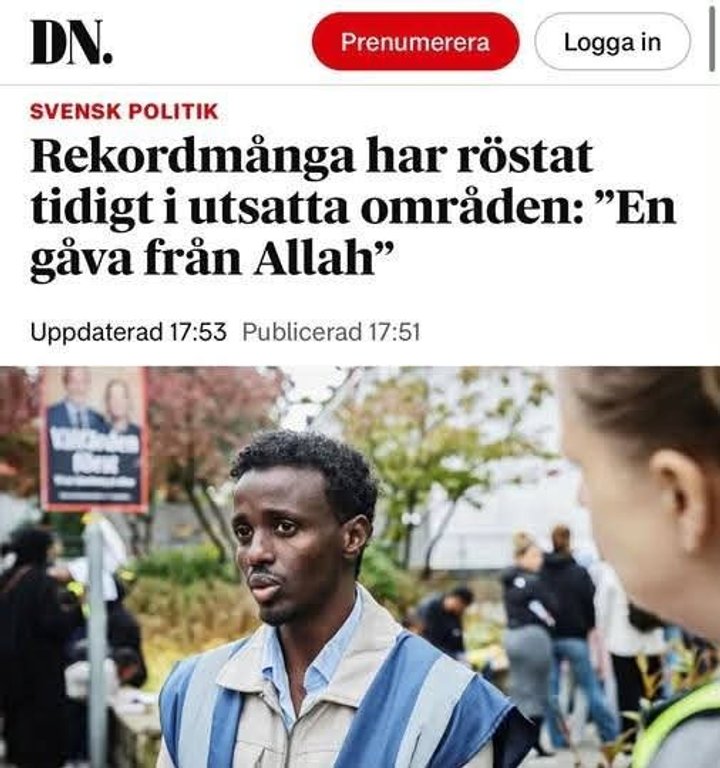
The right to vote – a gift from Sweden or Allah..? Photo: Screenshot Facebook/DN
Democracy’s Achilles’ heel
The Swedish election result has revealed questions that should obviously be discussed: Which groups are being mobilized? Who is mobilizing them? What messages are being used? What is their goal?
The questions do not become any less relevant because they are uncomfortable.
While we are at it, we can continue by asking ourselves what happens to democracy when people who previously abstained from voting are suddenly politically mobilized – with contempt for both democracy and Western freedom as a common denominator? What consequences does it have for Sweden, Swedes and Swedish society when Islam has grown strong enough to decide an election result? And what happens when groups of anti-democrats use democracy to abolish democracy?
These are uncomfortable questions for the noble knights of diversity. That is why they are not asked.
Sweden’s blind spot
The same analytical curiosity that gripped all of Sweden’s “pundits” in 2010 should reasonably arise when Islamist group mobilization changes the political landscape.
But there is deafening silence – and the silence reveals Sweden’s blind spot: We see neither the goals of Islamism, the strength of clans, nor the Swedish society’s inability to defend democracy.
And that could have considerably more serious consequences than the election result itself.
Top five electoral districts where the opposition enjoys near-total dominance
Rosengård Centrum, Malmö – 97.6 percent
S: 54.0% • V: 41.2% • MP: 1.4% • C: 1.0%
S and V combined: 95.2%
Örtagården Ö, Malmö – 95.9 percent
S: 52.3% • V: 40.6% • MP: 1.5% • C: 1.5%
S and V combined: 92.9%
Vivalla Ö, Örebro – 92.2 percent
S: 42.5% • V: 46.1% • MP: 2.3% • C: 1.3%
S and V combined: 88.6%
Rinkebysvängen N, Stockholm – 92.1 percent
S: 34.9% • V: 54.5% • MP: 2.4% • C: 0.3%
S and V combined: 89.4%
Hammarkullen C, Gothenburg – 91.9 percent
S: 45.7% • V: 41.6% • MP: 4.3% • C: 0.3%
S and V combined: 87.3%
(The percentage shown after each electoral district represents the combined support for the opposition parties S, V, MP and C.)


