

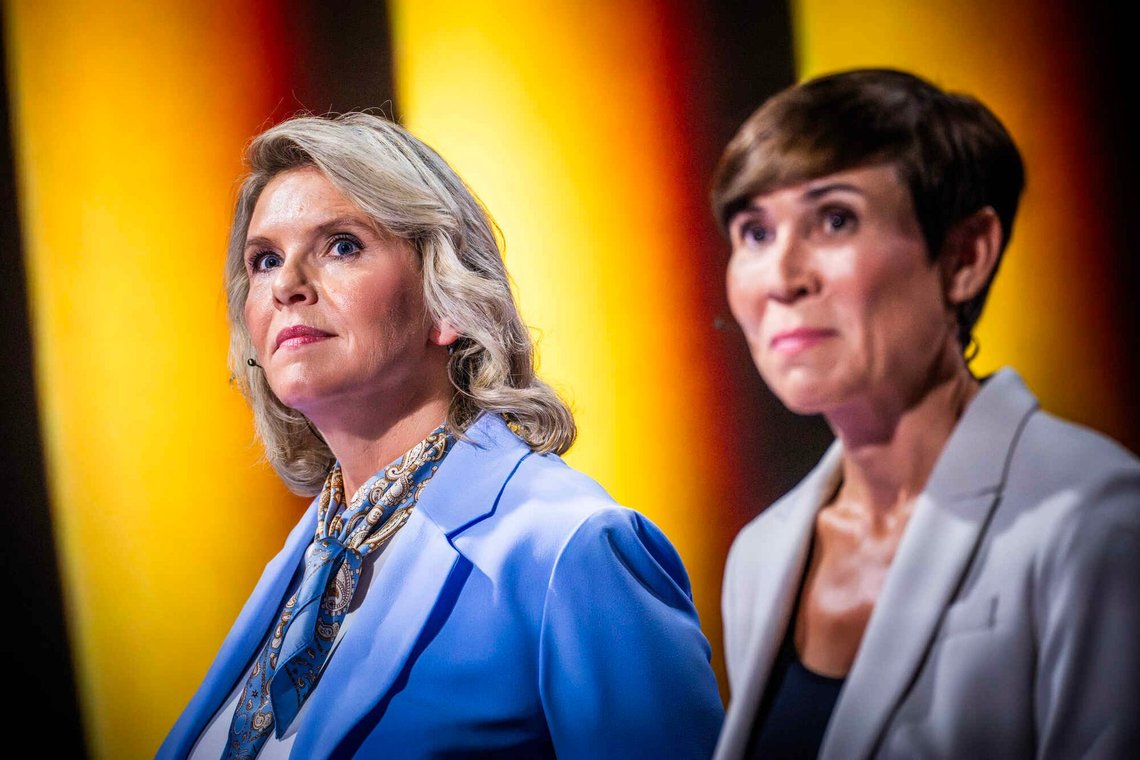
One thing is opinion polls. They go up and down, even though the balance of strength between the Progress Party (FrP) and the Conservative Party (Høyre) has remained unchanged for a long time. What lies beneath is more serious. FrP has taken ownership of key issues. Voters trust FrP more than Høyre.
– FrP has taken issue ownership away from Høyre. Voters trust FrP more than Høyre on tax policy – and even on climate policy. FrP has taken over as the party of government on the non-socialist side, according to election researcher Johannes Bergh.
This is serious for Høyre. If this impression becomes entrenched among voters, it will become self-reinforcing. Høyre’s position as the leading party on the non-socialist side will then be over. Erna Solberg will have been the last to bask in its glory. Ine Eriksen Søreide has been dethroned.
Has this dawned on Høyre politicians, or are they going around believing that things will turn around and that they will make a comeback?
Høyre receives 15.3 per cent in a new poll from Opinion, its weakest showing since Ine Eriksen Søreide was elected party leader in February.
The poll was conducted for FriFagbevegelse and Dagsavisen.
– Høyre is struggling in FrP’s shadow. The non-socialist bloc is ahead and is well placed, as it has been for some time, but it is entirely dependent on FrP’s high level of support. If FrP falls in the polls, the non-socialist and red-green blocs are evenly matched, election researcher Johannes Bergh of the Institute for Social Research tells FriFagbevegelse.
FrP remains clearly the largest party in the poll, with 29.1 per cent. The Labour Party receives 20.5 per cent, while Høyre follows on 15.3 per cent.
If Høyre is dethroned, we are talking about a lasting change in Norway’s political landscape. Bergh believes we are seeing a shift to the right that runs deeper. Voters have changed their views on climate, immigration, taxation and personal freedom.
This means greater distance between Labour and the left wing, which will attempt to shame FrP. Høyre’s decision to align itself with Labour’s definition of press freedom is a risky game for a party in as weak a position as Høyre now finds itself.
The Green Party (MDG) rises to 5.4 per cent and is thus larger than the Socialist Left Party (SV), which receives 5.2 per cent. The Red Party (Rødt) receives 7.9 per cent and the Centre Party 5.7 per cent, while the Liberal Party falls to 2.8 per cent.
All parties, with the change from the previous poll in June in parentheses:
Rødt 7.9 (-0.1), SV 5.2 (+1.2), Labour 20.5 (+1.0), Centre Party 5.7 (-0.1), MDG 5.4 (+0.7), Christian Democratic Party 4.0 (+0.7), Liberal Party 2.8 (-0.4), Høyre 15.3 (+1.0), FrP 29.1 (-2.8) and other parties 4.1 (+1.4). (NTB)
Rødt at around 8 per cent has now become established and is also a factor changing the political landscape. Klassekampen has grown to 37,000 subscribers. Rødt is taking over a role previously held by SV.


