


Norway’s formerly conservative newspaper of record Aftenposten has two summer interns asking whether we are heading towards an energy crisis. The fact that Norway has just emerged from a prolonged period of record-high electricity production and exports is not mentioned. This gives reason to ask whether Aftenposten is deliberately misleading its readers.
– Plucked out of thin air, says Tor Reier Lilleholt, head of analysis at Volue, of the journalism by summer interns Eline Lurud Dahl (26) and Malin Paulsen (24).
He is quoted in the article ‘Historically low water levels in hydropower reservoirs’, which Aftenposten published on page 6 on 17 August, but does not entirely recognise everything the summer interns have put into writing.
The article gives the impression that Aftenposten has discovered that water levels in the hydropower reservoirs are historically low, something Document warned about as early as this spring.
https://www.document.news/editorials/2026/06/hydropower-reservoirs-at-record-lows-electricity-prices-surge
‘Norway’s hydropower reservoirs are at record-low levels, while rivers in Europe are drying up. Are we heading towards an energy crisis?’ the summer interns ask.
Omits the most important point
They provide the answer in the first column, and it concerns heatwaves, drought in Europe and the conflict between Iran and the USA; the latter has choked off gas supplies from the Persian Gulf. But ‘Here in Norway, too, water shortages are a problem. This is affecting hydropower reservoirs, particularly in the southern parts of the country,’ they write.
What they do not write is that Norway has just emerged from a prolonged period of more than a year with historic records in both electricity production and electricity exports.
They show a graph that cannot be reproduced. An accurate picture of reservoir levels, however, is as follows:
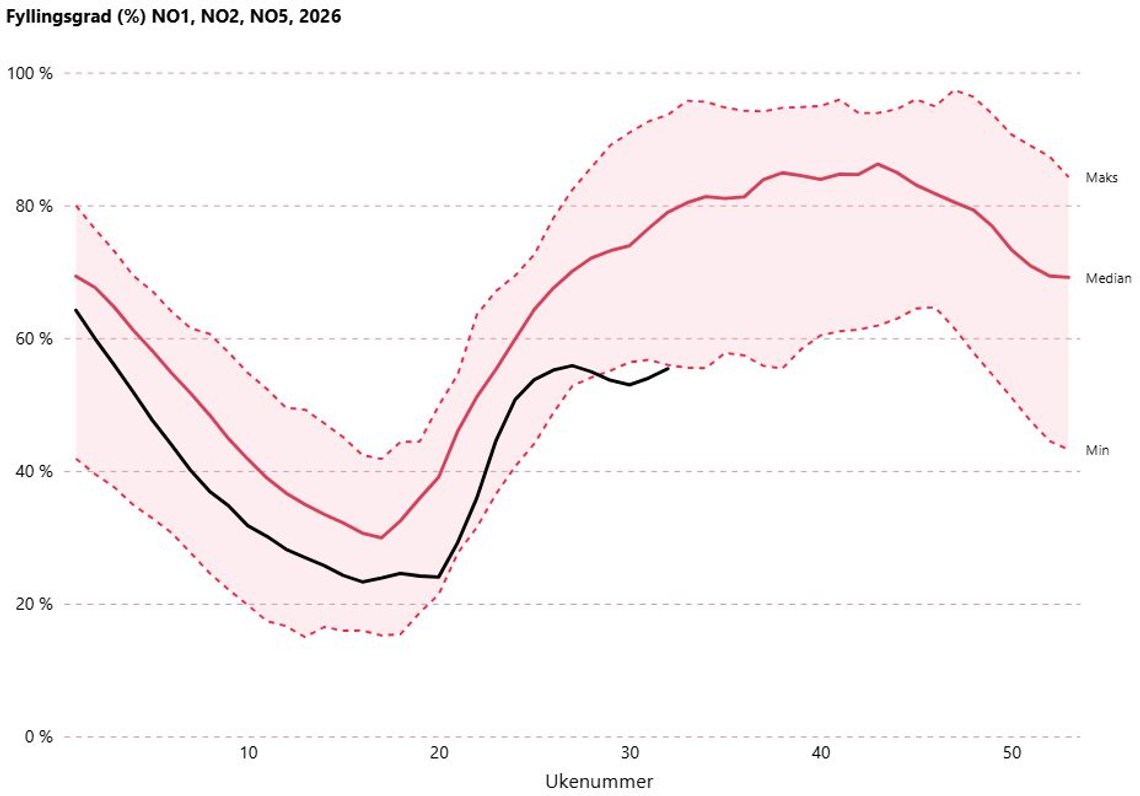 Reservoir levels as of week 32. Source: NVE
Ever since week 22 last year, reservoir levels in Southern Norway have been below normal. This is due to record-high production combined with lower inflows into the reservoirs.
A crisis foretold
Figures from Statistics Norway (SSB) show that Norway produced 162 TWh of electricity in 2025. Net exports were 23 TWh. Never before has so much electricity been produced and exported.
The previous year, 2024, was also a record year, with electricity production of 157.2 TWh, fractionally above the 2021 record of 157.1 TWh, and net exports of 18 TWh, surpassed only by net exports in 2020, which was a very wet year, combined with the country being shut down because of the pandemic.
The hydropower reservoirs in Southern Norway held 31.8 TWh as of week 32. That is 13.5 TWh below the seasonal norm. In the second half of last year and the first half of this year, however, net exports to the Continent from the NO2 bidding zone amounted to no less than 17.3 TWh.
Figures from NVE show that the energy content of the snow last winter was at a record low. The same was true in the winter of 2024/25. We have to go back to the winter of 2023/24 to find more snow in the mountains than normal, and consequently greater-than-normal inflows into the reservoirs.
Nevertheless, Norway has produced electricity at full tilt and set an export record on the cheap, while the price in Southern Norway today is above NOK 1.70 per kWh.
Logical failure – no answers
Document took note of a line of reasoning in the Aftenposten article:
‘In Northern Norway, the problem is the opposite. Reservoir levels there have been at record highs throughout the summer. That does not necessarily mean that electricity will be cheap, particularly if the autumn is wet. There is then a risk that the hydropower reservoirs will overflow, in which case the water is worth nothing. It may therefore pay producers to conserve the water, and prices may then rise. In that case, Norgespris may also become relevant for people in Northern Norway.’
The fact is that the electricity price in Northern Norway has remained below NOK 0.10 per kilowatt-hour this summer and has averaged NOK 0.39 so far this year.
Document tried, together with Lilleholt, to understand the logic of this reasoning, but without success. Document has contacted both Eline Lurud Dahl and Malin Paulsen to find out what they mean, but has received no reply.


