




As winter approaches, there is a shortfall of 12.6 billion kilowatt-hours in the reservoirs south of Dovre. This is the lowest reservoir level ever recorded in southern Norway. And this is due to a deliberate policy by the government and the Storting.
Every Wednesday at 13:00, the Norwegian Water Resources and Energy Directorate (NVE) updates the reservoir statistics for the past week.
For Week 46, which ended on 15 November, the measurements show a reservoir level south of Dovre and Sognefjorden of 34.4 TWh, which is a new record low. The normal level at this time of year is 47 TWh.
There is a shortfall of 12.6 billion kilowatt-hours to reach normal levels. Never before has there been such a severe shortage of water in southern Norway’s hydro reservoirs at the start of winter.
The following figure shows the NVE’s reservoir statistics for the power regions NO1 (Eastern Norway), NO2 (Agder, Rogaland, Vestfold and Telemark) and NO5 (Western Norway south of Sognefjorden)
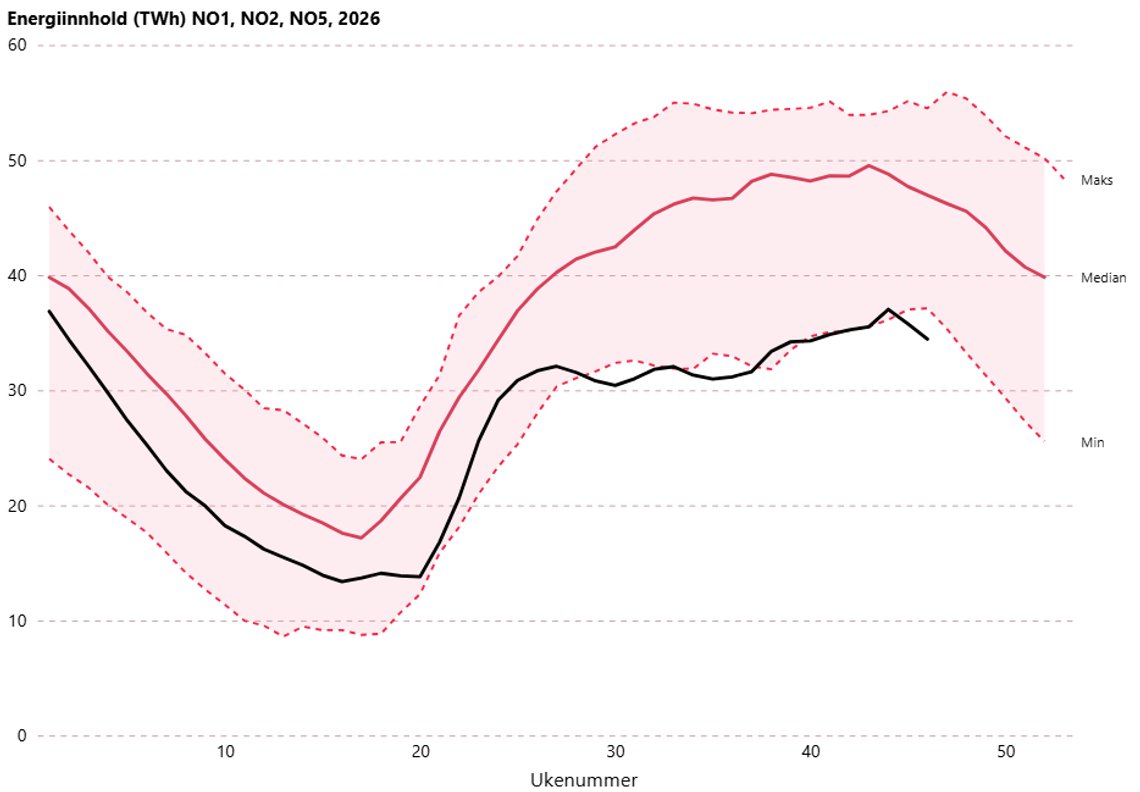
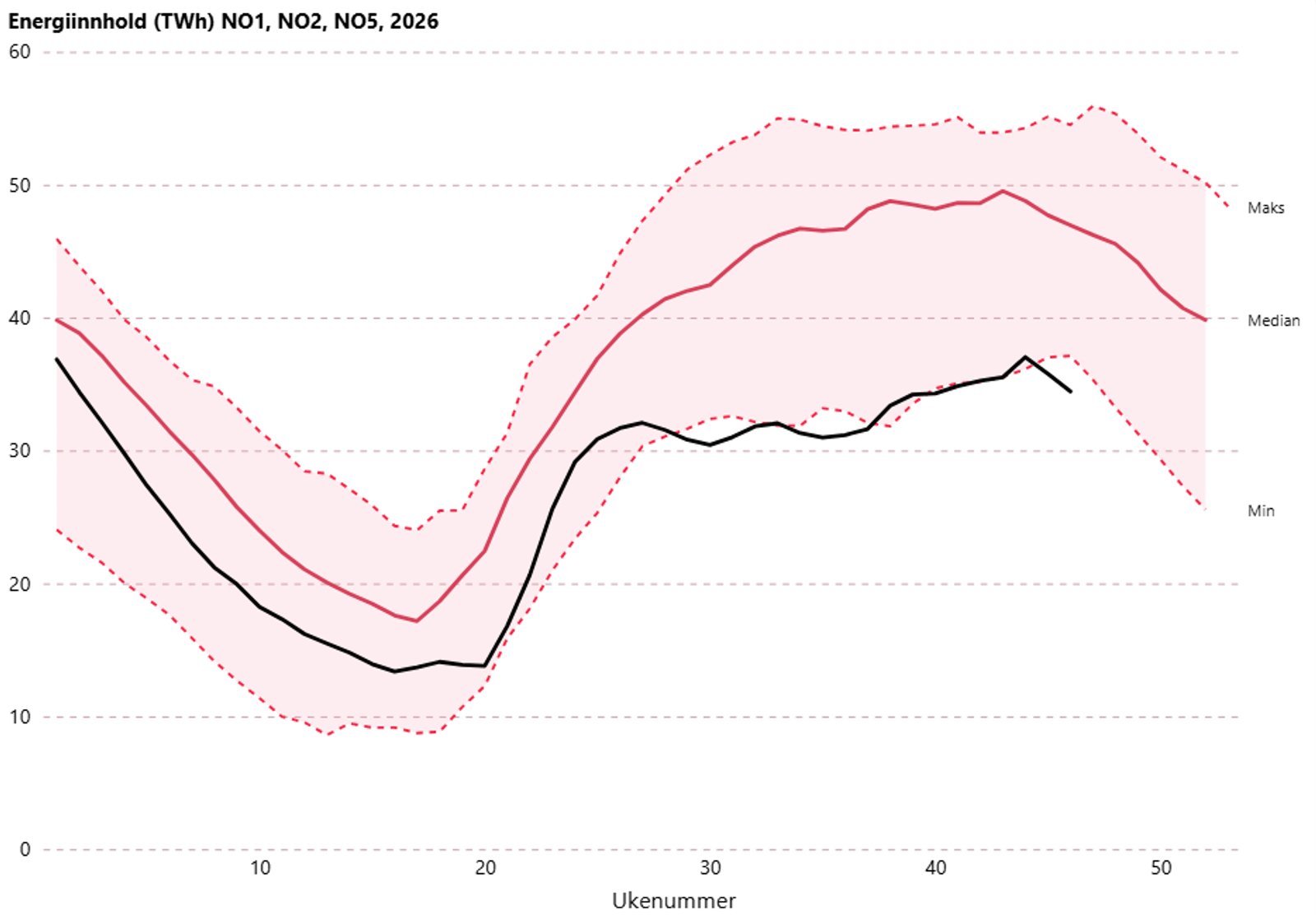
Hydroelectric reservoir levels as at week 46 in Southern Norway. Source: NVE
Record prices
Lower temperatures and a population forced to use electricity for heating are leading to increased demand for electricity.
Low stock levels combined with rising demand mean higher prices. We are seeing this now. The market price of electricity in southern Norway has settled at over 2 kroner per kilowatt-hour on a weekly basis.
Admittedly, there has been less rainfall this year than normal in southern Norway, with 61.7 TWh compared to the normal 74.1 TWh, and so-called usable inflow in line with that of 2021. At that time, Statnett and the rest of the power industry tried to explain away the high electricity prices by citing a dry year and the Russians, whilst the real reason was that German and British energy policies were having a direct impact on Norwegian power sockets via the new export cables.
Citing low rainfall is not a valid explanation in a regulatable power system such as Norway’s.
The explanation for the record-low reservoir levels is that electricity exports from southern Norway have been phenomenal.
In 2025, a new record was set for net exports (exports – imports) from NO2 to Germany, the UK, Denmark and the Netherlands, totalling 26.2 TWh. This beat the previous year’s record by 0.5 TWh. Even this year, with reservoir levels below normal, net exports from NO2 stood at a full 8.6 TWh as at the end of October. Consequently, the reserves are almost depleted.
What should have been a security of supply for Norwegian businesses and households heading into winter was exported in 2024 and 2025 for a song. In practice, the stock was sold off at rock-bottom prices. Now the reserves are running low and prices have soared.
This situation was predicted well in advance. Document’s regular reviews of the situation over the past year have highlighted the state we now find ourselves in, which is likely to worsen as winter sets in.
Deliberate policy
This situation is the result of deliberate policy on the part of the Government and the parliamentary majority. The Labour Party government bears particular responsibility. And the parties that provide the government’s parliamentary basis – the Socialist Left Party, the Centre Party, the Green Party and the Marxist-Leninist party Rødt.
However, the Conservative Party’s energy policy is virtually indistinguishable from that of the Labour Party. The same applies to the Liberal Party and the Christian Democratic Party.
All these parties believe, or want people to believe, that the Earth’s climate will improve as a result of Norwegian businesses struggling with high electricity prices and the state making the population dependent on schemes such as the ‘Norgespris’, which is in fact an admission of a dysfunctional energy policy that politiciansthemselves believe in but do not dare to implement for fear of not being re-elected.
The Progress Party has advocated a different direction in energy policy and has argued that electricity exports must be conditional upon security of supply for Norwegian households and businesses.
However, this would be in breach of the EEA Agreement, and this brings us to the root cause of the problem itself: the EEA Agreement.


