

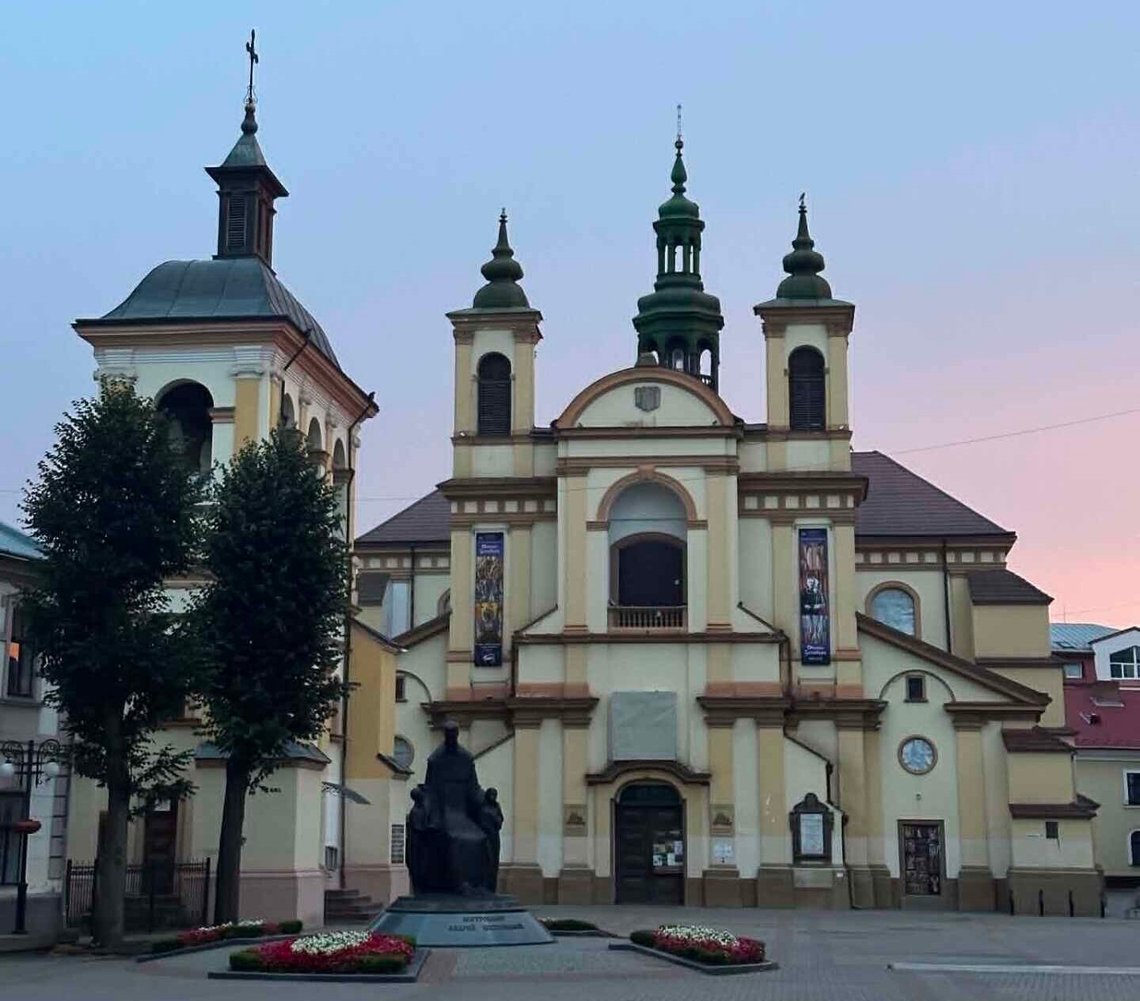
Day 4: Kyiv → Ivano-Frankivsk
3 August. A meeting with the spokesperson for a Ukrainian drone manufacturer, part of a MilTech cluster of more than 100 private small businesses, is unfortunately cancelled at the last minute. The diary therefore takes a small detour, to areas in the west and the Carpathians, before the course is set south towards Odesa and the Black Sea.
It is a strange feeling to be in a country where a neighbouring country wants to kill you. The thought strikes you, not exactly like a drone, but as a mild discomfort when you stare up at the massive glass surfaces that envelop the main railway station in Kyiv. “What would happen if…?” And of course, now the air-raid sirens begin to wail!
What do you do? Rush to the toilets in the basement? But with a ticket in your pocket and a suitcase cleared by the X-ray machine, the walk is short to the train waiting on the platform with departure in only ten minutes. The contrasts are great compared with blessed Vy, which battles signal failures in peacetime and cannot get the trains through a tunnel in Østfold. Not all the world’s employees in yellow high-visibility vests can help you reach a bus-for-train connection when management values passengers like a lightly chewed piece of gum.
In Ukraine you can be sure that when something fails, a Vladislav with powerful, tattooed forearms will appear and pull a lever. Or hammer his fist into an old Soviet apparatus that suddenly coughs back to life. Or not. Then he opens the toolbox and fixes the problem. Analogue style.
Bloodlands
The train is unperturbed by the air-raid siren, and on the stroke of the hour it sets off towards Ivano-Frankivsk, at the foot of the Carpathians. This mountain range, and the plains around it, have seen more conquerors established and dethroned than perhaps any other place in Europe’s recent history, well described in Timothy Snyder’s book.
The Polish-Lithuanian Commonwealth ruled from the late Middle Ages (14th to 16th centuries) and was finally displaced by the Habsburg monarchy in 1772. The Habsburgs were, as is well known, skilled at expanding the realm through strategic marriages, but utterly terrible at waging war. Emperors who insist that their officers must wear chalk-white uniform jackets and large black moustaches, which if necessary must be dyed regularly, have never experienced the results of rainy weather in the field.
 The synagogue in Ivano-Frankivsk has been returned to the small Jewish community of around 150–300 people. Photo: CB.
In 1918 it was over, and the short-lived West Ukrainian People’s Republic was established precisely in Ivano-Frankivsk (then called Stanyslaviv). But in the summer of 1919 the Poles are back, in the form of the Second Republic, which lasts until the German invasion in 1939, when Stalin advances from the east and the area becomes part of the Ukrainian Soviet Republic. But not for long, because in the summer of 1941 the Germans invade and establish the General Government – District of Galicia, annexed by the Thousand-Year Reich. But not quite that long either, because in the summer of 1944 Stalin’s workers’ paradise is back.
Anyone unfortunate enough to have been born in this area around 1900, and who managed to live until Ukraine’s independence in 1991, would – by living in the same place their entire life – have lived in at least seven different countries or forms of government.
Memorial plaques for the fallen from Ivano-Frankivsk. All Ukrainian cities and towns have similar memorial groves, and they expand further along pedestrian streets and squares every year. Photo: CB
Invasion of Ukraine – and Europe
We often hear about the enormous sacrifices the Soviet Union made to “liberate” Europe from Nazism. Apart from the fact that Stalin was Hitler’s ally until the outbreak of war, and that Stalin had no intention of liberating anyone at all, and that the Soviet Union avoided capitulation thanks to enormous quantities of food and war matériel sent by convoy to the Soviet Union from the Western powers – was it really necessary to sacrifice 10 million soldiers’ lives? And just as many civilians?
There is something about the socialist – including National Socialist – view of humanity. That two Soviet soldiers died for every Wehrmacht soldier must be seen in the context that the Germans after all lost the war and were slaughtered on the Eastern Front in the final year of the war. While the Russians fought only in their own neighbourhood; they were spared participation in the war in the Atlantic, in Africa, on D-Day, or in the Pacific against the equally bestial Japanese empire. Yet the losses were so vastly out of proportion compared with the other Allies.
High losses – static fronts
In the last two weeks of July, Russia lost 20,000 men, killed and wounded, in Ukraine. In the same period the Russians captured 25 km², almost exclusively in the Kostiantynivka area. That is an area a little larger than the Spanish enclave of Ceuta, at 19.5 km². Manhattan is 60 km². It takes the Russians roughly five weeks and 22,000–23,000 soldiers to capture an equivalent piece of Donbas, which most certainly does not have the same property prices as Manhattan. Especially when it will take a hundred years to clear the land and remove unexploded ordnance.
So why? It is of course more important to prevent a Slavic brother people from succeeding in freedom and showing that a better future is also possible for Russia.
For the same reason Ceuta, and the European Union, are being flooded by invasion forces without the ability to create a better future in their own homelands, or in ours – no matter the amount of aid and preferential treatment. The goal is to make us all unfree, so that our time’s “Supreme Soviet” can retain power and privileges. And above all, the illusion of their own good self-image.
Thinking, well-informed Ukrainians do not want to join the EU. They have had enough of empires.


