

Day 3: Lviv → Kyiv
The soothing notes of a piano fill the spacious waiting hall of the railway station. A group of Girl Guides, fourteen-year-olds who have been camping in the forests around Lviv, are now returning home to Kharkiv, a city subjected to daily bombardment. They laugh carefree among themselves as they employ a technique for putting on rucksacks that appear to weigh as much as they do: first sitting on the floor, then leaning forwards onto their knees, before rising with a powerful squat. A feat of strength that would once have seemed impossible has become second nature to Ukrainians since the invasion by their larger neighbour.
In recent days, it has not only been Lviv that has felt the impact of cruise missiles. Kyiv, too, has come under unusually heavy attack. An American-owned counter-drone company, Terminal Autonomy, is destroyed, though without loss of life. The same night, Russia uses North Korean KN-23 missiles for the first time since last summer, including against Kryvyi Rih, President Zelensky’s home city, where an entire family is killed.
Anyone for Zaporizhzhia? Lviv’s departure board calmly lists trains to the frontline city of Zaporizhzhia, despite the constant threat of Russian missile and drone attacks. Photo: CB
The numerous air raids across Ukraine that evening leave the train running many hours behind schedule. We arrive in Kyiv shortly after midnight, by which time the curfew has already come into force. Finding transport to the hotel now seems likely to prove difficult. A nervous quarter of an hour passes in the darkness, illuminated only by the Uber and Bolt apps, before “Rashid” unexpectedly accepts the fare. He is Syrian, and appears entirely unfazed by the anti-aircraft batteries opening up as we approach the hotel. Although the correct route is displayed clearly on his mobile phone, he stops repeatedly to check the way, despite being only minutes from our destination.
Just as we arrive and step out of the car, the anti-aircraft guns erupt once again, as though in a film. The hotel staff are quick to unlock the doors, but the receptionist merely explains that it is too dangerous to check in. Instead, he leads the way directly to the bomb shelter. We descend into a basement furnished with neatly made beds, together with tables, chairs and beanbags for prolonged stays. It resembles the dormitory of a school camp.
 Bomb shelter in Kyiv. Photo: CB
The following morning dawns beneath brilliant sunshine and temperatures of 35 degrees. Suddenly, the war feels far away. The walk from the hotel passes through the diplomatic quarter, by both the Norwegian and Swedish embassies. Many Americans live in this part of the city, as do some of Kyiv’s wealthiest residents. A Ukrainian-American in the hotel lobby explains that neither he nor his Ukrainian wife ever use the hotel’s bomb shelter, because “too many Americans live in this neighbourhood — Putin will not risk hitting them. In the same way, Moscow’s wealthiest districts are left untouched. It is not only Trump who knows how to make a deal.”
Our first destination is the magnificent St Michael’s Cathedral, which has also become a memorial to Ukraine’s fallen. Along its whitewashed walls hang photographs of dead soldiers in sorrowfully long rows. Here and there, relatives have gathered with flowers, dressed in white embroidered Ukrainian blouses and shirts.
Wall of Remembrance for the Fallen of Ukraine, outside St. Michael’s Monastery. Photo: CB
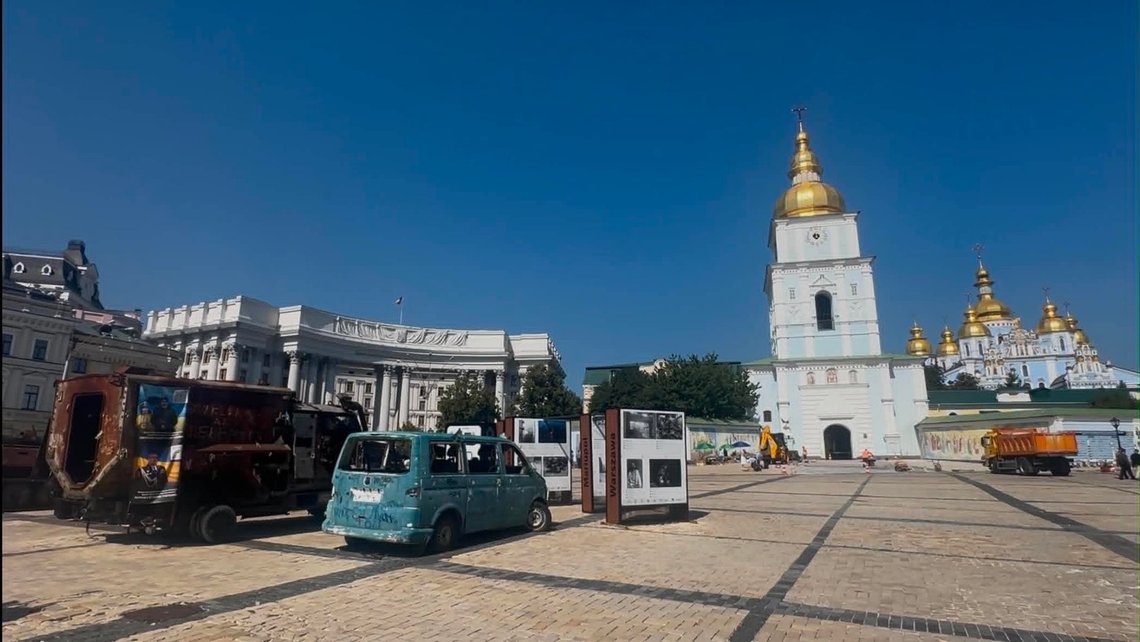
In the square outside the cathedral, close to several government buildings, stands a display of wreckage from the early stages of the war: burnt-out tanks, ambulances riddled with bullet holes, and shattered civilian cars. Among them, large wrought-iron letters spell the word “Freedom”. Ukrainians are reminded every day of what it costs.
Yes, Ukrainians know that their country is far from perfect. Yet here they are free to protest. Demonstrators demanding the return of former Defence Minister Fedorov are allowed to stand peacefully with their placards. In Moscow, protesters holding up blank sheets of paper were arrested.
Ukrainians possess something else as well: a country that remains recognisably their own. This is what Scandinavians are in the process of losing. How much of Oslo would a grandmother recognise if she were to return to earth today? The Scandinavia that the Nordic peoples knew only a few decades ago no longer exists anywhere in the world, and that sense of loss is scarcely even permitted to be expressed.
Ukrainians know what they have, and they are fighting to preserve it.


