

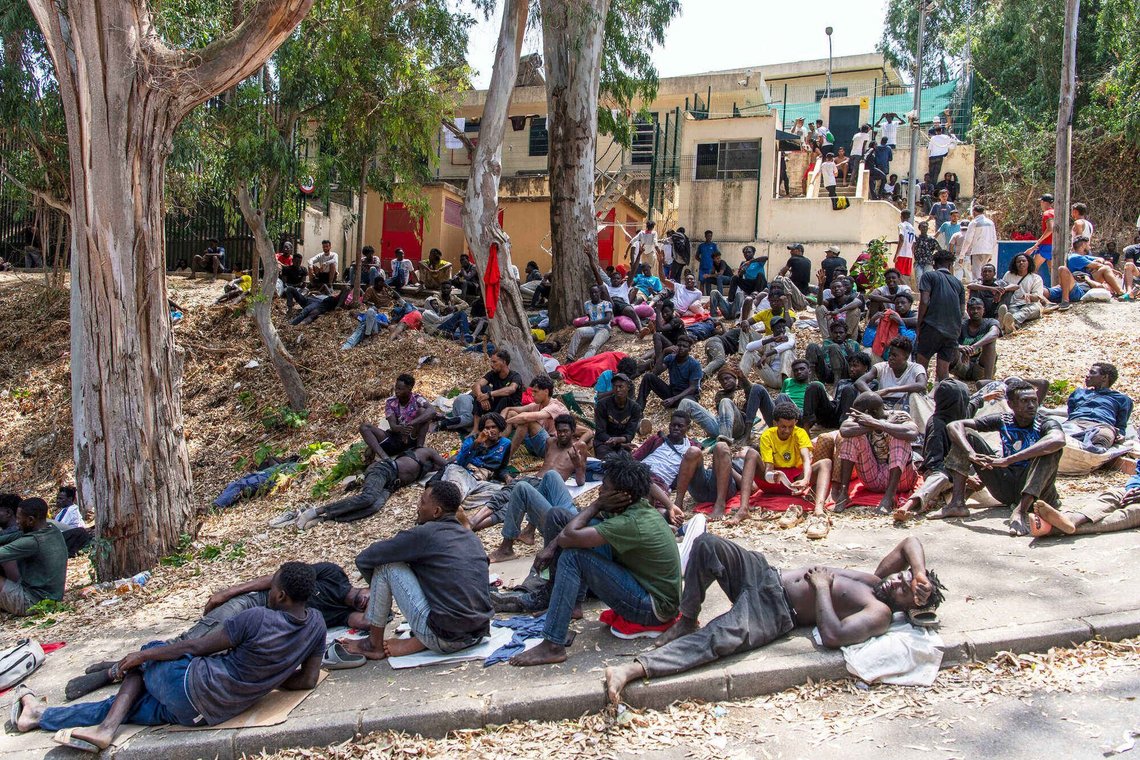
When 60,000 illegal migrants enter the Spanish exclave of Ceuta within a short period of time, this is not a random or humanitarian refugee crisis. What we are witnessing is a foreseen, deliberate and orchestrated collapse of the Schengen Area’s external border.
The overwhelming majority of those storming or swimming around the border fences are young men from Morocco – a stable country that is not at war. In legal terms, they are economic migrants with no need for international protection.
Yet the gates to Europe stand wide open.
This is not happening because of naivety; it is because cynical actors and people smugglers have been handed the perfect tools by the political elite.
– First, the crisis is the result of a political and legal own goal by Spain.
In June 2026, Spain’s left-wing government adopted a historic asylum amnesty granting legal residence to up to 700,000 illegal migrants. At the same time, the Spanish Supreme Court ruled that migrants arriving by sea could no longer be deported immediately. People smugglers interpreted this as a direct green light.
They cynically marketed the legal changes, filled the boats and sent thousands out to sea simultaneously, fully aware that the Spanish police now have a legal obligation to rescue them and process their cases.
– Secondly, the situation is being exploited as a geopolitical weapon in a form of hybrid warfare. Morocco has a long history of using migration waves as a form of political currency. Whenever the Moroccan authorities wish to pressure the EU for money or political concessions, the border guards quietly step aside and leave the floodgates open. Europe is thus “punished” from the outside because we have made ourselves vulnerable to blackmail.
Now unrest is simmering within Europe. It is an indisputable fact that the fundamental premise of Schengen has been shattered.
Europe’s open internal borders were adopted on the assumption that the countries guarding the external borders would exercise rigorous control. As Spain fails completely, Italian Prime Minister Giorgia Meloni is threatening to suspend Schengen cooperation with Spain and permanently reintroduce border controls. (Ed.: Italy has suspended Schengen.)
What does all this have to do with Norway? When Norway’s political elite and supporters of the EU defend the EU/EEA and our supranational agreements, they like to present them as ensuring that Norway is governed safely.
The EU’s new Asylum and Migration Pact entered into force on 12 June 2026. The legal position is clear that Norway is exempt from the Pact’s “solidarity mechanism” concerning mandatory relocation quotas. Mandatory relocation quotas therefore apply only to EU Member States.
Yet another good reason to stay well away from the EU… The EEA Agreement does not give the EU the authority to send buses of migrants from Ceuta to Oslo Airport. On the contrary, the Dublin rules provide Norway with a legal guarantee that any migrant can be returned to Spain – provided that they have been registered there.
But this is where the real trap lies: What happens if Spain stops registering them, allowing them to travel north unhindered? If their fingerprints are not entered into the Eurodac database, Norway has no evidence.
At that point, these illegal Moroccan men effectively become Norway’s responsibility as soon as they cross the Swedish border.
While international and social media are flooded with dramatic images from Ceuta, major Norwegian news organisations have chosen to downplay the scale of the events or present them as an ordinary humanitarian incident, rather than focusing on the security policy implications.
Since Norway is part of the Schengen Area, these unregistered men theoretically enjoy free passage all the way to the Swedish border as long as nobody stops them along the way. The Government’s unwillingness to comment on the situation or implement immediate measures (such as national border controls) is viewed by critics as a serious abdication of responsibility.
Norway must immediately introduce national border controls. This would not constitute a breach of international agreements; it would simply mean making use of the emergency safeguards built into the Schengen Borders Code itself (Schengen Borders Code Articles 25–28).
Countries such as Germany, Denmark and Austria suspended open borders long ago and introduced identity checks at their border crossings in order to safeguard their internal security.
The legal framework of the EEA Agreement has left us checkmated in the fields of climate and energy policy, but in the field of asylum we still retain formal room for manoeuvre.
The problem is that Norwegian politicians willingly accept and wag their tails for Brussels, even where the agreements do not require them to do so.
Now that Schengen’s external border has collapsed in Spain, permanent national border controls are the only tool we have left to prevent parts of this massive, unregistered and growing flow from suddenly ending up in Norwegian asylum reception centres.
It is time to close the door before it is too late!


