

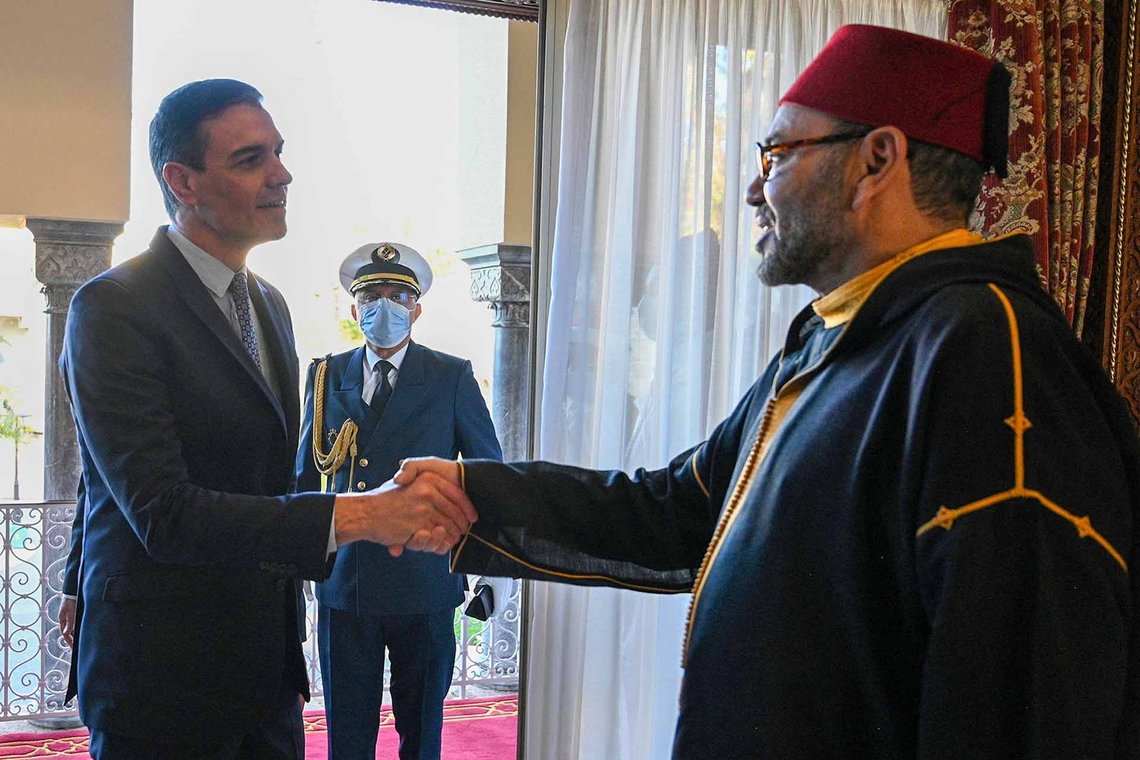
The Spanish government under Pedro Sánchez has systematically downplayed both the warnings, the scale and the risk surrounding the storming of Ceuta.
At the end of July, tens of thousands of young men from Morocco and sub-Saharan Africa crossed the border into the Spanish enclave of Ceuta. Officially, the figure cited is around 70,000–80,000 over the course of two days. Around ninety per cent were quickly sent back, but approximately ten thousand remained – and with that, Sánchez characterised the situation as ‘normalised’.
The government knew – but did not act
Recently declassified documents from the Spanish intelligence service CNI show that the authorities were warned the day before the invasion. On 29 July, CNI alerted both Moroccan counterparts and Spanish authorities to extensive calls on social media and in WhatsApp groups for a coordinated assault both on foot around the fence – and by swimming. The groups had a combined total of around 180,000 followers. The messages explicitly pointed to 30 July – the Moroccan Throne Day – since parts of the security forces would be taking part in the celebrations.
The Interior Minister and the government delegate in Ceuta claimed in the days that followed that there had been no advance information about an invasion. The documents reveal that this is not true. The government was warned about both the timing and the method. That they nevertheless left the border open to tens of thousands of intruders raises questions about responsibility and intent.
‘The worst of all’ remained in Ceuta
Among the 10,000 remaining is a hard core of criminals and Islamists. Soldiers and police on the ground have characterised them as ‘the worst of all’ – these are individuals with violent or criminal backgrounds and extremist Islamist profiles.
Spanish security sources describe the intruders who remained as the most problematic. Police have identified a number of individuals with links to jihad, previous investigations and/or deportations for terrorism-related matters.
«Hellige» krigere identifisert i invasjonshæren som stormet Ceuta
There are fears that some have not been located and may be hiding in the rugged terrain around Ceuta. Several are already said to have attempted, or succeeded in, making their way onwards to the Spanish mainland.
⚠️URGENTÍSIMO⚠️
PEDRO SÁNCHEZ ES TRAICIONADO y ACABAN CON ÉL tras ESTAR EL REY FELIPE VI con ROBLES.Como sabéis se han desclasificado diversos documentos relativos a la invasión masiva de Ceuta.
Entre ellos hay 2 del CNI que hunden literalmente a Pedro Sánchez y Marlaska y les… pic.twitter.com/leIbw3t9Pl
— UN ABOGADO CONTRA LA DEMAGOGIA (@UACD_Youtube) September 10, 2026
Morocco, perhaps the most contentious part of the story
Madrid has consistently avoided accusing Morocco of having organised the invasion. Prime Minister Pedro Sánchez has personally rejected the claim that the Moroccan authorities were behind it. He has portrayed the entire episode as a humanitarian crisis provoked by people smugglers, rumours and disinformation. Rabat categorically denies that the country organised or deliberately permitted the invasion.
During the summer, the first reports emerged that Spanish security authorities had known that something was afoot. The declassified documents contain uncomfortable details for Sánchez.
Spanish security authorities have reported that no reaction was observed from the Moroccan authorities as the situation began to spiral out of control. This was despite the Moroccan authorities having been informed of the plans. CNI reported that many people were already waiting by the coast the night before, ready to swim around the fence towards Ceuta. This makes it difficult to portray Morocco’s role as non-existent.
Sánchez: Around 200 voluntarily return to Morocco every day
While most returned to Morocco, several thousand remained. The figures vary considerably: the government initially spoke of around 5,000, but on 18 September the government itself estimated that it needs capacity to accommodate around 10,000 who are still in Ceuta. Around 6,000 are said to be housed in more or less makeshift reception centres and accommodation, while around 4,000 are on the streets, in mountainous areas and on beaches. The figures are twice those previously given by Interior Minister Fernando Grande-Marlaska.
Sánchez, for his part, claims that around 200 people voluntarily return to Morocco every day, something the local population scoffs at; they deny that the number of intruders is falling by 1,000 every five days. At the same time, the Sánchez administration has regularly updated the number remaining – from 5,000 to 7,000, and most recently 10,000.
According to local authorities and NGOs, the death toll has risen from at least 72 to at least 141.
Spania planlegger innkvartering for 10.000 migranter i Ceuta
Reception capacity is prioritised – not return
Instead of prioritising swift and complete return, the Sánchez government has announced that it will expand reception capacity in Ceuta, while the inhabitants of the small enclave (around 84,000) are left with a sense of having been abandoned and betrayed – they are experiencing in real time the collapse of public services, rising crime and the number of sexual assaults reaching unprecedented levels.
The local population accuses the Red Cross of contributing to the migrants remaining. By distributing free food and assistance that they do not receive in Morocco, an incentive to stay is created. There have been protests in which residents have blocked aid convoys.
The Red Cross is the reason why the invaders of Ceuta don’t go back to Morocco.
If they didn’t have free food, they would already be gone.
Never ever donate one penny to them. pic.twitter.com/AtW4Wo7m7X
— Ada Lluch (@AdaLluch) September 14, 2026
Sánchez buys Moroccan goodwill
What is happening in Ceuta is not an internal Spanish affair. On 17 September, the European Parliament adopted a resolution condemning the massive border violation and described migration used in ‘hybrid warfare’ against the territorial integrity of a Member State as a serious security challenge.
The European Parliament has also approved a request from the conservative Spanish party VOX to send an official delegation to Ceuta in February 2027 to meet local authorities, civil society and people affected by the crisis.
🔴 ÚLTIMA HORA | El Parlamento Europeo aprueba a petición de VOX una misión oficial para investigar la invasión de Ceuta: «Bruselas debe suspender los acuerdos con Marruecos»https://t.co/nlryTPSwlt
— LA GACETA (@gaceta_es) September 10, 2026
VOX’s demands include a possible suspension of the agreements with Morocco. Since 2018, Spain under Sánchez has invested between €1.2 and €1.3 billion in Moroccan goodwill in the form of loans, financing and aid. Despite the flow of money, the neighbouring country on the other side of the Strait of Gibraltar was unable – or unwilling – to prevent the massive invasion.
🚨🇪🇸 Segundo reportagens de veículos como Vozpópuli, La Gaceta e Telemadrid, o governo de Pedro Sánchez teria acumulado cerca de 1.000 milhões de euros (1 bilhão) em ajudas e empréstimos a Marrocos desde que chegou ao poder em 2018. 🔥🤯
A fatia mais gorda desse bolo é um… pic.twitter.com/aOMNPQDvWi
— Paulo Spitzbarth 🇧🇷🇩🇪🇮🇱 (@PauloSpitzbarth) August 5, 2026
The arrow points northwards
Ceuta is EU and Schengen territory. Those who have remained have demonstrated that they are capable of exploiting weaknesses in border controls. Experience suggests that they will do whatever they can to make their way onwards to the European continent.
The Spanish government has consistently downplayed the warnings, the number who remained and the security risk. The documents, the police identification of militant Muslims and the decision to build massive reception capacity instead of emptying the enclave send a signal: Return is not Madrid’s solution; those remaining are not a temporary problem, but a new reality.
Ceuta, and eventually Melilla, will become symbols of European impotence
What happened in Ceuta at the end of July 2026 was no ‘migration crisis’ in the ordinary sense – it was a controlled, large-scale border violation in which the Spanish authorities allowed themselves to be caught off guard despite warnings. It was a direct attack on Spain’s, and thus the whole of Schengen’s, our territorial sovereignty, carried out by a cynical autocracy that uses people as weapons.
The borders will continue to leak with the current power apparatus in Madrid and Brussels, and this will have political consequences in the form of weakened trust and a strengthened right.
Brussels will continue to issue declarations and provide money to Morocco – but as long as the border leaks, these will merely be postponements. Morocco has learnt that it can send thousands across and continue to receive aid and political goodwill. The present Spanish regime does not have the strength to respond to this.
Brussels risks appearing as a union that speaks of a ‘rules-based order’ while tolerating transgressions by authoritarian neighbours.
Without stricter return agreements, genuine sanctions and a clear doctrine that border violations are met with force – Ceuta, and eventually Melilla, will become symbols of European impotence.


