

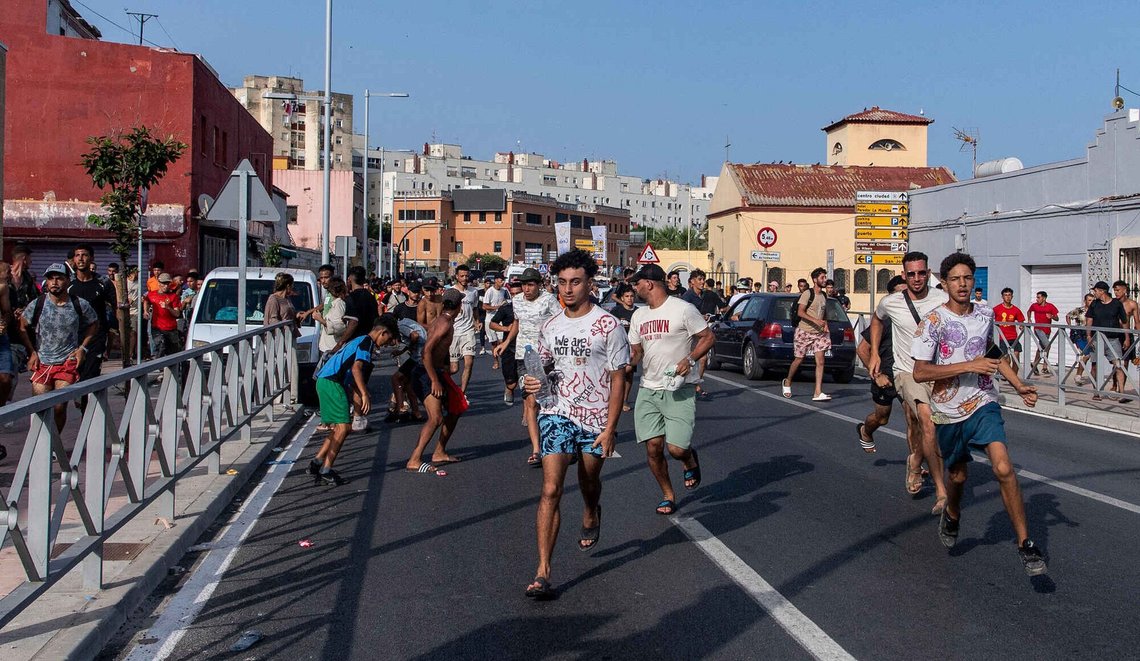
Spain’s Prime Minister has accused EU member states of “prejudice” in the wake of the migration crisis in Ceuta. He is calling for an emergency EU meeting. Meanwhile, the death toll continues to rise.
Since the invasion of Ceuta began, around 60,000 illegal migrants have forced their way into the small enclave, which forms part of the EU territory. Ceuta normally has a population of just over 80,000.
Melilla, another Spanish territory surrounded by Morocco, has also experienced an unusually high number of illegal migrants attempting to force their way in. There, however, the Guardia Civil appears to have the situation better under control than in Ceuta.
> “Life in this city has been severely disrupted by the border incident. Returns have begun in a satisfactory manner, but they must be completed. The city has still not returned to normal,” says Ceuta regional president Juan Jesus Vivas (NTB-AP-AFP-Ritzau).
At least 67 migrants died while attempting to enter Ceuta. The debate over how Europe should deal with illegal migration is now intensifying, writes Die Welt.
The Schengen Agreement
Pedro Sánchez, Spain’s Socialist Prime Minister, has come under heavy criticism from several other EU member states. Italy was the first to suspend Schengen cooperation with Spain. France has strengthened border controls with its neighbour.
Portugal is reinforcing its maritime border with Spain and has begun daily sea and land patrols along the Algarve coast. For the time being, however, it has no plans to follow Italy in suspending the Schengen Agreement.
But Sánchez is not the only EU leader who appears to have forgotten that the Schengen Agreement requires the EU’s external border to be protected.
The Schengen Agreement, which has not functioned properly since Germany’s then-Chancellor Angela Merkel opened the floodgates 11 years ago with her famous *Wir schaffen das*, is now at risk. Many Europeans would probably rather show their passports when crossing borders than allow mass immigration into Europe to continue at the current pace.
Brendan O’Neill expresses his frustration in *The Spectator*. He argues that much of Europe is complicit in what he calls the invasion of Ceuta.
> “It is not only Spain’s sovereign integrity that lies in ruins after the storming of Ceuta—it is also the euphemistic tyranny under which we have all been forced to live in recent years.
> Europe’s rulers have policed our language more rigorously than our borders. They have attacked anyone on the right who has used words such as ‘invasion’ or ‘colonisation’ to describe illegal immigration. Such aristocratic condemnation is plainly untenable in the aftermath of Ceuta.”
In the same magazine, David Goodhart writes that what is happening should serve as a wake-up call for Europe.
The scenes in Ceuta bear disturbing similarities to elements of Jean Raspail’s notorious French novel on immigration, *The Camp of the Saints* (*Le Camp des Saints*).
In a letter to the leaders of the European institutions on Saturday, Sánchez condemned the “attitude” of certain member states, which he said was motivated by “prejudice, misinformation, ignorance or political interests”. He has now responded by convening an emergency EU meeting in the form of a videoconference with the interior ministers of the 27 member states.
Danish Prime Minister Mette Frederiksen and her Swedish counterpart Ulf Kristersson are among more than 20 heads of government who on Sunday jointly called on European Council President Antonio Costa and European Commission President Ursula von der Leyen. They too demanded an emergency meeting.
Whereas Sánchez wants to discuss what he describes as the “selfish” reactions of EU member states, a number of other countries are demanding stronger action from Morocco and Spain.
> “It is absolutely crucial that we maintain control of Europe’s borders. The pressure we are seeing on the EU’s external borders requires an immediate and decisive response. First and foremost from Morocco and Spain,” says Mette Frederiksen.
The Spanish newspaper *El País* writes that Pedro Sánchez’s government ignored the warning signs along the Moroccan border.
> “It is clear that we had no information whatsoever. Had we had it, 50,000 people would not have entered the country within 24 hours,” a senior government official told the newspaper.
The authorities claim they were unprepared because they were preoccupied with the country’s ongoing wildfires. But Ceuta and Melilla have been targets for migrants for years, and that has nothing to do with forest fires in Spain.
It is the welfare benefits offered by EU countries that attract migrants. Many also believe that Spain’s recently adopted amnesty for illegal migrants already present in the country bears part of the responsibility for the invasion.
Spanish journalist Inacio Cembrero accuses Morocco’s border authorities of doing nothing whatsoever to resolve the crisis.
> “To reach the breakwater marking the border between Spain and Morocco, there are barriers with police and border forces. It is obvious that they allowed them to pass,” he says.
“`


