



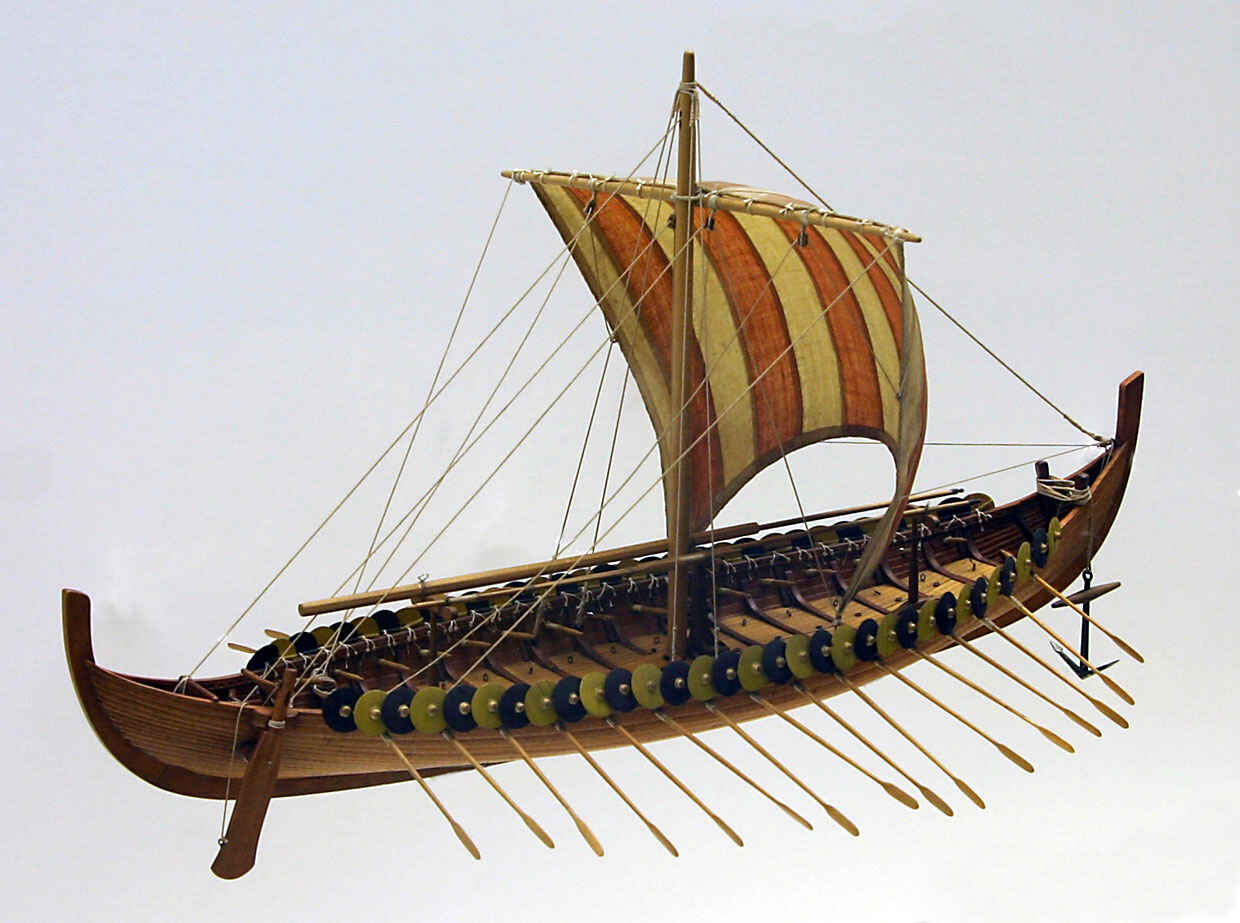
Model of the Gokstad ship. Photo: Softeis.
There is an odd, emotional tug-of-war going on about our own history in the public sphere. On one side we have a modern entertainment industry that spews out series like Vikings, in which the Norse epoch is reduced to a polished action theatre filled with intricate skaldic poetry, formidable ship technology and aesthetic violence. On the other side we find an academic elite and moral correctors who can hardly wait to reduce the entire epoch to a Scandinavian variant of IS or Hamas.
Both camps stumble over the same sociological rug. They confuse the commercial surface with society’s actual foundation.
If we apply a strict historical realpolitik to the Viking Age, we must dare to dismantle power’s own PR-bluffs. Take for example the established narrative from the Nestor Chronicle that the Slavic tribes in the year 862 sent a polite letter to the Viking chieftain Rurik and begged the Scandinavians to come and rule over them because «there was no order in the land».
This is history’s oldest and most successful cover-up of a raw, military coup. The chronicle was written by monks several centuries later, on direct commission from the Rurik dynasty to legitimise a monopoly on violence. The truth is that the Varangians had for a long time conducted hard extortion and tax collection along the strategic river routes from the Baltic to the Black Sea. The Vikings very much invited themselves. They were political opportunists who understood logistics and power. They were eminent administrators, yes – but in the sense that they rigged an effective protection racket with sword in hand.
This need to embellish raw exercise of power with a touching and palatable origin myth, we see in abundance also in modern times. The princes of capital use exactly the same methodology as the Rurik dynasty. Kjell Inge Røkke has for decades carried out precisely the same PR-coup by presenting himself in public as the dyslexic «school loser» who fought his way up from absolute nothing. But the truth does not withstand a sociological examination: Røkke was no school loser who lacked education; he completed compulsory primary school in a completely normal way. It was upper secondary school he consciously chose to forgo in favour of fishing and capital building. In the same way his position in the global circle is blown out of all proportion; he is a big fish in our local pond, but he is not at all among the world’s richest in the real international top tier.
The parallel itself stretches however far deeper than just personal origin myths. Looking at the methods, there is a striking structural similarity between Rurik’s tax collection apparatus and the way modern corporate structures operate. The Varangians in the east quickly realised that pure, headless plunder was bad business in the long run. Instead they cemented their position by taking control of the infrastructure – the river routes and trading hubs. Through this logistical stranglehold they forced the local tribes into a system where they had to pay fixed tributes in order to be allowed to conduct trade at all. It was a sophisticated, institutionalised protection racket.
Turning to the methods of the Aker system, we see exactly the same strategic architecture. One does not rig power by producing added value from the bottom up; one does it by securing control over society’s common infrastructure, energy resources and industrial nodes. Through intricate networks of subsidiaries, cross-ownership and strategic straws into the state treasury, one establishes a modern tax collection apparatus. The community and subcontractors are forced to pay tribute to the system’s owners in order to gain access to the resources. The myth of the school loser who conquered the world is a calculated narrative – just like Rurik’s «invitation» – designed to give this raw, infrastructural tax collection a popular and acceptable face.
No one disputes the genius of the longships or the navigational art of the seafarers. But being advanced in technology does not necessarily mean that one has left the stage of violence; it only means that one has industrialised it.
The real Norwegian, the true foundation of civilisation at this time, lay somewhere completely different from in the ship’s keel or with the warriors who chose the «raider» economy. It lay with the everyman in Norse society who through layered, slow maturation tamed a harsh nature and built up a proto-democracy. It was about being a trader, not a raider.
The linguistic and sociological red thread we find in the French word for Germany: Allemagne. It stems directly from the proto-Germanic Allamaniz – which means precisely «all men». It referred to the Germanic and Norse tribes’ flat, decentralised power structures.
These were all-thing assemblies in practice. Long before authoritarian kings arrived with foreign mercenary armies to force through an absolute, centralised monopoly on violence, the free farmers and coastal chieftains gathered at Tingvoll, Tinghaug and at local thing places. Here they resolved conflicts through legal mediation and economic compensation rather than endless blood feuds.
Laws and judgments were not dictated from above; they were approved through the ritual weapon-taking (vápnatak). The weapon-bearing men struck swords and axes rhythmically against their shields to mark their agreement. The louder this acoustic democracy resounded over the thing place, the stronger the consensus. By participating in the weapon-taking each individual man committed himself to enforcing the law. Power lay in the community, not with a tyrant.
It is this dramatic pattern that culminated in the Battle of Stiklestad in 1030. Olav Haraldsson did not come to bring mild, civilised values; he came with a foreign mercenary army to crush the traditional, decentralised trading network that coastal chieftains like Tore Hund and Ottar had built up through generations based on stockfish and furs. Tore Hund did not only lead a «peasant army» – he defended the producer’s and trader’s independence against a king who wanted to tax and monopolise everything under one centrally controlled crown. That Olav was later canonised as a saint is the victors of posterity writing their own PR.
Here we can draw a line to Proverbs of Solomon: «Make me not so rich that I forget God, or so poor that I curse his name.» The golden mean is about protecting substance and integrity against extreme concentration of power on the one side, and desperation on the other.
The all-thing assemblies and the thing tradition were this golden mean. It was a soil that already understood the value of law over power, which made it possible for Christian law and Magnus Lagabøte’s National Law later to land and strike deep roots.
When we today are shaped by what the philosopher Guy Debord called the Society of the Spectacle – where everything is reduced to surface, clickable emotions and topical moralism – we must retrieve again this discipline of silence. The Vikings went out and made headlines; the decentralised all-thing remained and built civilisation. It is on those shoulders we stand, not on the premises of the brutal warriors or the centralising kings.


