

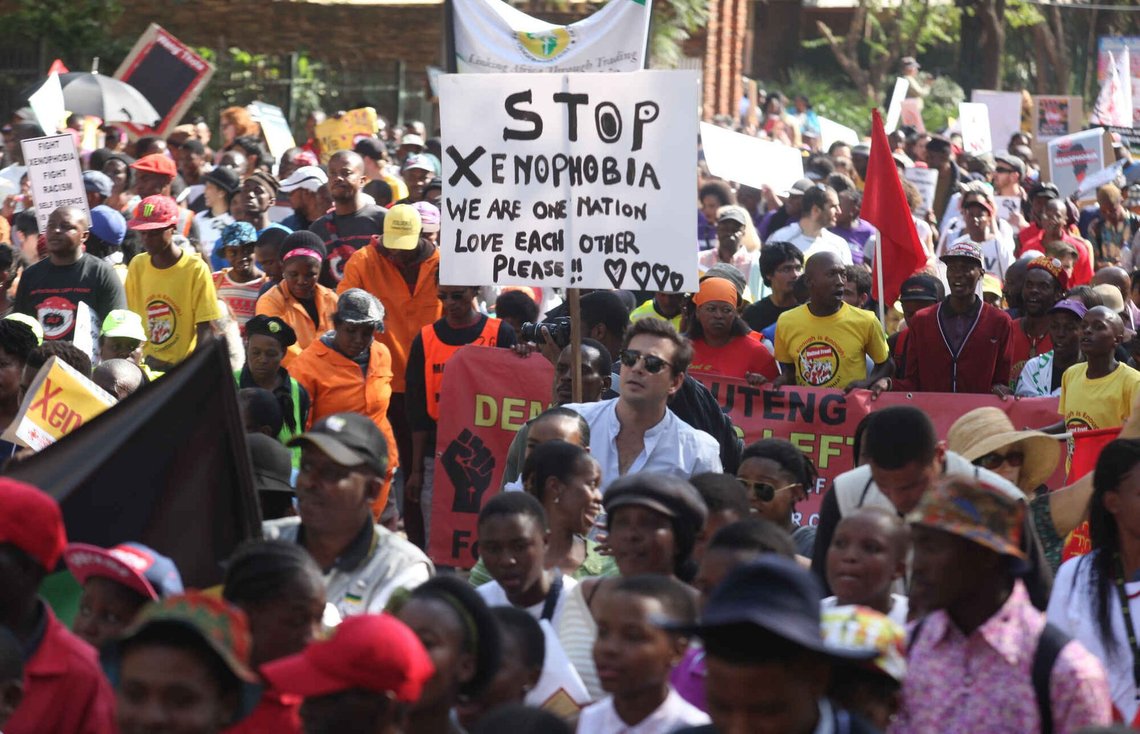
South Africa is struggling with mass immigration. This has led to record-high unemployment, growing frustration, and a wave of violence against immigrants.
But in South Africa, immigrants are not greeted with signs saying Refugees Welcome. They are met with discontent, fear, hatred, violence, murder, and disgust. This is black-on-black conflict, making it difficult to blame white people’s racism.
There is also a degree of hostility between different tribes, something that has not exactly characterised Europe’s indigenous population in modern times, although we have imported conflicts from the Third World.
The entire Western world condemned apartheid. Contempt for the country’s white population was sung by pop stars, and the country was boycotted by Western nations. Free Nelson Mandela became a major hit for us Western virtue-signallers.
Few know the history, but a few simple figures show that South Africa has hardly become a better place since apartheid ended and Nelson Mandela was elected president in 1994.
During the entire period that apartheid existed, from 1948 to 1989, a total of 7,000 people died in connection with political violence. During the transitional period of just four years (1990–1994), this figure rose to 21,000 deaths.
The killings during this period largely consisted of black people killing black people. Some of it was ordinary crime, but a considerable proportion resulted from the struggle for power after apartheid was dismantled. White farmers were subjected to numerous murders, rapes, and other atrocities, something that continues to this day.
Yet the world celebrated and rejoiced that South Africa’s black population had finally gained its freedom.
Things have only worsened since then. In 2024, more than 26,000 murders were recorded in a single year. In the final quarter of 2025, 6,351 murders were recorded, in addition to 127 rapes per day.
South Africa today finds itself in a situation marked by despondency, frustration, and pent-up anger. Many of the problems from the apartheid era have persisted, violence has exploded, political corruption is rampant, the energy supply is deteriorating, and leading politicians sing Kill the Boer before tens of thousands of enthusiastic supporters. The broad smiles of the 1990s did not last long.
The Danish online publication Point of View International (POV) writes:
Unemployment today stands well above 30 per cent. The country is the most unequal in the world. Cities with more than one million inhabitants are in complete decline.
Infrastructure such as electricity and water supplies is beyond saving, corruption is worse than ever, and 32 years under the old liberation party, the ANC, have changed little for ordinary people—so little that growing numbers of South Africans are finding it increasingly difficult to blame the white apartheid racists of the past for all the world’s misfortunes, as has otherwise been customary for all these years.
And the violence is still there, namely the ordinary everyday violence, which mainly consists of property crime or family and gang conflicts. On average there are 58 murders a day, but now the violence has acquired an intensified dimension which, although it has flourished for around 20 years, is only now truly entering the spotlight of the media and commentators.
Much of the violence is directed at migrants from other African countries, who according to official figures number around three million people. But few trust these figures from the corrupt and incompetent authorities, and the actual number is probably far higher.
There are constant demonstrations in the streets, often ending in violent riots. In May, five immigrants were killed during unrest in Johannesburg. Such attacks on immigrants have been going on for years.
https://www.document.news/news/2026/06/anti-immigrant-unrest-is-rising-in-south-africa
Mass immigration is class division on speed
As in much of the West, the effects of mass immigration are felt differently across society, writes Robert King in The Spectator.
The wealthier sections of society isolate themselves in enclaves and often view immigrants as a source of cheap, reliable, and unorganised labour.
By contrast, poorer communities face the daily pressures of competition for jobs, housing, and public services, compounded by cultural and linguistic tensions in a stagnant economy.
These factors have created the powder keg that has led to the current situation. Several organisations in South Africa have now decided that remigration is the next solution.
In recent years, activists have rallied around established anti-immigration organisations such as Operation Dudula, ActionSA, and the highly active March & March, which recently set 30 June as the deadline for illegal immigrants to leave the country. Otherwise? Well, what then?
Most members of the three groups insist that their demonstrations are not about xenophobia, but about enforcing the law. Foreigners residing illegally in the country—and most of them are—must leave.
In Western countries, including Norway, those who speak of the remigration of illegal, criminal immigrants are denounced as racists and almost as Nazis. Few of these voices use similar language about the population of South Africa, or about Gaza and Arab countries that have rid the land of Jews.
Mass immigration, both in the West and in South Africa, is an example of a class divide that socialists rarely care about. It is those on low incomes who are hit hardest by the enormous amount of crime.
The working class feels that foreigners are stealing their jobs and depressing the wages of those who still have work. It is also their children who are exposed to robbery, threats, humiliation, and violence in broken schools.
But in a country where unemployment recently reached a record 34.9 per cent, there are not many jobs to steal.
Dale McKinley, active in the association KAAX (Kopanang Africa Against Xenophobia), told POV that a large part of South Africa’s problem stems from a distortion of facts. This claim about misinformation and fake news is well known in the West as well.
“South Africa has experienced an unemployment crisis for the past 25 years. There are certain sectors where foreigners have found employment, for example in retail and construction, but they constitute a small minority.”
McKinley points to OECD figures claiming that immigration actually creates more jobs than it eliminates. Western politicians have likewise claimed for decades that we need helping hands to care for an ever-growing elderly population.
But in practice, far more of these migrants from non-Western countries end up as criminals than as employees in the healthcare sector. Added to this is the large proportion of people who spend their entire lives on welfare benefits financed by those of us who remain taxpayers.
Some jobs are indeed created to deal with the problems caused by immigration, but these are generally jobs that generate no income and involve enormous costs, financed by the public sector—which means by us taxpayers.
The term routinely used to describe concern about massive immigration is “xenophobia”. Real and pressing concerns are dismissed as “phobias” by the Left.
Yet concerns about mass migration are real, and therefore a degree of unease, insecurity, frustration, and fear for one’s children’s future is not a phobia but a concern supported by plain facts.
In Europe, most people accept that a German may move to Switzerland, or that a Swede may move to Norway. After all, we are not that different and generally get along reasonably well.
In South Africa, the situation is different, because internal migration also creates conflicts. The movement of people from the Eastern Cape, where the Xhosa are the majority, to the Western Cape, with its many well-established Western-oriented communities, has contributed to a growing sense of cultural alienation and insecurity.
Norway has experienced something similar, in connection with the Sami, and in modern times when people from Northern Norway were unwelcome as tenants in Oslo’s housing market. But this was on a far lower level, without much violence, and it passed fairly quickly.
Since it created problems and dissatisfaction when people from Bodø moved southwards, it is almost incredible that Norwegian politicians have never seen any problem in people from Syria, Afghanistan, and Somalia moving to our country potentially creating certain challenges.
King believes the problems in South Africa deserve attention for at least two reasons.
First, South Africa gives Western countries a preview of Africans’ strong desire to live in orderly, prosperous Western economic regions. It also demonstrates how quickly chaos emerges in such regions after massive, rapid, and uncontrolled immigration.
Second, South Africa’s stability has a direct impact on the Western immigration crisis. Despite all its problems, the country still possesses the infrastructure, institutions, and economic strength required to serve as a crucial stabilising force in sub-Saharan Africa.
The same applies to Europe: the situation here must become far worse before people from poorer countries stop seeing migration here as a worthwhile investment.
Only when countries such as Norway end up in total poverty, with no taxpayers left to fleece in order to finance their own downfall, will immigrants who cannot survive through their own efforts choose new destinations.
Large parts of Europe will collapse economically and socially long before Norway does. But unfortunately, Norwegian politicians are incapable of looking into the future, even when the future is obvious in countries such as Britain, Sweden, Belgium, the Netherlands, Spain, and Germany.
Norway follows obediently along the path towards ruin.


