

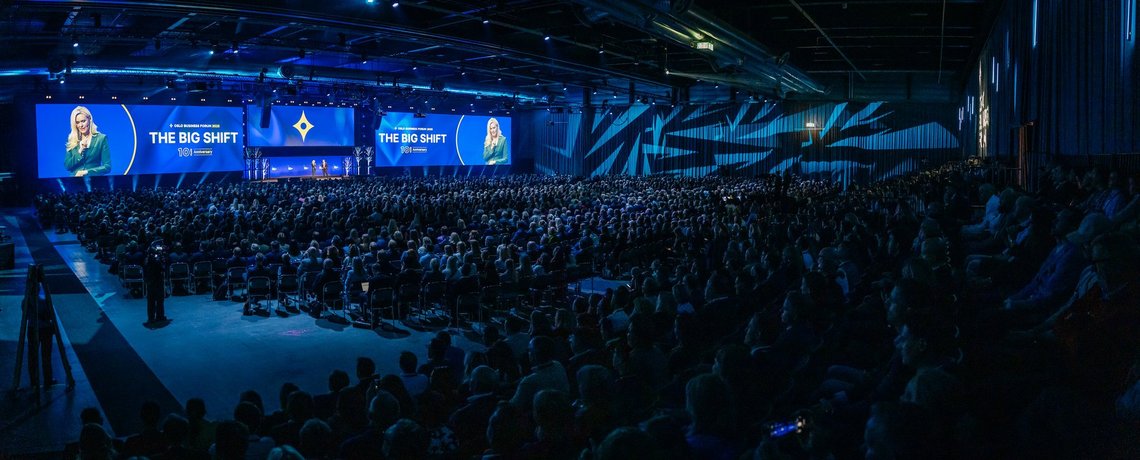
A ticket to Oslo Business Forum is not priced like a casual afternoon of inspiration.
The 2026 conference, titled The Human Edge, is scheduled for 16–17 September at Nova Spektrum. At the time of writing, the Conference Pass is listed at NOK 14,995 before VAT and fees, while the VIP Pass is listed at NOK 21,995 before VAT and fees. For that, attendees get speakers, networking, catering, event materials, recordings and access to an executive environment where the coffee break is not an interruption. It is part of the product.
That price is not the scandal. It is the business model.
Oslo Business Forum is not selling a public square. It is selling access, status, concentration and language. The organizers say they bring together 3,000 leaders across two days, with 60 percent of them C-level professionals. This is a paid gathering of people who decide what companies hire, buy, build, postpone and quietly stop discussing.
Norway should have serious business forums: places where owners, founders, exporters, investors and executives can step outside the domestic loop of committee reports, subsidy applications and cautious consensus.
But the real product is not only the keynote. It is the room.
Executives pay because other executives are there. Partners pay because the room is filtered. Speakers matter because they give the event weight, but the expensive part is the density: decision-makers, consultants, ambitious managers, founders, investors and corporate teams moving through the same controlled environment.
Business still runs on relationships as much as spreadsheets. Deals are rarely confined to procurement portals. Sometimes the conversation before lunch matters more than the slide deck after it. That is how business often works.
The challenge for any modern leadership forum is that business is messier than conference language. Real companies still live with payroll, taxes, margins, permits, currency swings, slow systems and customers who do not care about The Human Edge unless the delivery arrives on time. A company can applaud courage on Wednesday and return on Friday to the same cautious memo.
The event’s language belongs to the modern executive world: leadership, trust, creativity, resilience, culture, AI, disruption and the human strengths technology cannot replace. Many of those topics are real. The risk is that serious problems become too polished once they are translated into conference language.
Oslo Business Forum describes its mission as empowering leaders to change the world. That language comes naturally in this universe. It is ambitious, and it gives the event a larger frame than ordinary business networking. But the practical test remains closer to the ground: whether leaders leave with clearer decisions, better contacts and sharper execution.
Norway should care about that.
We are a small country with a large public sector, high trust in systems and a business class that often prefers sounding responsible to sounding hungry. The risk is not that Oslo becomes too ambitious. The risk is that ambition becomes a performance: polished, networked, responsible, innovative — and still not quite willing to compete hard enough once the room empties.
That is not an argument against Oslo Business Forum. Quite the opposite.
The event matters because Norway needs more serious business ambition, not less. It needs executives who can think internationally, sell abroad, understand technology without worshipping it, read geopolitical risk before it reaches the balance sheet, and compete without apologizing for wanting to win.
But the forum should not be treated like a temple. It is a market, a stage and a meeting place. It sells access, status and ideas. Fair enough. The question is whether it makes companies sharper.
Does it help leaders hire, invest, export and compete? Does it create discipline once the lights are off and the name badges are gone? Or does it mostly give already fluent executives better vocabulary?
This is where leadership language runs into the old business test.
Can you build something? Can you sell it? Can you make money on it? Can you keep people, fire when necessary, invest when afraid, and still know the numbers when the consultant has left?
Ole Gunnar Solskjær at Oslo Business Forum, where access, credibility and high-level networking are part of the real product on stage. Photo by Oslo Bsuiness Forum
Oslo Business Forum’s own story began in 2016, when Sir Alex Ferguson was its first keynote speaker at Oslo Concert Hall. Ferguson built with standards, discipline, talent, pressure and a habit of winning. Norwegian business could use some of that spirit.
A good business city should welcome a forum that brings serious people, international names and executive ambition into one room. Oslo should have that. But it should also keep a little skepticism at the door.
The value of an expensive pass is tested after the event, when leaders return to hiring, investment, exports, margins and execution. Not every leader needs to change the world.
Some should start by building a better company.


