

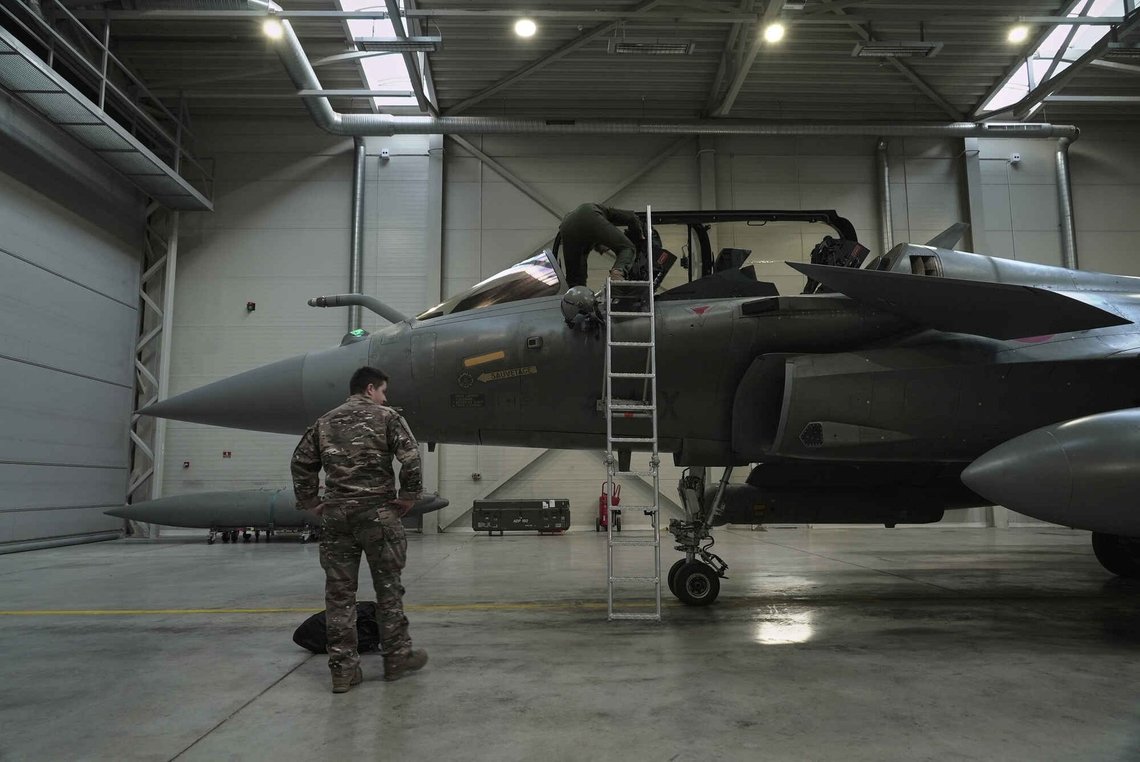
Macron announced last week that the collaborative project for a new European fighter aircraft must be abandoned. The companies involved have failed to cooperate, and $116 billion has been lost. It is a defeat for Europe that will reverberate widely. But where is the self-criticism?
France and Germany have withdrawn from the fighter aircraft component of the “Future Combat Air System” (FCAS), according to French and German authorities – a project worth approximately $116 billion that was launched in 2017 to develop a next-generation combat aircraft intended to replace France’s Rafale fighters and the Eurofighter fleets of Germany and Spain by 2040.
“The German authorities considered that it was not possible to exert further pressure on the companies concerned,” stated the Élysée Palace, the office of French President Emmanuel Macron, in a press release.
It is almost impossible to comprehend that the heavyweight countries of the EU – France, Germany and Spain – have had to throw in the towel. What does this say about the ability to cooperate within the EU?
Will these countries be able to confront Russia in two or three years’ time, as current forecasts suggest?
How does this square with their open distancing from Trump’s America?
As Fox News notes:
Europe’s most ambitious effort to develop its own sixth-generation fighter jet has collapsed, dealing a major blow to the continent’s pursuit of military independence at a time when NATO allies are pledging historic increases in defence spending.
Something is seriously wrong. Such a vast gap between rhetoric and reality should not be possible.
The technical requirements for a modern fighter aircraft are extensive. Is Europe technologically too far behind?
The programme was envisioned as Europe’s answer to future American and Chinese air dominance and was intended to combine a stealth fighter with advanced networking capabilities, artificial intelligence and accompanying drones. European leaders also viewed it as a cornerstone of the continent’s push for greater defence autonomy and a stronger domestic defence industry.
A project of this magnitude is a test of capability, and the answer is now clear: Europe has failed. Yet the cancellation has not made headline news in the countries that wish to be prepared for war with Russia.
What, in fact, does Europe have to offer?
Sixth-generation fighter aircraft are expected to combine stealth technology, artificial intelligence, advanced sensors, networked systems and swarms of accompanying drones. Military planners view them as the future of air combat and a key capability in potential conflicts involving major powers such as China or Russia.
European leaders regarded the programme as a test of whether Europe could develop cutting-edge military technology without relying on American defence contractors, making the programme’s collapse a setback for broader ambitions of defence self-sufficiency and strategic autonomy.
One is tempted to conclude that Europe has not passed the test, that Europe will not be able to field a challenger to China and the United States. The question now is rather which alliance partner Europe will choose. We have an elite that actively opposes Trump’s America, not least within the media.
Concerns about the programme’s viability had been growing for months. Earlier in 2026, EU Defence Commissioner Andrius Kubilius described the programme as a “failure” and warned that Europe lacked successful examples of major multinational defence projects.
The collapse now raises fresh questions about whether Europe can translate promises of rearmament and strategic autonomy into the complex multinational weapons programmes required to compete with the United States and China.
The new Europe is characterised by a lack of self-criticism. This failure should have dominated the headlines, because it reveals a weakness in today’s Europe that concerns capability and execution. This applies not only to defence but also to industry. Europe wants to lead the green transition.
It prefers moral superiority.
Propaganda against Trump and the United States replaces strategic thinking. It creates the feeling of understanding more and knowing better.
But Europe’s adversaries see what they see.
“It is hardly an ideal signal either to Washington or to Moscow,” Douglas Barrie, Senior Fellow for Military Aerospace at the International Institute for Strategic Studies, told Reuters.
Friedrich Merz questioned whether there would even be a need for a sixth-generation fighter aircraft by the time it was completed. Macron wanted an aircraft capable of delivering nuclear weapons from aircraft carriers.
The collapse underscored the depth of the disagreements between the governments and industrial partners involved in the programme.
Macron’s office stated that France would continue working for European defence cooperation despite the setback.
“The French authorities will continue to encourage our companies and armed forces to explore ways and means of implementing ambitious European projects that are aligned with our national security interests,” the office added.
The collapse of the fighter aircraft programme also raises questions about the future of other major European defence initiatives.
One may ask whether Prime Minister Støre’s desire to allow French Rafale aircraft to be stationed on Norwegian soil in a crisis situation, armed with nuclear weapons, is connected to the cancellation of the sixth-generation fighter project. Is this Macron’s substitute for the disappearance of the fighter aircraft and everything it was supposed to bring about?
It is typical French solo play.
Europe was supposed to develop a common warfare platform that would integrate different branches of the armed forces and allow them to communicate and identify hostile targets in real time.
France and Germany have struggled to maintain momentum in the “Main Ground Combat System” (MGCS), a next-generation tank programme, while several other joint defence projects have been delayed, restructured or cancelled in recent years.
Is it the national framework and sense of purpose that are failing?
The German economist Thilo Sarrazin once remarked during a visit to Copenhagen that the euro would never be a success because it presupposes that Italians can become Germans. But that will never happen.
Is that the reality now revealing itself?
The fighter aircraft project collapsed because the French and the Germans could not speak the same language.
However, disagreements emerged over industrial leadership, intellectual property rights, technology sharing and the future design of the aircraft itself. France sought to preserve key sovereign capabilities linked to its nuclear deterrent and aircraft carrier operations, while Germany pushed for a more equal industrial partnership.
It is therefore a defeat for something far greater than an aircraft project. It is the very nerve of European defence cooperation that is failing.
German Defence Minister Boris Pistorius hit the nail on the head:
“With the knowledge we have today, we would not have launched this project in the way it was originally planned,” he said, describing FCAS as “an ambitious European project” that had “crashed into reality”.
https://www.foxnews.com/politics/europes-116b-fighter-jet-failure-raises-fresh-doubts-about-ability-defend-itself-without-us


