

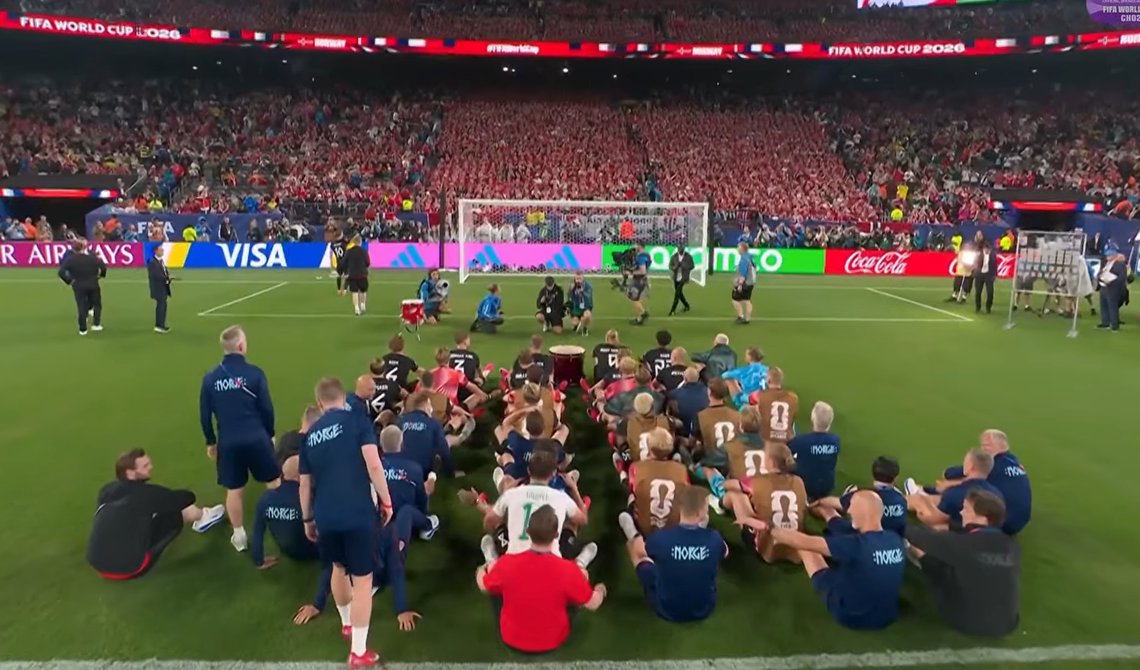
The Viking row did not stop. It followed Norway into East Rutherford, through a wet New Jersey night and into New York/New Jersey Stadium, where red shirts gathered behind the Senegal goal in the first half and made the place sound less neutral than FIFA probably imagined. The arms went forward, the bodies rocked, and the noise kept rolling across a stadium built for 82,500 people.
For a country that had waited a generation to see its men’s team back on this stage, the sound mattered. Norway were not returning quietly. They were being carried back in full voice.
Norway beat Senegal 3–2, took six points from two matches, and moved into the knockout rounds of the World Cup. Marcus Pedersen scored before halftime. Erling Haaland scored twice after the break. Ismaïla Sarr scored both Senegal goals and made the final minutes far more uncomfortable than Norway wanted.
Heavy rain earlier in the day had already made the evening feel less tidy than a normal group-stage match. Roads around MetLife Stadium had been waterlogged as flood-watch conditions threatened the evening schedule. The match still began on time. Wet roads, nervous skies, football anyway.
Princess Ingrid Alexandra and Prince Sverre Magnus were seen in the stands. Princess Ingrid Alexandra was visible cheering when Haaland scored and following the rest of the squad through a tense finish. She was not the story, but she made the night feel official in a way another VIP could not. Norway did not sneak back into the World Cup as a private project for football obsessives. It arrived with flags, royalty and supporters who had clearly decided silence was finished.
For a while, the football matched the noise. Pedersen’s opener came at exactly the right moment, before halftime, when the match was still awkward enough to tilt either way. Senegal had not collapsed. They had pace, strength and enough threat to make Norway work. But Pedersen punished the moment, and Norway walked into the break with the one thing tournament teams need most: a lead that changes the opponent’s mood.
Then Haaland did what Haaland does. He changed the emotional temperature of the game. One goal became two, and suddenly Norway looked less like a team trying to survive the group and more like a team capable of frightening bigger countries. There is a strange brutality to watching Haaland in this setting. He does not need the match to be beautiful. He does not need Norway to dominate every phase. He waits, moves, appears, and the whole scoreboard tilts.
When Martin Ødegaard gets time to face forward, Norway’s attack becomes cruelly simple. Opponents step out, and Haaland runs behind. Opponents sit off, and Norway start working the wide areas. Hesitate, and Norway are already past you. Iraq felt it first. Senegal felt it next.
But this was not a clean Norwegian performance, and Ståle Solbakken will know it. Senegal were not finished. Sarr’s first goal dragged them back into the match, and his second, deep in stoppage time, turned the final minutes into the kind of scramble serious teams try to avoid. Norway won, deservedly, but they left the door open too long.
That cannot become a habit.
Haaland can cover a lot of sins. He cannot be asked to cover all of them. Norway still have moments when control becomes reaction. The back line drops, the midfield loses a second ball, and suddenly the opponent believes again. Against Senegal, Norway survived it. Against France, the bill gets larger.
France are next, and that match is no longer just another group-stage fixture. It is a measurement. Norway are dangerous. That much is obvious. The question now is whether they are serious enough to clean up the one part of this performance that cannot travel: the back four needs to shape up.
Kylian Mbappé and company are another breed of attacker. France beat Iraq 3–0, with Mbappé scoring twice, and Norway’s analysts will have enough video to keep them busy. Senegal made Norway uncomfortable late. France will punish the same flatness earlier, faster and with less warning. If Norway’s back line drops too passively, if the midfield loses the second ball, if the spacing between fullback and centre-back opens the way it did at times against Senegal, France will not need an invitation.
Solbakken will have tired legs and happy players to manage, which is always a dangerous combination. The next day should bring regenerative work, of course. That is tournament reality after a wet, emotional night and another match coming fast. But the sharper work will be in the walkthroughs and the video room. Norway’s analysts will be staring at France against Iraq, looking at the timing of Mbappé’s runs, the speed of the wide players, and the moments where Iraq were pulled flat before the pass came.
That is the next Norwegian problem. The Viking row can carry the emotion. Haaland can carry the scoreboard. Ødegaard can carry the rhythm. The back four has to carry its shape.
Norway are no longer allowed to be treated like a nice story. They are through. They have Haaland scoring. They have Ødegaard conducting. They have six points from Iraq and Senegal. They have supporters turning a wet New Jersey night into something that sounded like home. The noise matters. It just cannot defend set pieces or kill stoppage time.
Solbakken looked like a man who understood both sides of the night. After the match, he could be seen rushing toward the stands, looking for his wife. He found her, kissed her, and the Norwegian fans cheered him on. It was messy, personal and perfect. Not a federation clip. Not a sponsor-board moment. Just a coach who had carried the weight of a football country and, for a few seconds, looked less like a manager and more like a husband trying to find the one person he needed first.
Then the players gave the night its lasting image. It ended with Ødegaard on the drums, the national team joining the Viking row inside the box, and the Norwegian supporters in the stands rowing back at them. Players and fans, same motion, same noise, same release.
A captain on the drum. A squad rowing on the pitch. Thousands of Norwegians answering from the stands as if a generation of waiting had finally found its rhythm.
Solbakken can worry about France tomorrow. He should. There are defensive problems to fix, spaces to close, and late-game nerves that cannot follow Norway into the knockout rounds. Not yet. For one night in New Jersey, Norway came back in full voice, and everyone could hear it.


