

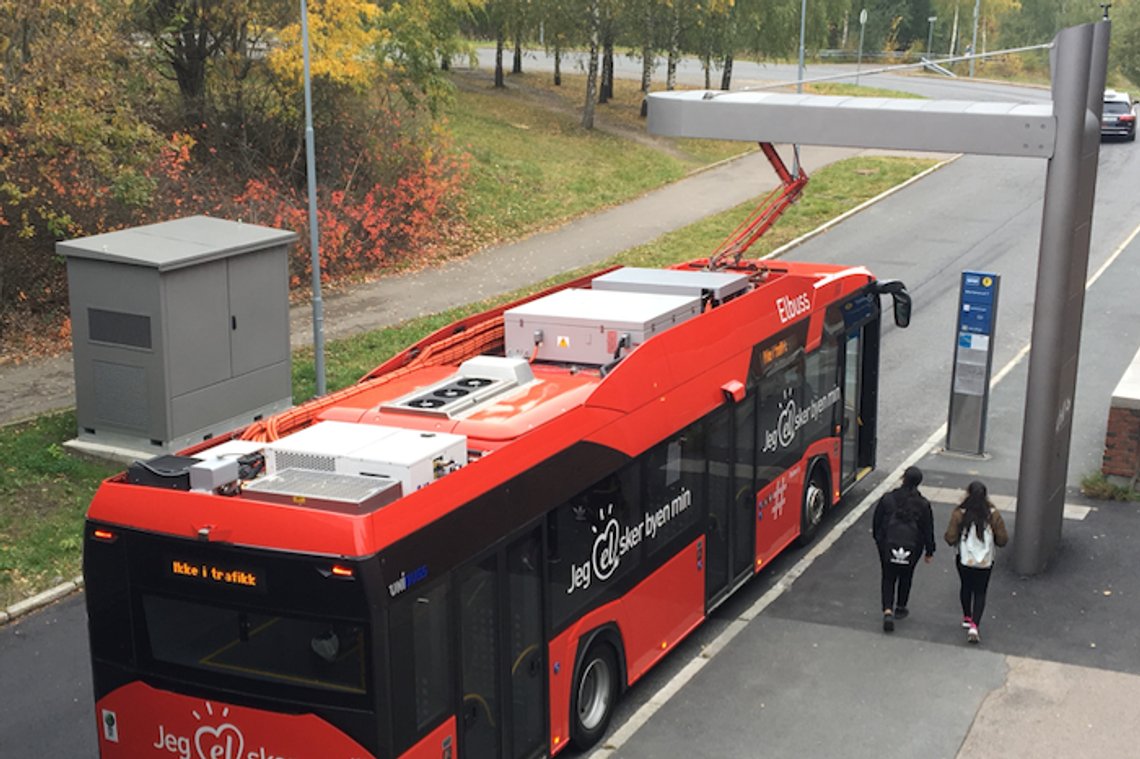
The electric buses that were supposed to replace polluting diesel buses around Oslo have become so heavy because of their batteries that the county roads cannot withstand them.
Akershus was supposed to be finished with diesel buses by 2028. Now the deadline may slip to 2031.
The reason this time is not the cold, but weight. The batteries make the electric buses far heavier than the diesel buses they are intended to replace, and large parts of the county road network are simply not built to carry them.
– We see that this is a bigger problem than we had hoped, says County Councillor for Transport Håkon Snortheim (H) to NRK.
In Hadeland, the public transport company Ruter has calculated that more than 40 per cent of the roads cannot withstand the weight. There, new electric buses were supposed to replace the diesel buses in 2028. The company is now asking to be allowed to wait until 2031. In populous areas such as Romerike and Asker, the centre-right county executive council is also open to postponement.
Snortheim rejects the idea that the county can legislate its way out of the problem by raising the roads’ permitted weight limit.
– The buses weigh the same regardless. So even if one obtains an exemption, the result will be that the road is driven to destruction, he says.
The same wall in east and west
This is not an Akershus phenomenon. In Vestland, Skyss is struggling with exactly the same issue.
– There are some roads that cannot withstand the weight of the electric buses that are available today, says Skyss press contact Øyvind Strømmen.
In the new bus contract for Indre Sogn, the solution is that 40 per cent of the buses will still run on diesel. Not because anyone wants it, but because the road network cannot cope.
The Norwegian Public Roads Administration (Statens vegvesen) confirms that the problem is well known.
– The Norwegian Public Roads Administration is aware that some electric buses are heavier than parts of the road network are currently designed for, says Department Director Anette Hauge.
The taxpayer pays twice
The financial aspect is the interesting one. In Akershus’ revised budget, an additional NOK 150 million has been allocated for road maintenance to prepare the roads for the heavy buses. At the same time, the county is saving NOK 180 million by postponing the phase-in – money that was supposed to have been spent on converting bus depots for electric operation.
In other words: the taxpayer pays to prepare roads that cannot withstand the buses, and for delays in a project that is already delayed. The money that is “saved” is money that had been planned for use on the same initiative.
The weight problem comes on top of a history that most Oslo commuters know first-hand.
In the winter of 2023–2024, parts of the capital’s bus service collapsed when the cold set in. The range of the new electric buses was almost halved: down to 140 kilometres in the December cold, compared with around 250 in good weather. A diesel bus, by comparison, travels around 420 kilometres on one tank. On the worst day, 8 January 2024, almost 1,000 departures were cancelled. On 24 January, bus traffic in Oslo and Bærum at times came almost to a complete standstill.
It happened again in January 2026. On that occasion, Ruter blamed a “shortage of rolling stock” – a term which in practice means electric buses that do not start, do not accept charging, or have lost too much range to operate.
And the warning came in advance. Teknisk Ukeblad has documented that Ruter was warned by its own hired consultants against electrifying too quickly. The company nevertheless doubled the number of electric buses – and has since refused to answer questions about the matter.
More expensive – also on paper
Electric buses are not cheap either. In 2023, a new diesel bus cost around NOK 2.6 million. A comparable electric bus cost around NOK 4.2 million – approximately twice as much. To this must be added billion-kroner investments in charging infrastructure.
Several counties have done the calculations and declined. In 2019, Rogaland ordered new diesel buses for the Ryfast tunnels because electric buses would have cost NOK 8.6 million more per year, plus NOK 21.6 million in one-off investments.
The Institute of Transport Economics (Transportøkonomisk institutt) states that electrification does not solve the cost problem. The cost per route kilometre is expected to increase by around ten per cent from 2025 to 2035, even after adjustment for inflation.
– Even if the buses become electric, the cost challenge does not disappear, the institute states.
Forced from above
The entire initiative rests on a state mandate. Since 2022, the state has required the counties to purchase zero-emission buses. The climate targets were adopted in municipal councils and county councils. But weight, cold, and price cannot be legislated away.
For the passenger, this means that, for the time being, the green bus is mostly green on the outside. Inside, diesel is still running the service – and that will remain the case for several years, whether passengers think that is acceptable or not.
The Socialist Left Party (SV) believes that the county executive council is using the problems as an excuse.
– The climate problems mean that we must change course, and then it is not enough to ask for postponement after postponement, says Tuva Todnem Lund (SV).


