



“Give your Christmas decorations extra meaning with Proud Pine, beautiful handmade Christmas decorations crafted by Afghan refugees living in Pakistan,” proclaims the Nobel Peace Centre.
They also offer Christmas decorations made by people from Sudan and Mali, amongst others. Each decoration is designed to tell a story of cultural heritage, creativity and resilience. And they’re reasonably priced, as the aim is to keep traditions alive. From other parts of the world.
Proud pine from Afghanistan
On its website selling Christmas decorations, called A Peaceful Christmas, the Nobel Peace Centre writes:
The Christmas decoration Proud Pine (Proud Pine) features a design inspired by the pine trees that characterise Afghanistan’s mountainous landscape, and is intended to be a symbol of strength, endurance and hope. Each decoration tells a story of craft traditions that have been passed down through generations, whilst also providing income opportunities for refugee craftspeople.
The Afghan pine is just one of many designs.
Christmas decorations inspired by Sudanese wedding attire
There you will also find, amongst other things, Sweet Swirl, handmade Christmas decorations crafted by Sudanese refugees living in Egypt.
The decorative spiral is hand-crocheted in vibrant red and white colours – the same colours traditionally used in Sudanese wedding attire. The result is a decoration that celebrates culture, community and joy across borders. With its spiral pattern and decorative tassel, Sweet Swirl is an expression of craft traditions that have been passed down through the generations.
Each decoration is meticulously crocheted with a single crochet hook in a radiant pattern that highlights the craftspeople’s precision and skill. Each decoration tells a story of cultural heritage, creativity and resilience, whilst also providing income opportunities for refugee craftspeople.
This is according to the Nobel Peace Centre, which is the museum for the Nobel Peace Prize and is largely funded by the Norwegian Ministry of Culture.
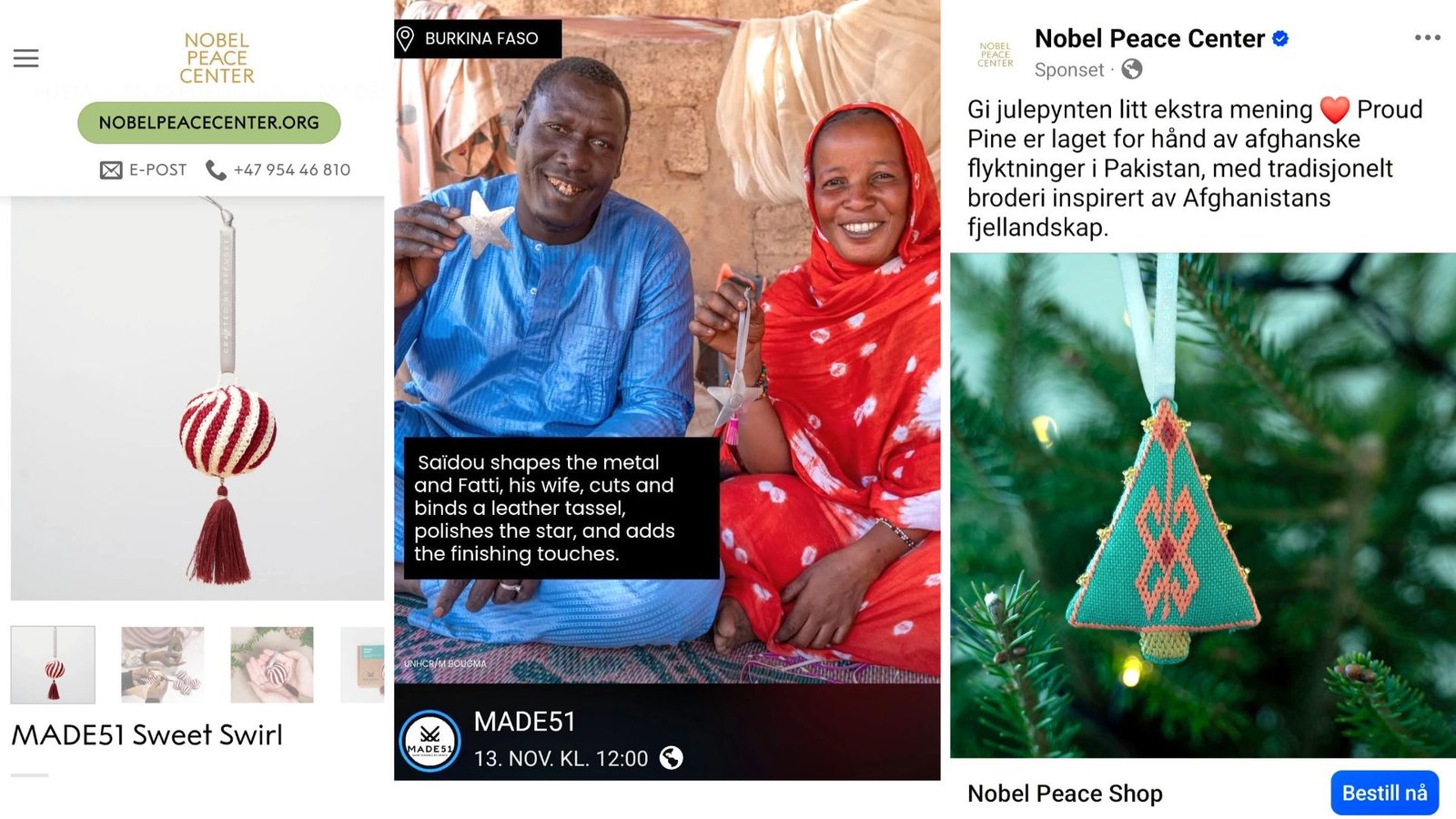
Christmas decorations for Norwegian Christmas trees sold by the Nobel Peace Centre. In the centre is ‘Shooting Star’, a Christmas decoration made by Malian refugees. The stylised star reflects the traditional metalworking techniques of the Tuareg people. As the Tuareg are nomads in the Sahara, the stars in the night sky have been important navigational tools. Photo: Social media.
Christmas decorations from the Sahara Desert
You can also choose Shooting Star, handmade Christmas decorations crafted by Malian refugees living in Burkina Faso.
The stylised star is an expression of the traditional metalworking techniques of the Tuareg people, renowned for their exceptional craftsmanship passed down through generations. For the Tuareg, who have traditionally lived as nomads in the Sahara, the stars in the night sky have been vital navigational tools. This decoration therefore carries with it a story of orientation, journeys and the way forward, whilst also symbolising hope and light in the darkness.»
Once again, the focus is on the fact that these Muslims from the desert, the Tuaregs, have a rich cultural heritage that deserves to be preserved. To end up on Norwegian Christmas trees.
Star from Sudan’s night sky
Back to the Sudanese, who are also contributing Christmas decorations Star of Unity, handmade by Sudanese refugees living in Egypt.
The star-shaped decoration is created with intricate beadwork and is inspired by the vast night sky above Sudan’s desert landscape, where the stars shine as symbols of hope, community and unity. Beadwork is an important part of the cultural heritage of many ethnic groups in Sudan. For generations, beads have been used both as decoration and as an expression of identity, traditions and a sense of belonging. Each decoration bears witness to a living craft that is passed down through skilled hands and strong cultural roots.
It is not only Muslims who have created their own version of Christmas decorations for Norwegians. From Hindu Nepal come, amongst other things, small fabric figures resembling reindeer and Christmas trees. Once again, praise is heaped on the skill of the local craftspeople, and the importance of preserving local jobs and ancient craft traditions is emphasised. The same applies to hearts and stars made by “skilled women in Thailand and India, using traditional techniques that preserve local craftsmanship”.
And if you want to go all out for Nobel’s Christmas, you can get a whole collection of decorations for a few thousand kroner, created by refugees from East Africa, Syria, Afghanistan, Mali and Myanmar who now live in various parts of the world. “Through each decoration, traditional techniques and cultural expressions that have been preserved through generations are passed on.”
Collaboration with the UN High Commissioner for Refugees
The Nobel Peace Centre collaborates, amongst others, with MADE51, an initiative by the UN High Commissioner for Refugees (UNHCR) that connects refugee artisans with international markets. By purchasing these Christmas decorations, you are supporting both traditional craftsmanship and the prospect of a safer and more sustainable future for people who have been forced to flee their homes.
MADE51 collaborates with sponsors including Lagardère, Shoppe Object, Mastercard, the World Fair Trade Organisation, the Frankfurt Trade Fair and Herbert Smitth Freehill.
The Afghan fir tree appeared in this journalist’s Facebook feed, and I asked whether it was Christmas decorations made by Christian Afghan refugees living in Pakistan?
No reply was received to this. The question appeared to have been deleted, but the Nobel Peace Centre is welcome to send us a reply. Not that we believe they and their partners have managed to find any Christian refugees from Afghanistan who make Christmas decorations.
Caring for others is all very well, especially at Christmas time, but they could at least have said something about how they also believe Norwegian and Christian traditions should be preserved and celebrated. Especially at Christmas? More than just a couple of figurines from Hadeland Glassverk, described as timeless, and a ballerina from Porsgrund.


