

“You will now listen to my voice … On the count of ten you will be in Europe.” Thus sounds Max von Sydow’s hypnotic voice in the opening of Lars von Trier’s film Europa. Three decades later it is tempting to say that we never woke up. We are still in Europe.
Von Trier’s masterful Europe trilogy – The Element of Crime (1984), Epidemic (1987) and Europa (1991) – was at the time perceived as a sombre but detached artistic play with a continent in ruins after the war. Today the trilogy can rather be read as a prophetic image of its time.
In this double chronicle I will watch the films again and write about them on the occasion of von Trier recently turning 70 and having curated a current exhibition that sounds highly promising. It includes among other things Hammershøi’s masterpiece “Five Portraits”. But one recognises the style from the films. The hypnotically captivating, eerily beautiful, grey-brown darkness into which one is literally sucked.
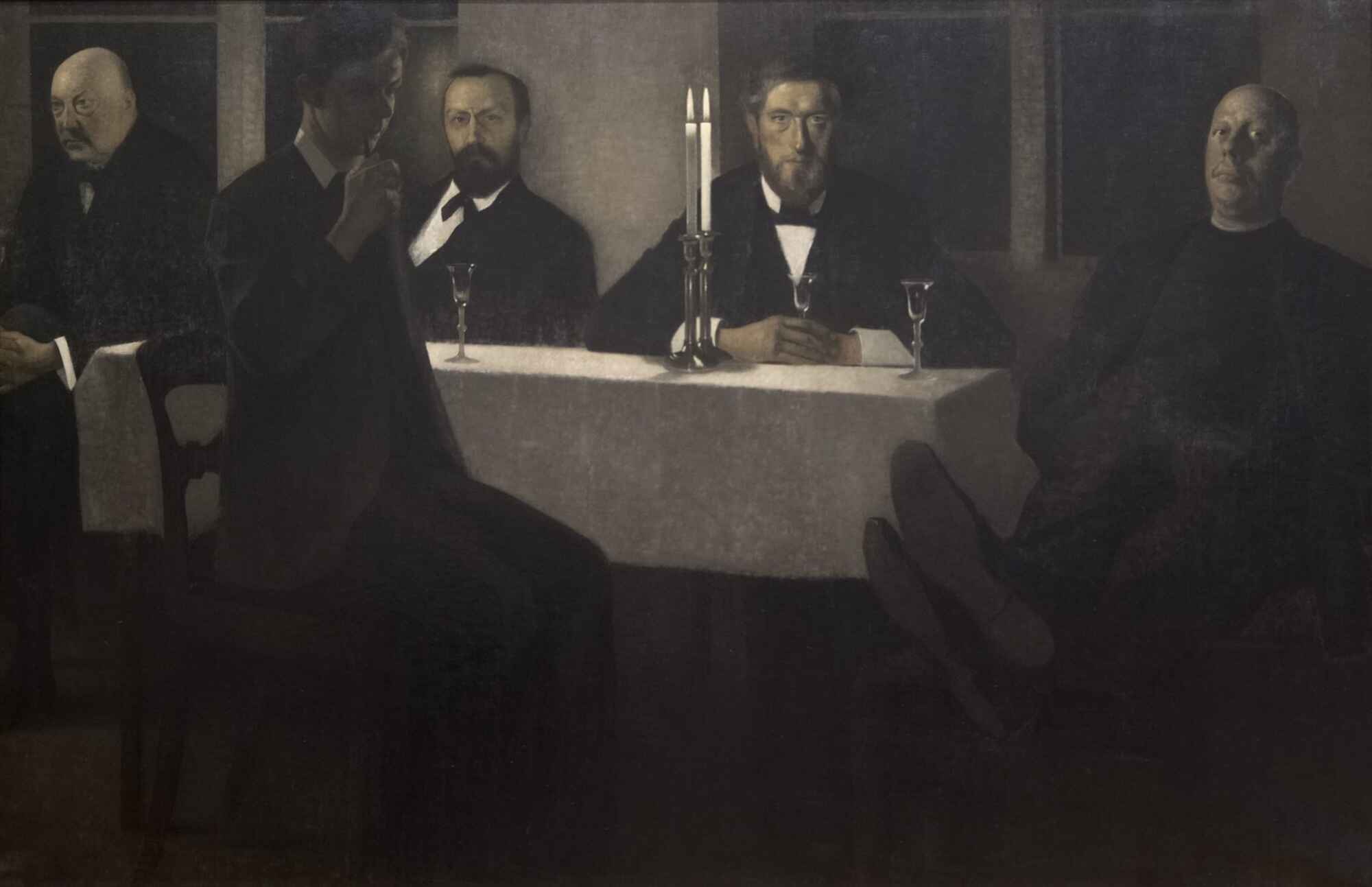 Vilhelm Hammershøi, “Five Portraits” (1901–02)
In this first chronicle I will focus on the themes of the trilogy. The second part will deal with von Trier’s artistic form.
The idealist who becomes the evil he combats
The thematic pattern that binds the trilogy together centres on the well-meaning idealist who travels into a traumatised Europe to do good, but ends up himself contributing to the misfortune.
In The Element of Crime the exiled detective Fisher allows himself to be hypnotised back to his last case: the hunt for a serial killer whose victims are young girls. In order to understand the killer, Fisher immerses himself so deeply in the killer’s logic that the boundary between hunter and prey finally disappears.
In Europa the German-American Leopold Kessler travels to occupied Germany in the post-war period with a naïve dream of “showing a little kindness” to his fatherland. Instead he becomes entangled in a Nazi network and ends up himself as an instrument of the evil he thought he could rise above.
The same pattern repeats itself in the manuscript that von Trier and Niels Vørsel have written for Epidemic. The main character is the doctor Mesmer, who defies the health authorities and travels out to help a population afflicted by plague. His mission ends with the opposite. It turns out that he himself has carried the infection with him and spread it.
There also lies the trilogy’s basic figure: He who sets out to save others without first having acknowledged his own vulnerability and sinfulness ends up becoming the source of the catastrophe himself.
The film’s ending makes the point even more disturbing. It is one of the most horrifying scenes I have seen in Danish film.
In order to prove that their manuscript is only fiction, Lars and Niels let the hypnotist Ali Hamann lead a young woman into the film’s universe. But the hypnosis goes wrong, and the woman is overcome by the visions and screams incessantly in terror, until it dawns on those present that she has contracted the deadly disease that the fiction is about. What was supposed to prove the distance between story and reality instead proves the opposite.
Idealism without a sense of reality is dangerous, for he who does not want to look evil in the eye will sooner or later become its accomplice himself. This is a classic, tragic insight that much of our time’s political thinking has forgotten. It wants to save the world, but forgot to protect ourselves.
That is also why it is worth spending time on von Trier’s trilogy.
Warning in the midst of optimism
Great artists are a kind of seismographs who can sense tremors deep down in the subsurface that ordinary people are unable to perceive.
It is worth remembering when Europa was actually created. The film had its premiere in Cannes in May 1991, half a year after German reunification and in the middle of the euphoria that followed the fall of the Wall. These were the years when an entire generation believed that history’s great conflicts had been resolved, and that Europe could now look forward to a long, linear progress towards paradise on earth, the end of history.
In this shift of eras von Trier made a film about a Germany that was still permeated by the shadow of Nazism, about a great power, the USA, that did not understand the country it wanted to civilise, and about a main character who allows himself to be hypnotised into a sleepwalker-like acceptance of what is happening around him.
That is, a film about a continent celebrating its own liberation at the same time as it represses how much the demons of the past are still stirring in the basement under the European house.
A Europe that cannot wake up
The trilogy’s point is a rejection of the very progress narrative on which the EU project has since built further. The notion that Europe is moving forward, away from its dark past, towards ever more peace, prosperity and enlightenment. The EU famously received the Nobel Peace Prize in 2013.
In von Trier there is no such direction. The past does not close, but lays itself down as new layers on top of the old, until the present’s horrors become impossible to distinguish from the original ones. History is not a series of completed chapters one can leave behind with an apology and a memorial ceremony, with cancel culture and grand attempts to censor the European populations.
History is a living heritage that continues to shape the present, whether one wishes it or not. The return of the strong gods that the champions of the open society fear.
The account of repression
One of the most telling images in the trilogy concerns the Allies’ denazification process, where Germans after the war had to fill out questionnaires to determine the degree of their guilt. Von Trier treats this process as a symbol of a deeper self-deception. It is the belief that moral guilt can be measured, registered and concluded by means of bureaucratic procedures.
But evil cannot be administrated away with forms. Evil follows human freedom like a shadow, as the German philosopher Rüdiger Safranski writes in the book “Evil or the Drama of Freedom”.
Our time’s institutions, with their public apologies, diversity forms and symbolic declarations, suffer from the same fallacy.
Epidemic is in the same way a disturbing image of how an elite – cultural, political, academic – observes a societal crisis from a safe distance, while in reality already being part of the problem it claims to analyse.
Not with a view to civil war, as Enzensberger wrote around the same time, but in the middle of its first stages.
The trilogy’s unforgettable images
While large parts of the political and cultural elite in the 1990s and 2000s chose to believe in history’s happy direction, von Trier chose to film its nightmare. There are scenes and images in the trilogy that never leave us once we have been confronted with them.
A horse slowly sinks into a flooded landscape full of abandoned junk, while the sick, sulphur-yellow light settles like a disease over the entire image surface. Inspector Fisher wades through a flooded office, where case files float between overturned filing cabinets like remnants of a civilisation no one can save any longer. A glimpse of red blood breaks through the black-and-white image, as if it were the only truth a numb world can still perceive. A corpse drifts quietly down the river, while the
narrator with his hypnotic voice makes the viewer sink with it. Down into the dark waters of oblivion.
In the next chronicle we shall look more closely at these – beautiful and horrifying – images.


