

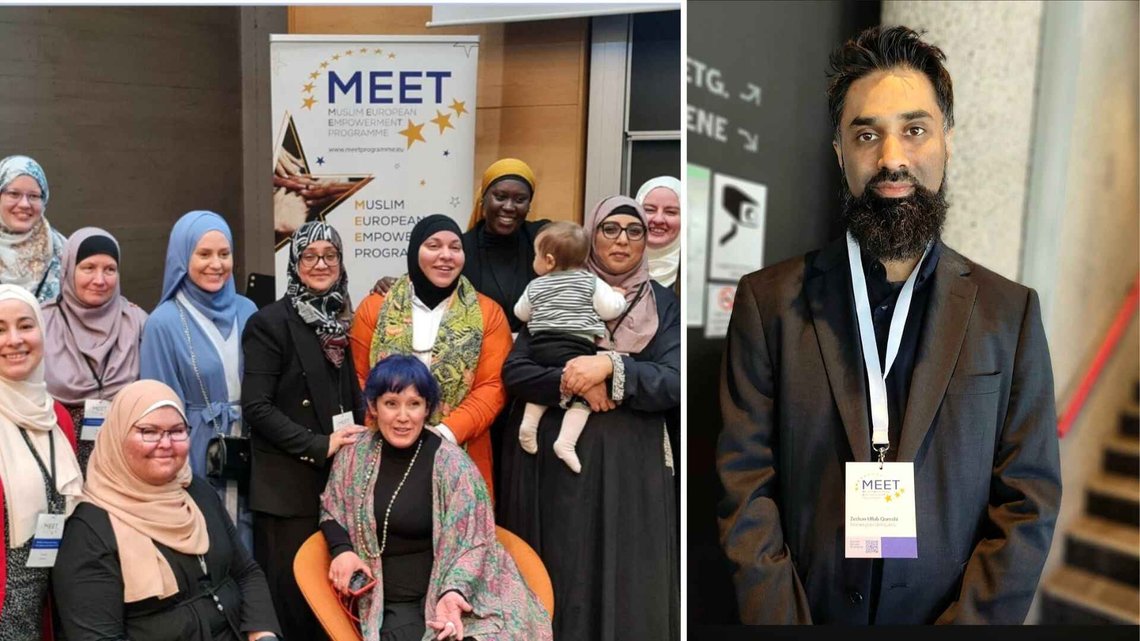
Muslim leaders from large parts of Europe are gathered in Kristiansand from 1 to 5 May. Muslim European Empowerment Programme (MEET) was established in the city in 2022, and is a programme intended to strengthen Muslims in Europe, through annual gatherings in Kristiansand during Democracy Week (Demokratiuka). The Islam Net imam at the former Faculty of Theology (Menighetsfakultetet) is one of the actors. Dagen editor Vebjørn Selbekk will also debate among all the Muslims.
How Kristiansand has become the venue for the large gathering of imams and other Islamic leaders from various European countries does not emerge from either the MEET website or that of Democracy Week in Kristiansand, where the Muslim MEET forms part of the programme. But in 2026 it was the fifth time that this major conference took place.
Research on Islam under attack
I presented today at MEET – The Kristiansand Conversations, on the topic: “Research on Islam under attack – from France to Norway”. European identity is apparently threatened by research on the Qur’an, wrote Zeshan Ullah Qureshi on Facebook on Sunday and also posted photographs.
Qureshi also participated in the Islamic gathering on Saturday, and summarised it as follows:
Had the honour of participating in a panel discussion today on the topic: “The situation in our democratic society – What is it like to be a Muslim in a democratic Europe?” It became a truly fruitful discussion with experts on political engagement from Italy, Greece, Belgium and Ireland. I spoke about the situation in Norway. Organised by Muslim European Leadership Retreat 2026 during Democracy Week, by MEET – Muslim European Empowerment Programme.
Det tidligere Menighetsfakultetet har ansatt imam fra Islam Net
Strengthening Muslims in Europe
The participants from the aforementioned countries must therefore have been Muslims and Muslim leaders, since that is the entire point of the conference. “Empowerment” means making people more powerful and stronger, and leadership training for imams and other Muslims ranks highly on the agenda, which is described, among other things, as follows on the MEET 2026 website:
“Promote democratic values, in light of the Islamic faith. Promote understanding of Muslim communities, their faith, values and culture, and address negative stereotypes.”
And further:
“Through intergenerational dialogue, leadership training, engagement with decision-makers and interreligious discussions, participants will develop practical tools to help build more inclusive, resilient and democratic societies. The weekend will provide a space for reflection, collaboration and action, and equip participants to assume meaningful leadership roles in their local communities and in broader public life.
With a focus on the importance of civic participation and social cohesion, MEET 2026 will highlight how Muslim communities can contribute to strengthening democratic culture throughout Europe. By bringing together diverse voices and experiences, the programme aims to promote understanding, encourage collaboration and inspire long-term engagement for the common good.”
In other words, more Islam for more democracy and for the good of Europe.
Cooperation with municipality and university
The most important partners for the Islamic conference are Kristiansand Municipality, the University of Agder, Islamic Council Norway (Islamsk Råd Norge), Muslim Dialogue Network (Muslimsk Dialognettverk), and Arkivet, which was originally a centre for war history, but which is now investing in becoming a centre for peace and human rights, in addition to expertise on extremism.
The Islamic conference MEET in Kristiansand has a web address pointing to the EU. It does not state how that connection functions, or what and how much the EU sponsors. But the EU flag is included in information about the event. Among other places in information disseminated by one of the participants, Shaukat Warraich, who calls himself a mosque doctor and who associates with imams and mosques around Europe, including Norway. Just before Christmas he attended a mosque conference in Saudi Arabia, at an event organised in cooperation with the UN, so this is probably a global milieu.
On Facebook on 3 May, Warraich wrote, translated from English:
“A great honour today during @meet2026 to launch the World Premiere of the new short documentary ‘August 10, 2019 – The days that followed’, the film addresses the key persons in the mosque that was attacked in Bærum, Norway. Very emotional.”
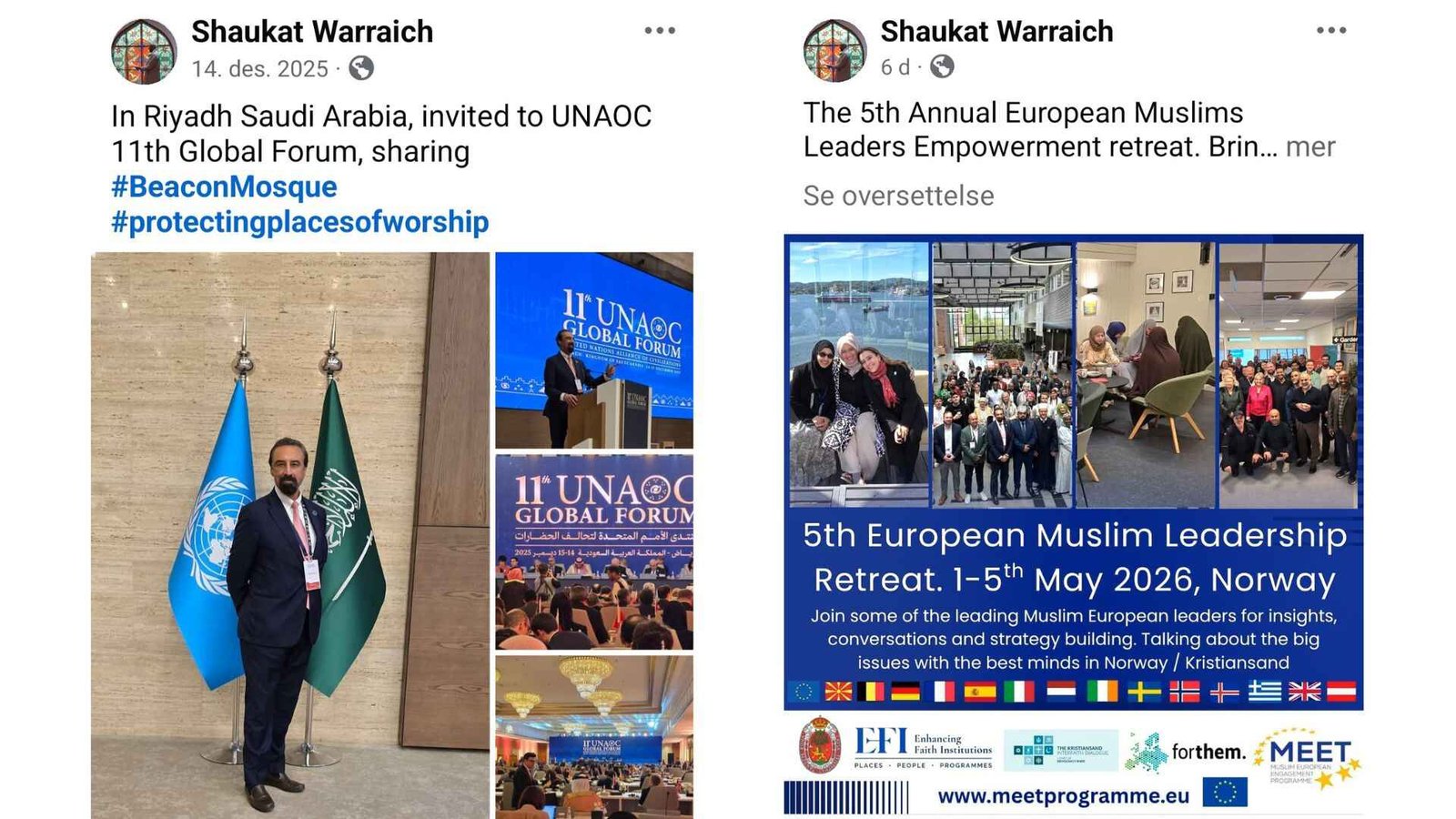
The dates for the major Islamic seminar do not entirely overlap with Democracy Week, since it lasts from 2–8 May in 2026, and allegedly gathers “people from all over Europe in Kristiansand”. With the Kristiansand European Conference as the main event during the week. That event is organised in cooperation with the EU, i.e. the Council of Europe, writes the organiser.
“Kristiansand European Conference is being organised for the seventh consecutive year! On Tuesday 5 May we once again gather voices from across Europe for one of the most important meeting places for democracy and human rights. In cooperation with the Council of Europe, we invite you into important conversations and lectures about the future of democracy, human rights and the security situation in Europe. Together we take the pulse of Europe right now and raise our gaze towards what lies ahead!”
Otherwise, there will be much dialogue during Democracy Week. On Monday 4 May with, among others, the aforementioned Zeshan U. Qureshi, Vebjørn Selbekk from Dagen, Elise Kruse from Vårt Land, who was highly sceptical of Dagen’s coverage that MF has employed Qureshi, and Mohammed Isak Abdullahi from Islamic Council Norway.
Later in the day there will be more dialogue, with, among others, Arshad Jamil from Muslim Dialogue Network, and Abit Hoxha, Kosovo-Albanian associate professor at the University of Agder.
The following day there will, among other things, be a focus on Palestine. Abit Hoxha is participating again, together with, among others, Anna Blekastad Watson, associate professor, and Pål Nygaard, professor from BI Norwegian Business School. The conversation is led by Rasha Abdallah at UiA for Palestine.
To mention a few things.
Democracy Week has only recently been registered in the Brønnøysund Register Centre (Brønnøysundregistrene), so there is no annual report and no accounts to be found there. But this year’s Democracy Week was in any case sponsored with NOK 500,000 from the Sparebank Foundation, and NOK 75,000 from Fritt Ord.


