

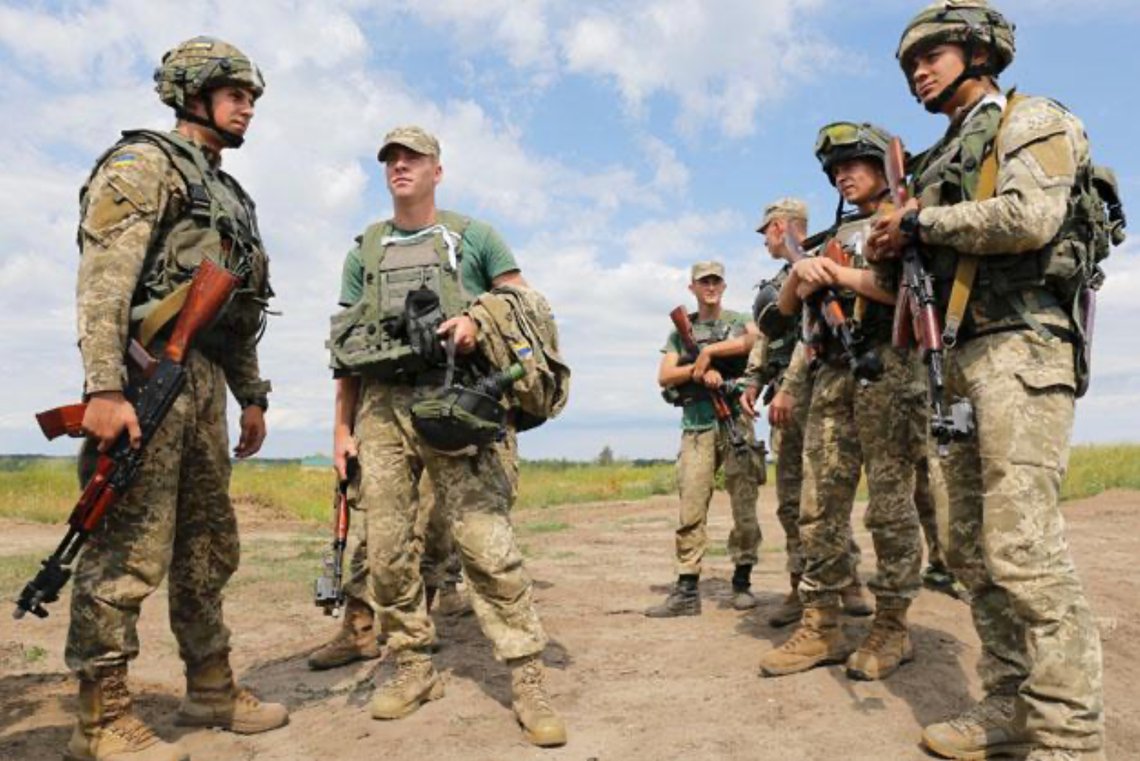


It is a fact that the Ukrainian National Guard is detaining soldiers who have deserted, and that conscripted soldiers have been subjected to criminal acts of violence. In Ukraine, this is confirmed both by official admissions and by judgements in criminal cases. Officially, it is stated that abuses are taking place and that many of those responsible have been punished.
However, allegations have also recently emerged that the Ukrainian military is committing systematic abuses such as torture. Do these allegations hold water? It is difficult to get to the bottom of this. As is well known, truth is the first casualty of war.
On Monday, an unusual incident took place on the outskirts of Kyiv, when a crowd clashed with the police and the military. The crowd wanted to free conscripts who were being held captive – and almost certainly subjected to brutal treatment – at a facility belonging to the National Guard. Some of those present say that torture is taking place, whilst others claim to be medical staff and are demanding to be let in. A video from the scene that has gone viral shows a woman tending to a bedraggled, very young man.
A journalist from the Kyiv Independent is at the scene, and he senses that the protest appears to have been staged. But is he reporting in good faith?
The National Guard acknowledges that deserting soldiers are being held in custody at the facility, and that force is being used to keep them there against their will, but denies that this constitutes systematic abuse such as torture – something it would presumably have done in any case.
Pavel Lokshin, who is a correspondent in the region for Die Welt, wrote on Friday that most questions relating to the incident remain unanswered. But perhaps the most pressing issue is not the distinction between the military’s lawful and unlawful use of force against its own citizens, but rather that coercion occurs on such a large scale as it does in the recruitment of soldiers for the war against Russia.
The mobilisation of soldiers to the front is increasingly leading to violence in Ukraine. An army in need of recruits is faced with men who wish to avert defeat – but who are increasingly unwilling to fight for it.
Ukraine needs 30,000 new recruits every single month, but dissatisfaction with the military’s methods is growing.
There has long been talk in the country of ‘bussification’, that is, the abduction of men from the street, from their workplace or, in some cases, from private premises. The term originates from the minibuses into which recruitment officers drag the men. Such incidents can be seen in a number of videos on social media.
Thousands of cases of abuse have been reported, and the number is rising:
There are currently no official statistics on human rights violations in connection with the mobilisation. However, one figure is available: last year, Rada’s Human Rights Ombudsman, Dmytro Lubinetz, recorded 6,127 complaints against staff at the ‘territorial recruitment centres’, known as TZK.
In 2024 there were 3,312 complaints, in 2023 just 515, and in the first year of the war only 18.
Yet the judiciary goes to great lengths to legitimise the use of violence:
Conscription takes precedence over any abuses during mobilisation, Ukraine’s Supreme Court ruled last year.
But some of these abuses prove fatal. Some claim that more than a hundred people have died as a result of the mobilisation.
Some of these deaths are being investigated. Verdicts have been handed down against staff at the mobilisation centres, but some of them are nevertheless allowed to remain in service. As early as last year, the Council of Europe’s Commissioner for Human Rights, Michael O’Flaherty, criticised the situation and called for independent monitoring of the mobilisation centres, as well as for the Ukrainians’ right to conscientious objection to be respected. This right has been suspended in Ukraine since the major Russian invasion.
The military is showing ever less regard for human considerations:
In Kryvyi Rih, for example, a 34-year-old single father to a five-year-old girl was called up in June. Being the sole carer is, in fact, grounds for exemption.
People do not like this:
In a poll conducted by the Ratings Group polling institute in August, 79 per cent of those surveyed were opposed to coercive measures in connection with conscription. 68 per cent of those surveyed have no confidence in the recruitment centres.
The authorities defend it nonetheless:
Politicians claim that up to 95 per cent of all call-ups take place without incident. But the damage to the army’s reputation is real.
Some go into hiding to avoid being sent to the front:
This is also having an impact on the labour market. Although the official unemployment rate stands at just under ten per cent, employers are struggling to find staff. This seems contradictory at first glance. Hundreds of thousands, perhaps millions of men, are simply withdrawing from the labour market and public life – for fear of being arrested and sent to the military.
Others are fleeing the country, and Ukrainian corruption makes it easier for them:
Others try to avoid conscription by paying bribes of several thousand euros or by being smuggled out of the country. As the newspaper ‘Ekonomichna Pravda’ has reported, this has now developed into an entire industry run by corrupt officials.
The next step could be to expand the recruitment base:
In Ukraine, consideration is being given to conscripting younger age groups as well, who have so far been exempt from compulsory mobilisation. There is also speculation about conscripting women. For the time being, they are permitted to serve in the army on a voluntary basis.
In this way, Ukraine risks demographic depletion. What will actually remain of the country if the war continues for much longer?


