



Republican strategists assured voters this week that the opinion polls ahead of the upcoming mid-term elections only look bad for the Republican Party if you actually read them.
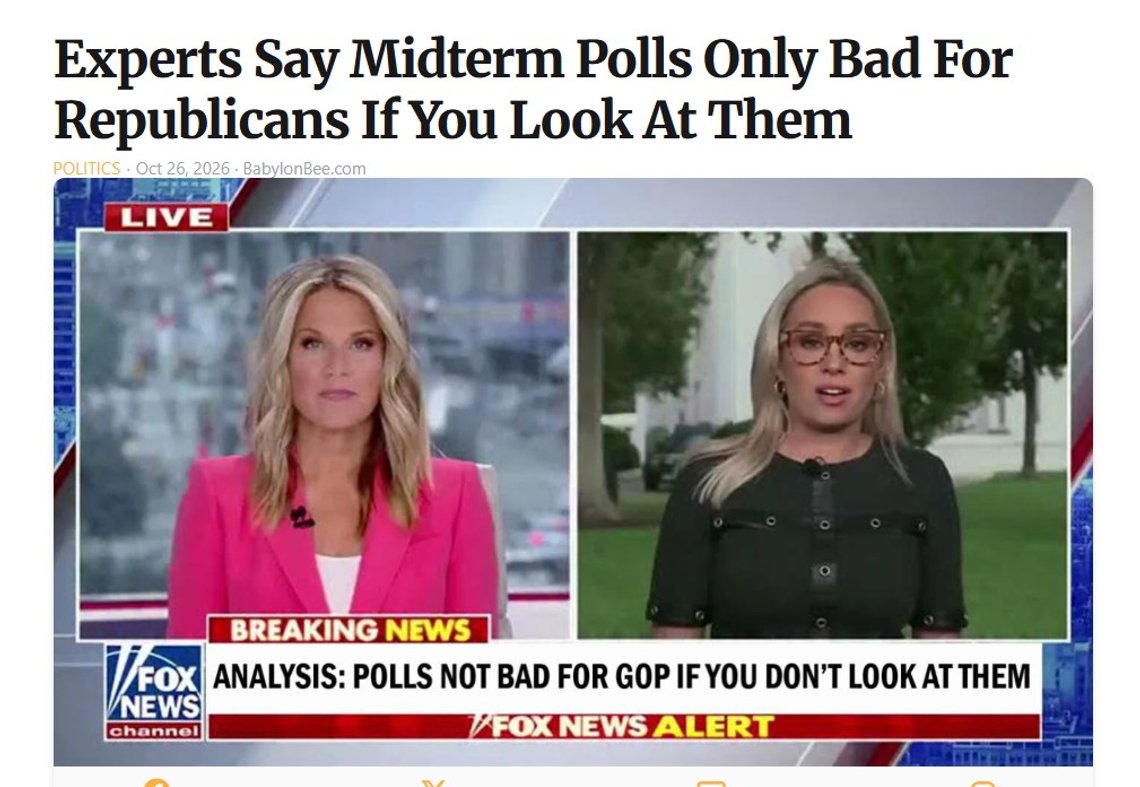
Although recent polls suggest the Republicans may be heading for a crushing defeat, party officials insist that the figures aren’t so bad if you choose not to look at them.
– Six new opinion polls from conservative media outlets came out just this morning, and they all show we’re in trouble. But once we’ve bin them, everything looks fine,” explained Republican party official Roger Millican.
“Whenever anyone tries to tell me how we’re doing in Texas, I just close my eyes and make siren noises. So far, it’s working, said Millican.
Opinion polls have admittedly underestimated Republican support in the past, but the results have looked considerably bleaker than usual in the run-up to this year’s mid-term elections.
– We have to admit that the polls look grim when they’re in print. But that only lasts until you set fire to them, said county party leader Max Bennett. – Wow, look at the smoke. It smells good. See? Nothing to worry about.
Several GOP spokespeople report that the new strategy has led to a sharp rise in optimism amongst both voters and politicians.
Satire that hits the mark
At least, that’s how it sounds in the satirical newspaper Babylon Bee, but it describes quite well how many Republicans are feeling these days.
There is hardly any good news to be found for the party just four days before the mid-term elections. On the contrary, the polls seem to be getting worse with each passing day.
Fox News’ latest forecasts show that the Democrats are set to win a majority in the House of Representatives. The channel estimates that the Democrats will win 223 of the 435 seats, whilst the Republicans are set to win 195. 17 seats are considered too close to call, with no clear favourite at this stage.
In the Senate, Fox News estimates that the Democrats are set to win 48 seats, compared with 46 for the Republicans. Several states are seeing very close races, including Michigan, Maine, Iowa, North Carolina, Alaska and Nebraska.
Fox News’ figures are projections based on how close the individual races are. They are not actual election results or measures of how many Americans will vote for each party.
The Democrats lead in the generic ballot
The Democrats lead by ten percentage points over the Republicans in the so-called generic congressional ballot, reports The Hill. This is a poll in which voters are asked which party they would vote for in a congressional election, without any specific candidates being named.
A poll by Emerson College Polling, published on Friday, shows that 52 per cent would vote for the Democrats, compared with 42 per cent for the Republicans. In September, the Democrats’ lead stood at eleven percentage points.
According to The Hill, Decision Desk HQ estimated on Thursday that the Democrats’ chances of winning a majority in the House of Representatives stood at 80 per cent, whilst their chances of winning a majority in the Senate were estimated at 60 per cent.
The survey was conducted between 24 and 26 October amongst 1,000 likely voters. The margin of error is around three percentage points.
For the Republicans, it might be just as well to ignore the opinion polls, set fire to them or bury their heads in the sand. Alternatively, they can take comfort in the fact that the polls are wrong.
Politico: Republican pollster sows doubt about the Democratic ‘blue wave’
We don’t want to go back to ‘crazy’
Speaker Mike Johnson also believes the opinion polls are wrong.
Johnson told Laura Ingraham on Fox News this week that he believes the polls showing large leads for the Democrats are underestimating the Republicans.
He believes the polls are even further off the mark this time, because an increasing number of Republicans are unwilling to take part in the surveys.
They do not want to give their details to anyone over the phone. They call it non-response bias (nonresponsive bias), said Johnson.
Speaker Johnson tells Ingraham that we do not want to go back to that madness.
If Republicans are more likely than Democrats to refrain from responding, this may affect the results of the polls.
This problem has been recognised within the polling industry in previous elections, writes The Hill. It was particularly noticeable in 2016 and 2020, when the polls underestimated Donald Trump in several key swing states.
But those were presidential elections. According to The Hill, the polls have been considerably more accurate in the mid-term elections of 2018 and 2022, and did not underestimate the Republicans.
An unlikely scenario
Despite political headwinds, including high petrol prices and low approval ratings for Trump, Johnson has continued to express optimism about the Republicans’ prospects.
Earlier this month, he told CBS News that he expects to remain Speaker of the House of Representatives, as he does not believe the Republicans will lose their majority. He called it an ‘unlikely scenario’.
Tanner Stening at Northeastern University also questions how much confidence one should place in the opinion polls.
In an article published on 16 October, he points out that the response rate has fallen significantly over the last few decades. Consequently, it is not certain that those taking part in the surveys provide a representative picture of the electorate.
A review of previous elections shows that opinion polls have been significantly off the mark, including in 2016 and 2024. A key challenge is predicting who will actually turn out to vote. Opinion polls provide a snapshot of the election campaign, but offer no guarantee of the election result.
Next week we’ll find out the final result. Until then, both optimists and pessimists will have to make do with the opinion polls.
Leading Democrat James Carville hopes the Republicans will retain the House of Representatives


