

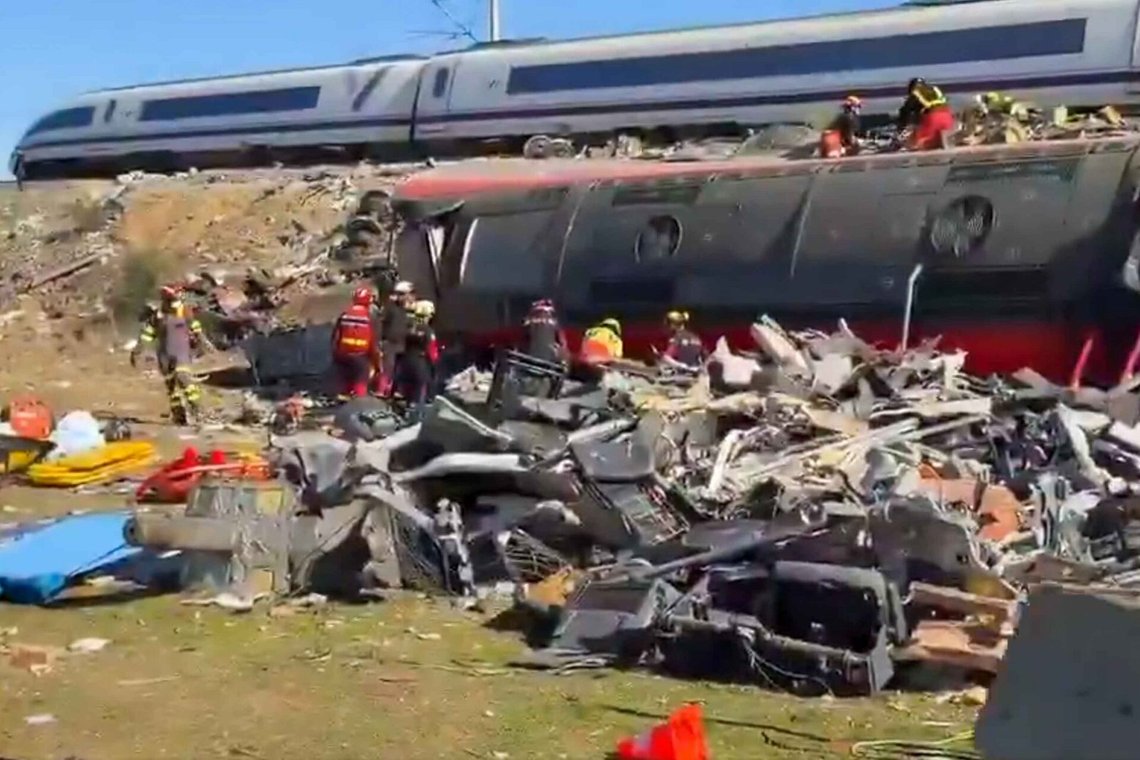


Spain has Europe’s largest high-speed rail network, which has been regarded as one of the safest in the world, but this year’s accidents have changed that picture.
On Wednesday 28 October, two high-speed trains collided on the Madrid–Seville line. A Renfe train crashed into a stationary Iryo train. 68 people were killed and dozens more were injured, several of them critically. This is the deadliest rail accident in Europe since the Santiago de Compostela derailment in 2013, in which 80 people died.
People no longer want to travel by high-speed train
According to the Spanish authorities, the automatic signalling system temporarily shut down due to a communication fault. Several trains were halted before the control centre in Madrid gave the all-clear for services to resume without speed restrictions – something Transport Minister Óscar Puente has described as ‘inexplicable’. The Renfe train continued and crashed at high speed into the stationary Iryo train. Several carriages overturned down a slope.
Both trains were travelling from Madrid to Seville. There were a total of 544 passengers on board the two trains.
This is the second major high-speed accident on the Madrid–Seville line in less than nine months. In January 2026, 46 people were killed in Córdoba. Passenger numbers fell sharply following the January accident.
🇪🇸 Spain has recorded at least five fatal high-speed rail accidents in 2026
1) Adamuz rail disaster (18 January)
A high-speed Iryo train derailed in Adamuz (Córdoba) on the Madrid–Seville line after a fractured rail weld. Seconds later, a southbound Renfe train crashed into the… pic.twitter.com/66pONqdW2B— Visegrád 24 (@visegrad24) 28 October 2026
This year’s two major accidents occurred on the same high-speed corridor and involved the same operators. Preliminary information points to problems relating to signalling systems, the switch to manual control following technical faults, and questionable decisions made in the control centres.
The signalling system on parts of the older Madrid–Seville line is over 30 years old.
@MarioBojic https://t.co/5MYoDls4Pp
— majar (@JabarMasar) 28 October 2026
Until this year, Spanish high-speed trains had been regarded as extremely safe, but this year’s two accidents have significantly undermined public confidence.
The accidents have led to a marked fall in passenger numbers on the high-speed network, which set a record in 2025 with 44.5 million passengers. Following the January accident, the trend reversed, with a 15 per cent decline compared with the previous year. The Madrid–Seville routes saw 27–30 per cent fewer passengers in the first half of the year. The Madrid–Málaga/Granada route saw a decline of up to 61 per cent in the first quarter.
Traffic on the Madrid–Andalucía line has been suspended until further notice. Renfe has halted ticket sales to Andalusia until mid-December. Following the latest accident, a new crisis of confidence and a further decline in ticket sales are expected.
🚄What happened in the train accident in Spain? 🇪🇸
Explained in detail 👇🏽 pic.twitter.com/l45lfXrele— Alberto Rueda (@AlbertoRuedaE) 29 October 2026


