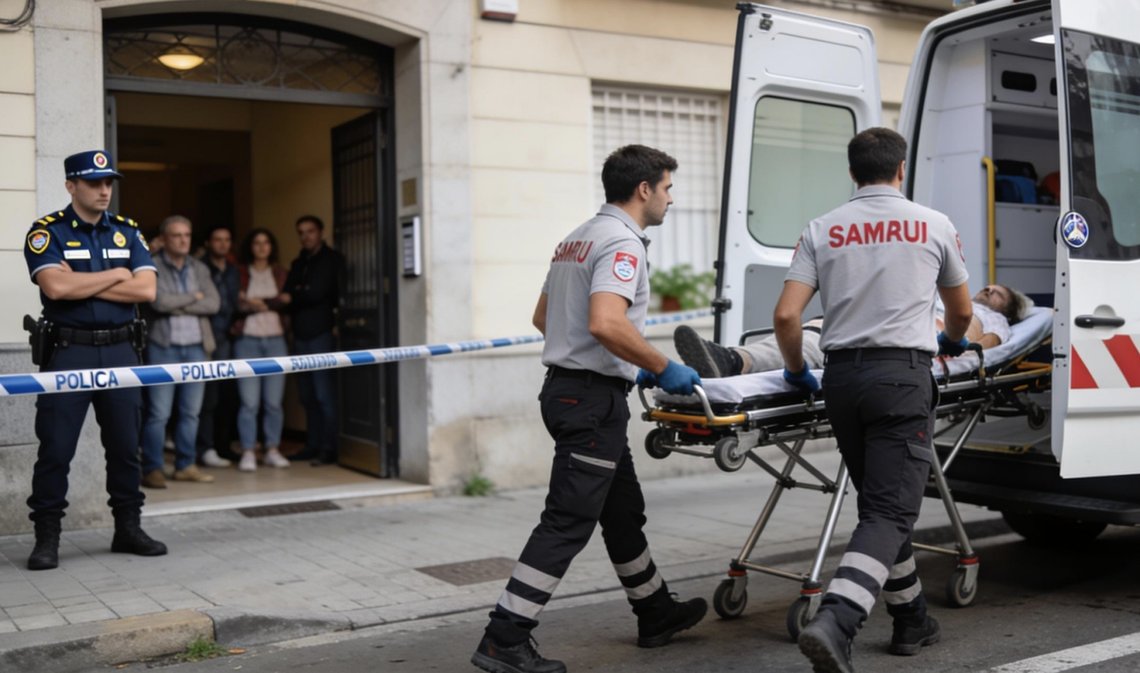


Maricarmen Abascal (87) has died. She died in hospital in Madrid on Wednesday, two weeks after she was carried out of the flat where she had lived for around 70 years.
She never managed to move back home. On Monday 28 September, however, she and the landlord agreed that she could return, for a rent of around 500 euros, according to The Irish Times.
Her family had been renting the flat in Retiro, Madrid, since 1956. Then it changed hands, and the investment company Urbagestión wanted to raise the rent from 500 euros to 2,650. Eventually, the rent settled at 1,650 euros. Her pension was 1,350 euros a month.
On Wednesday 23 September, the police arrived. She was carried out on a stretcher, surrounded by protesters.
“I was unable to defend my home, but I have fought so that others may learn to fight for what is theirs,” she said in a video after the eviction, according to the AP.
Tens of thousands demonstrated in Madrid in the days that followed, and the protests spread to other cities. Prime Minister Pedro Sánchez was among the first to offer his condolences on X when news of her death broke.

Major protests in the streets of Madrid following the death of María del Carmen Abascal. Photo: AP / Bernat Armangue / NTB
Sánchez’s Socialist government tabled two housing decrees. The conservative PP party, the far-right Vox party and the Catalan party Junts voted them down in Congress, the Spanish lower house, on Friday 2 October. On Monday 5 October, Sánchez called a general election for 29 November. He admitted at the time that he had made mistakes and had failed to fulfil previous promises, reports Al Jazeera.
Sánchez has been Prime Minister since 2018. The average rent has almost doubled in ten years, according to the property portal Idealista. House prices rose by 12.2 per cent over the past year, according to the Spanish National Institute of Statistics (INE).
Spain’s central bank, the Banco de España, estimates that the country is short of 750,000 homes. In 2025, 240,000 new households were formed, whilst 92,000 homes were built. The bank itself points to immigration as a key factor driving demand.
Social housing accounts for 1.5 to 1.7 per cent of the housing stock in Spain. The EU average is 6 to 7 per cent, according to the European Commission.
In April, the same government adopted a scheme allowing undocumented migrants who were in the country before the New Year to apply for residency. The government opted for a royal decree rather than a law passed by Congress, and the scheme came into force two days after the decision.
The government had estimated that around 500,000 people would be eligible for residence. By the time the deadline expired on 30 June, 1,174,978 applications had been received. Almost eight out of ten applications were from undocumented migrants, with the remainder from asylum seekers. This is according to the government itself.
On 2 July, the government stated that 609,737 applications had been processed. As of 30 June, 159,097 workers from non-EU countries were registered in the social security system as a result of the scheme.
The PP believes that the scheme is attracting more migrants to Spain. In March, Congress passed a motion tabled by the PP opposing it, but the decree was nevertheless implemented. Three EU officials told Euronews in February that the European Commission had strong reservations. Migration Minister Elma Saiz said in February that the scheme is intended to promote economic growth and social cohesion.
Opinion polls suggest that a coalition led by the PP, with the support of Vox, is the most likely outcome of the election, writes Al Jazeera.
Buy books from Document Forlag here!