

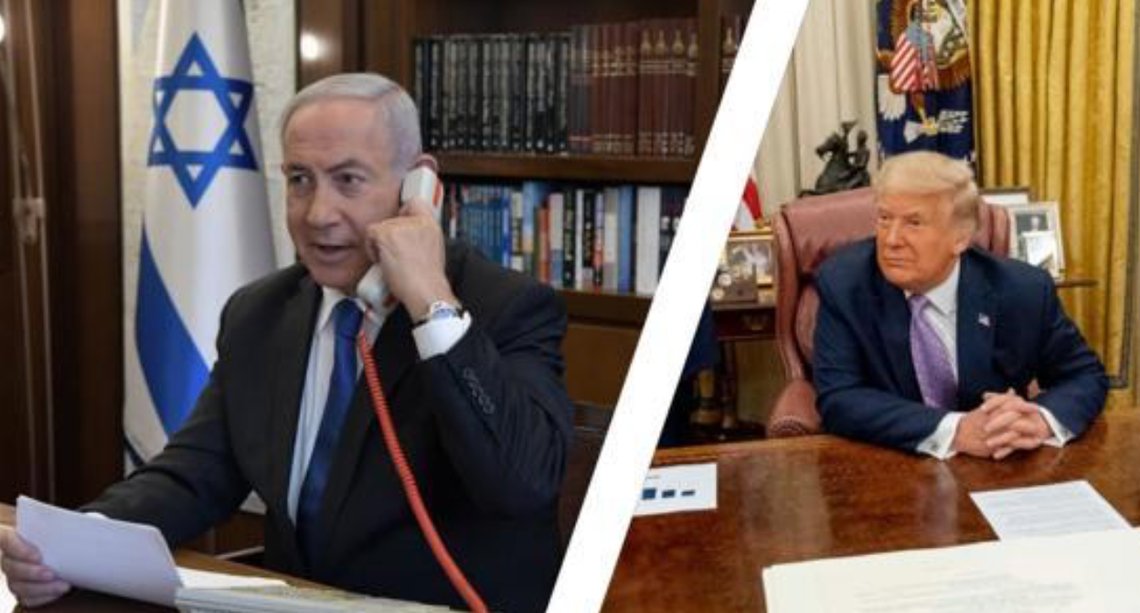


Israeli Prime Minister Benjamin Netanyahu is said to have pushed for a joint US-Israeli attack on Iran before the election, but this was not approved by US President Donald Trump.
This was reported by CNN on Monday.
Israeli Prime Minister Benjamin Netanyahu has been pushing for new attacks against Iran, but US officials have asked him to postpone this until the Trump administration is ready to carry out joint operations, according to two US officials and an Israeli security source.
“Netanyahu really wanted to convince Trump of a joint attack on Iran before the election, and he tried to get him to agree to it, but Trump did not give the green light,” the Israeli security source told CNN.
On Sunday it was reported the Israeli TVChannel 12 reported that Netanyahu and the Chief of Staff of the Israel Defence Forces, Lieutenant General Eyal Zamir, had clashed over an instruction from the Prime Minister regarding military action which the defence authorities believed could have led to a confrontation with Iran shortly before the election.

Chief of the General Staff of the Israel Defence Forces, Lieutenant General Eyal Zamir. Photo: IDF Spokesperson’s Unit /CC BY-SA 3.0/ Wikimedia
Netanyahu and his office have rejected both reports, but the atmosphere of war so close to tomorrow’s election raises the question of whether and how the election might be postponed, writes The Times of Israel. Document has reported on this earlier today.
This is only the second time that a general election in Israel has been postponed; the first was during the Yom Kippur War in 1973. That war began when Israel was attacked on 6 October, whilst the election was scheduled for 31 October.
Such a postponement was not provided for by law in 1973; it was not until 1996 that it was decided that the Knesset could postpone elections. However, as Guy Lurie and Assaf Shapira of the Israel Democracy Institute have pointed out: this requires a solid majority in parliament.
The Knesset stipulates that elections may only be postponed under ‘special circumstances’. In practice, this means that 80 out of 120 members of parliament must agree that ‘special circumstances’ exist in order for a law to be passed that extends the Knesset’s term of office and postpones the election.
‘The special circumstances must be truly exceptional: a genuine crisis situation that makes it impossible to hold elections on time’, wrote Lurie and Shapira.
If there were a risk that Iran was about to resume its missile attacks on Israel, the IDF would inevitably regard any large gathering of people – such as queues at polling stations – as an unacceptable security risk, which could fulfil the criteria for ‘special circumstances’.


