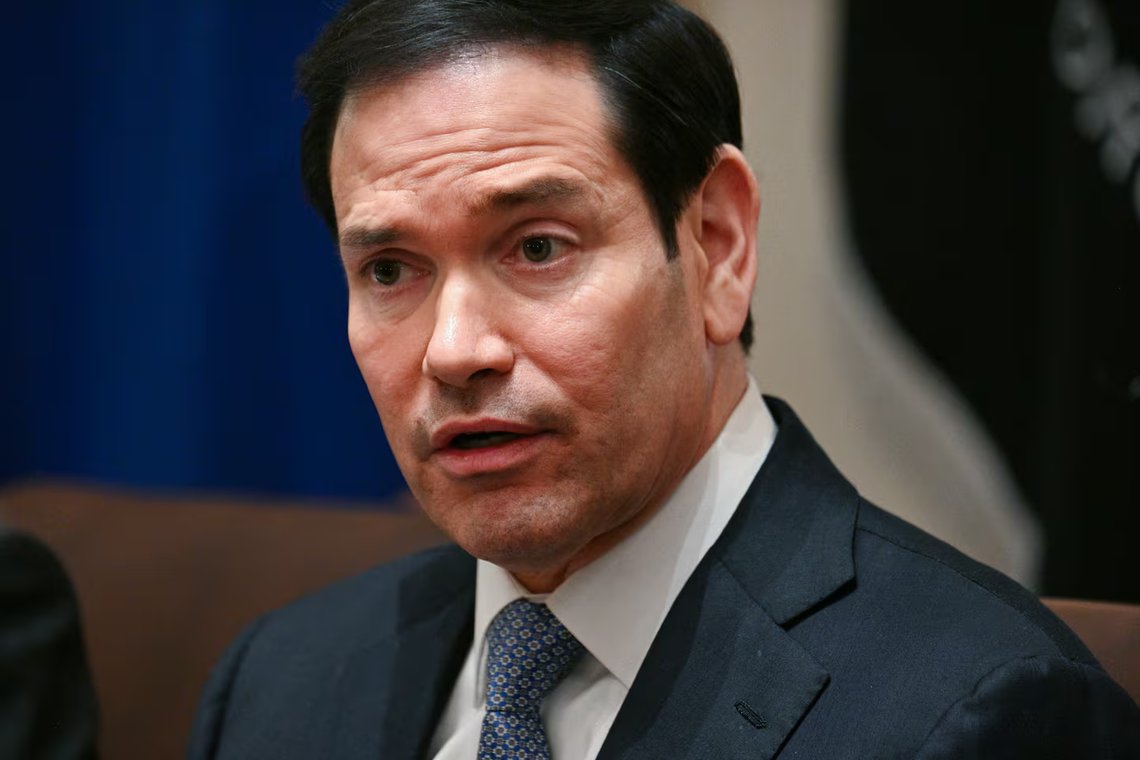


Marco Rubio’s remarkable speech in front of the Acropolis and the Parthenon on 7 October has a sense of historical significance about it, yet is barely mentioned in the European and Norwegian media.
The location was not chosen at random. It was here that the Athenian Assembly met. It was from here that the West drew democracy, and something even more fundamental: a particular way of viewing humanity and the world.
The speech is remarkable because it places today’s political and geopolitical challenges within a civilisational perspective spanning 2,500 years, and because it explicitly links Trump’s America First policy to this legacy.
Not as destructive nationalism, nor as something unique to the US, but as a way of navigating the international community – an approach with deep historical roots which the Trump administration believes Europe should also follow.
The speech is first and foremost a reckoning with the globalisation policies of Europe and previous US administrations. Naturally, the globalists in European capitals and within the Democratic Party in the US will not want to hear a word of it. That would be to admit that they were wrong.
The mainstream media are therefore keeping the speech completely under wraps, insofar as they understand at all what it is about and what is at stake. That is a shame, for it draws attention to the enormous challenges Europe is currently grappling with.
Rubio began by recalling the legacy of Athens and its significance for the development of the West: Athens gave us democracy, philosophy, Plato and Aristotle, and the city-states shaped ideas about law, morality, citizenship and forms of government. Even political language, Rubio pointed out (democracy, tyranny and politics), stems from ancient Greece.
But the fundamental legacy runs even deeper, he argued, referring to the Greek philosophers and the belief that the unknown can be grasped, and that the world has a rational order that can be mapped out and understood. This laid the foundations for Western science, medicine and philosophy, where idealism and ambition went hand in hand, and subsequently for Christianity and the Enlightenment.
According to Rubio, large parts of the West have today forgotten this. The ideal has become the international legal order. But the world is not like that. ‘A world of perfect security, without risk or defeat, does not exist’. We are building downwards, prioritising the mediocre and the safe over the exceptional and the extraordinary, whilst at the same time feeling ashamed of our own achievements and progress.
‘Nationalism has become a dirty word. We tore down monuments, condemned our own history and taught our children to be ashamed of the countries they were to inherit.’ In the process, borders were opened, industry was outsourced and the military was allowed to fall into disrepair. Sovereignty was outsourced to global bureaucracies. This has created a power vacuum that rivals are only too happy to fill, Rubio pointed out in his speech.
Rubio describes the present as a turning point: ‘The next decade and the decisions we make now will shape the history of the next century. The course we choose will determine whether the West retains its leading position in the world or resigns itself to a future of servility and decline. He warns that we must either act now or risk losing the opportunity to act at all.”
According to Rubio, under President Trump, the US has made its choice. This involves regaining control over critical supply chains, reindustrialising the economy and bringing back jobs, rebuilding the defence sector, and taking the lead in the development of the technologies and industries of the future. Specifically, he referred to advances in advanced automation and superintelligence, drones, weapons, chips, minerals, cyber technology, energy and space exploration.
According to Rubio, the Greeks understood that nations have interests; that statecraft requires wisdom and diplomacy, but also the will and ability to use power when national interests are challenged. Power requires credibility. This is the classic, realpolitik understanding of international politics that the Trump administration wishes to restore. It is a warning to a hesitant Europe.
Rubio expressed hope that Europe might ‘awaken from its long slumber and rekindle the fire that was lit in Athens millennia ago’. He highlighted positive signs: that European NATO member states are now beginning to take responsibility for their own defence, and that new partnerships and production lines are being established in line with the commitments made at the Hague Summit.
He pointed to Greece as an ally and a role model, and as an example for other European countries to follow. Alliances must be strengthened, he said, with clear reference to NATO, but pointed out that burden-sharing is a prerequisite. They must defend the sovereignty of member states, not replace it.
He rejected the idea that an ‘enlightened’ foreign policy means prioritising ‘the global community’ over one’s own country and people. He referred to the ancient Greeks, who knew that loyalty to the nation was not selfish, and to the fact that patriotism, duty and honour on behalf of the nation are nothing to be ashamed of.
He referred to Socrates, who remained steadfast in his pursuit of truth; the Spartans, who fought bravely at Thermopylae; and to Achilles, who chose honour over a long life – all role models who later influenced Christian martyrs, patriots and the American Declaration of Independence.
He pointed out that these are not universal values, but the result of a specific tradition that originated in ancient Greece. The West must defend this tradition against threats, which have once again become a reality in the form of increased great-power rivalry, war, aggression, terrorism and the exploitation of new vulnerabilities. He asserts that national interests did not disappear with the establishment of international institutions.
Rubio traced the lineage from those who built the Parthenon, via Christianity, which gained a foothold in Europe, to Michelangelo, Copernicus, Newton, Magellan, Columbus, Alexander, Caesar and Cortés, and on to the American frontier spirit.
Rubio pointed out that the most significant leaders of every generation in the West are bearers of these values from their forebears – ‘born in Athens, shaped by Rome, baptised in Christendom and tempered in medieval Europe’. Together, the West must rediscover this spirit and not forget where we come from.
The symbolism in front of the Acropolis emphasises that what is at stake is not merely politics or economics, but the continuity of Western civilisation.
Whether Europe chooses to follow the course set by the US under Trump, or continues with its policies of globalisation and open borders, will, according to Rubio, shape the next century.
The speech follows the same line and conveys the same message as that expressed by Vice-President JD Vance at the Munich Security Conference on 14 February 2025. That, too, was a speech imbued with historical significance, and one that was deliberately overlooked and, to some extent, ridiculed in Western capitals.
Both speeches were delivered on European soil. Both are addressed to the European elites. And both describe a West in civilisational decline, where disintegration and internal crises are just as threatening as external threats. Under Trump, the US has taken action. Europe is urged to follow suit.
Both highlight mass immigration and open borders as a problem affecting both civilisation and security. Vance highlighted politicians’ disregard for how immigration affects their own people, whilst Rubio addresses the offshoring of industry and jobs, how the defence forces have been weakened, and how shame over its own history has rendered the West incapable of safeguarding its own interests in the international community.
Both are critical of European leaders’ constant reference to the international legal order. They characterise this as outsourcing of sovereignty and as a contradiction in terms. Vance criticised the elite’s lack of contact with the grassroots, the exclusion of critical voices, media conformity and the tendencies towards censorship and the suppression of the free exchange of views.
Both argue that national loyalty is legitimate and necessary. With clear reference to the European Commission, they believe it is directly undemocratic to transfer decision-making to global bureaucracies that are not subject to democratic control.
The underlying diagnosis is the same for both: the West stands at a crossroads. Internal divisions and weakness pose a greater threat than Europe’s leaders are willing to admit. Follow the US, restore national self-awareness, strength and sovereignty. Or fend for yourselves.
These two speeches form the central theme of the Trump administration’s message to Europe. They are intended both as an invitation and as a warning.
They are an invitation to stand together. And a warning that the US will go its own way if Europe does not take matters into its own hands.
The ball is now in the court of the European capitals, including Oslo. Unfortunately, however, there are many indications that Vice-President Vance and Secretary of State Rubio are, for the most part, preaching to deaf ears.
The invitation from the US is something that Jens Stoltenberg, Jonas Gahr Støre and Espen Barth Eide strongly reject. In other words, they are distancing themselves from our most important ally: the country on which they themselves have made Norwegian security entirely dependent.
Caretaker
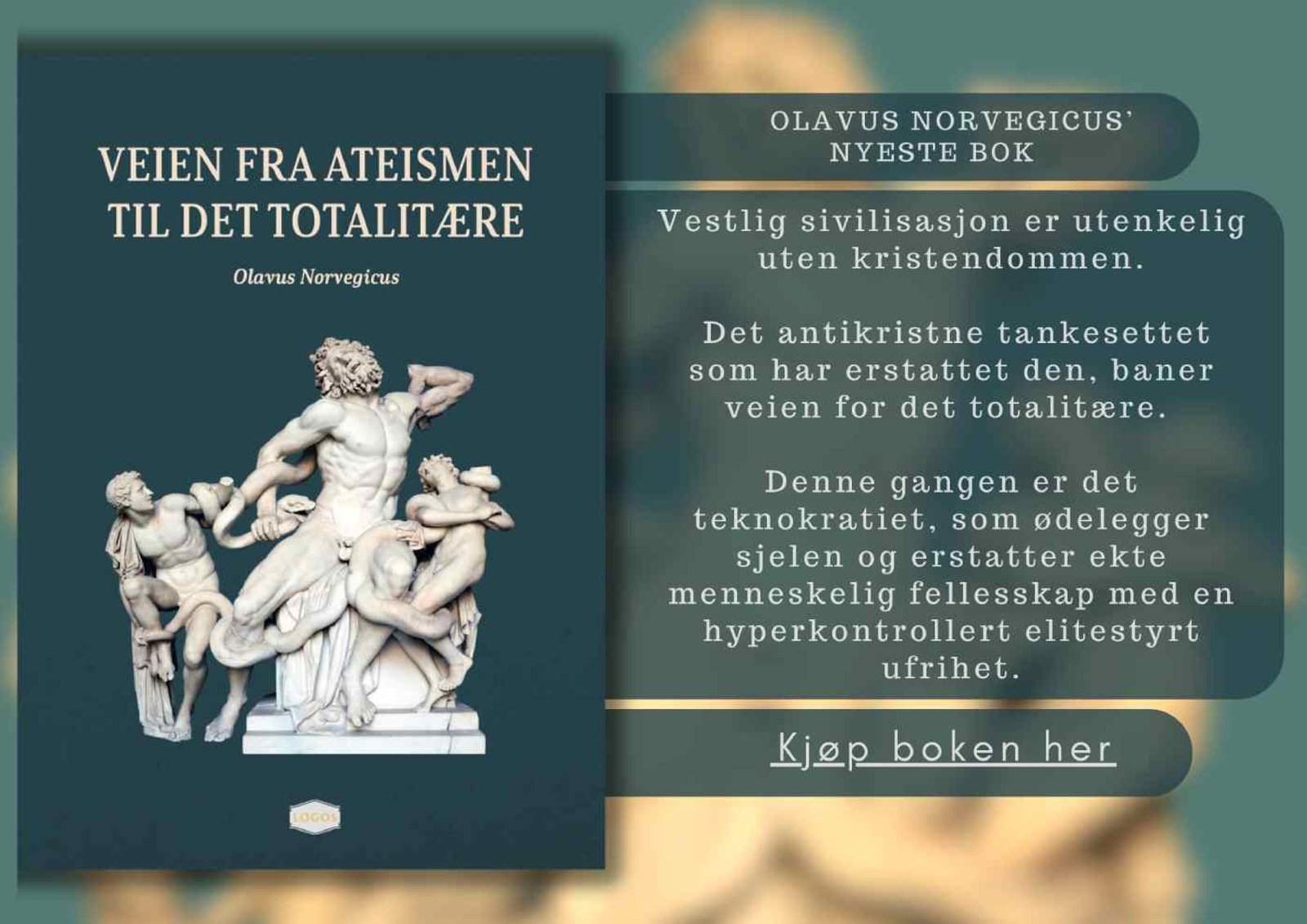
Buy ‘The Road from Atheism to Totalitarianism’ by Olavus Norvegicus. You can also buy the e-book here.