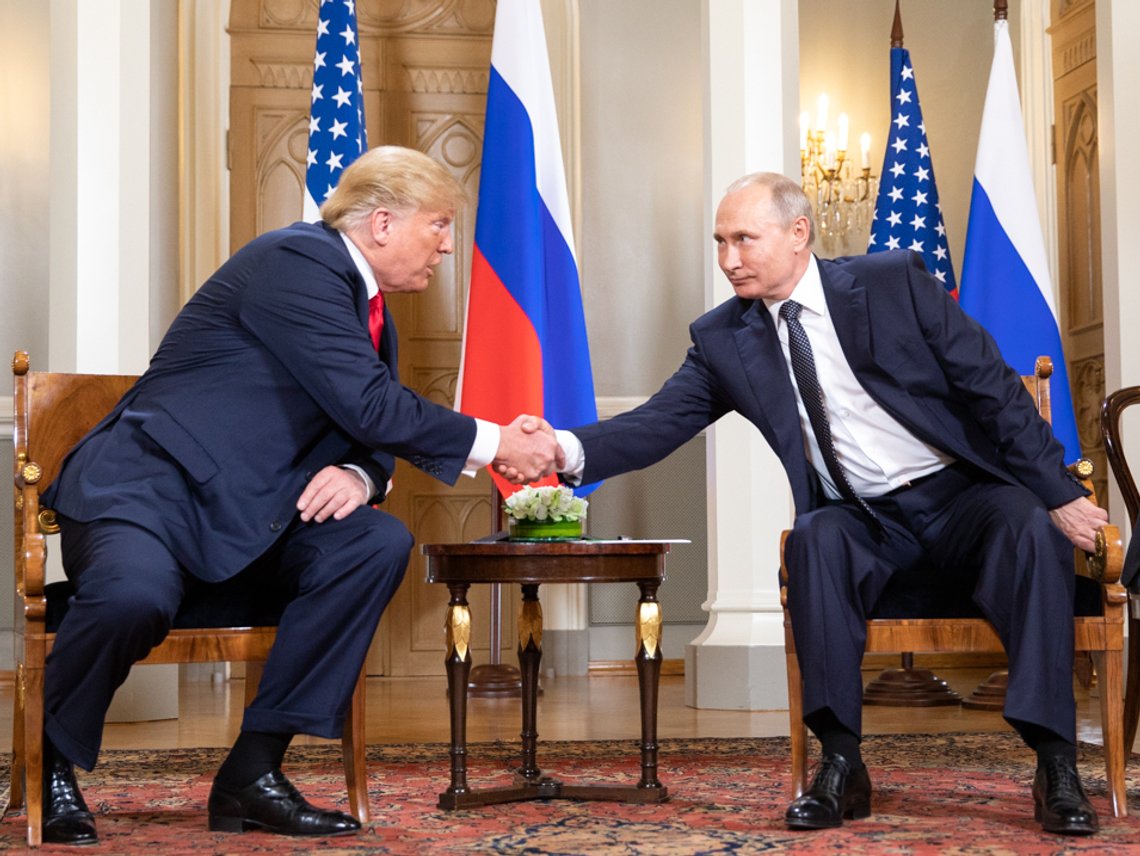


Only Donald Trump could pull that off. Although Friday’s top international news story – that the US is to be allowed to buy diesel from Russia to bring down diesel prices in exchange for easing the sanctions regime – should come as no surprise.
The real story here is not about diesel, but about the rapprochement between the US and Russia and the deterioration in relations between Europe and the US. This is a development with a long history, and one that could have major consequences for Norway.
The timing of Trump’s latest move points to the upcoming US mid-term elections on Tuesday 3 November. The globalists in the Democratic Party want the war with Ukraine to continue and petrol prices to be as high as possible. However, the Trump administration’s approach to Russia began early on in Trump’s second term.
As early as February 2025, shortly after Trump took office, he rang Putin to discuss peace in Ukraine. This was followed up by the meeting in Riyadh immediately afterwards. Then came the meeting between Trump and Putin in Anchorage in August 2025. And a month ago, it continued with CIA Director John Ratcliffe’s unannounced visit to Moscow.
The rapprochement between the US and Russia is nothing new in US-Russian relations. It is clearly rooted in realpolitik and has deep historical roots, even though it appears to be a complete paradigm shift for the generation that grew up during the Cold War with NATO and the Warsaw Pact.
The historical relations between the US and Russia are among the most complex in international politics. The US and Russia have not always been enemies. Nor have the US and Europe always been allies.
Throughout history, the US and Russia have often found common ground long before the Cold War defined the antagonisms we recognise today. Together, they formed a counterweight to the old European colonial powers, particularly in response to British imperialism from the 18th century until the latter half of the 19th century.
Throughout the 19th century, Russia, unlike Britain, France and Spain with their colonial ambitions, one of the few European great powers that did not threaten American territory, a situation that culminated during the American Civil War (1861–1865).
Russia openly supported the Union and the Northern states, primarily because it saw the US as a counterweight to its main geopolitical rival, the British Empire. Throughout the 20th century, relations with Russia fluctuated. But after 1945, everything changed.
The Cold War made the Soviet Union the United States’ main enemy. NATO was established in 1949 as a Western defence alliance against the threat from the East, with the United States, the United Kingdom and the old European great powers at its core. The Cold War lasted until the fall of the Iron Curtain in 1989 and the collapse of the Soviet Union in 1991.
It is worth noting, however, that the arms control treaties SALT I and II and the INF Treaty, as well as the Helsinki Accords, were, for the most part, implemented bilaterally between the US and the Soviet Union, over the heads of the European NATO countries, as early as the 1970s. In the early 1990s, immediately after the end of the Cold War, the US and Russia cooperated closely, both on START II, within the NATO Council and through joint operations in Bosnia and Kosovo.
Russia even sought NATO membership and wished to be included in a common European security architecture. However, this did not come to pass. NATO’s rapid eastward expansion, the US missile defence initiative, the 2003 invasion of Iraq – without a UN mandate – and the recognition of Kosovo in 2008 drove Moscow and Washington apart once again.
Since then, we all know how things have turned out. Russia intervened in Georgia in 2008, annexed the Crimean Peninsula in 2014 and invaded Ukraine in 2022, in order to prevent Ukraine’s accession to NATO. This led to a complete freeze in relations between the US and Russia until Trump 2.0 and what might be seen as the beginning of a new spring in US-Russia relations.
The Trump administration’s break with the globalisation policies of previous US administrations and the EU has also altered relations between the US and Europe. Trump wishes to bring back the industrial base that has been exported to China and other low-cost countries, whilst at the same time reversing immigration from the south.
The export of industrial capacity has led to economic growth in the BRICS countries, but has undermined the Western countries’ own economies and their ability to create value. This has been further exacerbated by climate and energy policy, whilst immigration from the south both undermines the welfare state, leads to significant redistributive effects and alters the electorate’s demographics.
This has not only weakened economic growth in the West, but also the collective security of Europe and the US. Whilst the Trump administration has changed course and is now attempting to reverse globalisation policies, the EU continues undeterred on the same path. Whilst the Trump administration seeks peace in Ukraine and a rapprochement with Russia, the EU member states are continuing with their globalisation policies and allowing the war in Ukraine to escalate.
It is primarily this that is now challenging transatlantic relations. Continuing the war in Ukraine is not in the US’s interest. The Trump administration is primarily concerned about China and the emerging alliance between China, Russia, Iran, North Korea and several of the non-aligned countries in the Global South. Just as Russia in the 19th century viewed the US as a counterweight to its main geopolitical rival, the British Empire, the US now sees Russia as a geopolitical counterweight to an emerging China.
The US and Russia have rarely been natural enemies, except during the Cold War. They have been so only when European power politics forced them to be. Today’s approach under Trump revives the old logic: the old European colonial powers cannot be trusted. Russia may be a useful ally against China and as a substitute for a divided, weakened and unreliable EU.
The long-standing ties dating back to the 19th century still endure and shape US foreign policy more than people in Brussels, London, Paris and Berlin care to admit, and more than most in Oslo’s defence and security policy circles are able to grasp in their unanimous support for continuing the war in Ukraine.
Admittedly, the timing of Trump’s diesel announcement is linked to the US mid-term elections in three weeks’ time, in the same way, but with the opposite sign, just as the Conservative Party can undeterred pursue its rigid petrol and diesel policy in Norway, knowing full well that the next parliamentary election is a long way off, and that the electoral bribery can be saved for then.
But Trump’s diesel announcement is about far more than just diesel prices. The real story has a realpolitik foundation and a major geopolitical dimension. The Conservative Party’s diesel policy does not. It smacks of domestic political amateurism and a total lack of understanding of what is in the interests of the voters and the country.
Trump’s move must be seen in the light of the reorientation taking place in international politics, whereby the world’s leading superpower is being challenged by a rapidly advancing China, whilst the US’s closest ally, Europe, appears increasingly weakened, and whilst Russia is in the process of becoming the deciding factor that tips the balance in the wrong direction.
It is this development that the Trump administration is attempting to reverse and which the Democratic Party and the heads of state in European capitals are opposing. It is first and foremost this that is putting Euro-Atlantic relations at stake.
Trump’s diesel move may have little impact on the price of diesel. The volumes are too small for that, at least to have any significant impact in the three weeks leading up to the mid-term elections. It is the geopolitical signal it sends to Moscow, Kyiv and the capitals of Europe that is important.
The Conservative Party could have played a role in reducing diesel prices in Norway. But in Norway, it is clearly too long before the election for the party leadership to take any notice. The story of the Conservative Party is the story of a party that history has long since left behind, and which is in the process of being cannibalised by the Progress Party, which realises that the high petrol and diesel prices in oil-rich Norway are in neither the voters’ nor the country’s best interests.
Øystein Steiro Sr.
Caretaker