

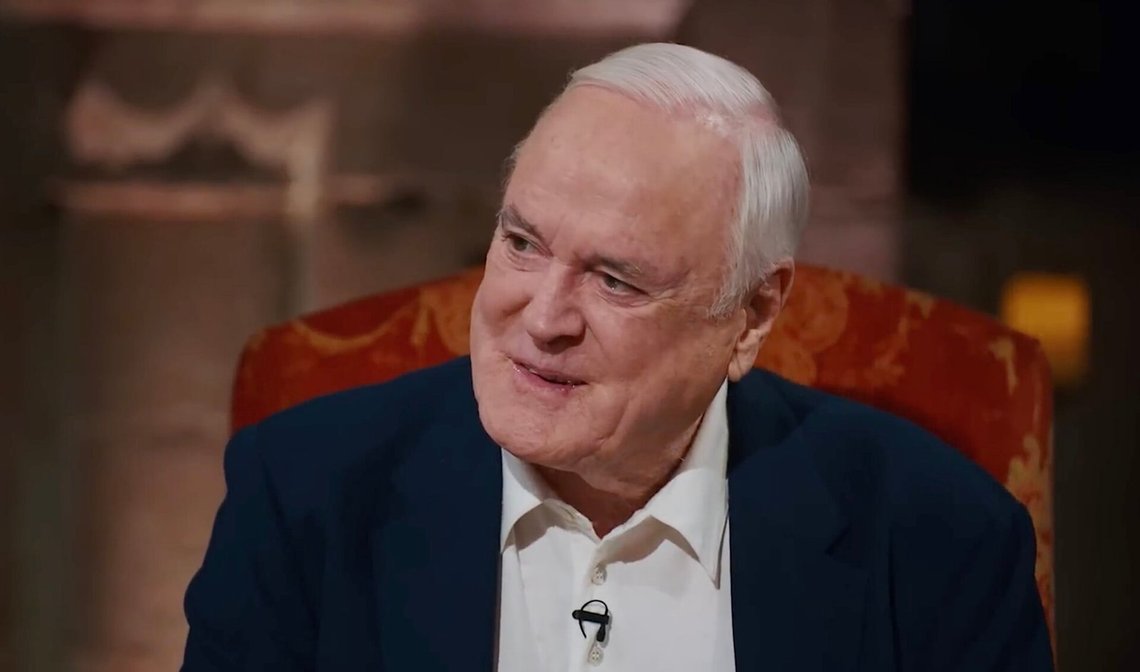
The comedian and actor John Cleese, best known for *Fawlty Towers* and Monty Python, has reportedly been reported to Prevent, the UK government’s programme to tackle extremism. The Muslim website 5pillars is behind the report. They believe that, through a series of posts on X, he has engaged in “anti-Muslim rhetoric”. Prevent is intended to counter terrorism, not to act as a censorship body, says Reform politician Suella Braverman.
The website 5pillars has long had it in for Cleese. They claim he “demonises, dehumanises and collectively attributes violence and crime to Muslims and Islam”, according to 5pillars.
I’m not a racist. I’m a culturalist
I believe some cultures are superior to others
For example, I prefer cultures that do not encourage wife-beating, paedophilia, clitoridectomies, stoning and the constant inflation of the male ego
I am also aware of the difference between… https://t.co/WNCRrzQvZi
— John Cleese (@JohnCleese) 30 July 2026
They clearly do not appreciate his constant jibes at the ‘religion of peace’. Commenting on the fact that he had been reported, Cleese said: “Men with inflated egos, as encouraged by Islam, cannot accept any form of criticism and therefore feel that it must be wrong.” The comment was a response to Adrian Hilton, who wrote on X:
«This is a bit odd. We were assured that the recently introduced ‘anti-Muslim hostility’ would not affect the freedom to criticise, satirise, dislike or insult Islam and its practices. John Cleese is free to express his scepticism about Islam in ways that some might find disrespectful, but it is not illegal to do so, and it certainly should not be a matter for Prevent, as there is nothing in what he says that can be countered. ‘Anti-Muslim hostility’ protects Muslims, not Islam. There is no blasphemy law, and Prevent should not attempt to turn it into one.»
Men with the inflated egos that Islam encourages,
cannot accept any form of criticism, and therefore feel that it must be wrong https://t.co/KIF7GN4rEA— John Cleese (@JohnCleese) 30 September 2026
Suella Braverman, a former Conservative minister and now an MP for Reform UK, agrees. Once again, the issue of blasphemy laws arises:
«Prevent is intended to identify potential terrorist threats and prevent them through deradicalisation. It is not intended to silence legitimate comments or debate about Islam. If this goes any further, it will show just how broken our counter-terrorism system is, and that a blasphemy law has been reintroduced in the UK through the back door.»
“One of the proudest moments of my life”
Cleese, who is 86 years old, is laughing it all off, and wrote on X: «One of the proudest moments of my life. I would like to thank everyone concerned.» («One of the proudest moments of my life. I would like to thank everyone involved.») He may well be at an age where he no longer needs to worry about pleasing everyone, and his audience has never consisted of religious fanatics, whatever their faith.
Criticism of religion has never been alien to him, but in the days of Monty Python it was Christianity that bore the brunt. The consequences of criticising Islam, however, are of a different calibre. As Braverman and Hilton point out, it may seem as though the UK has surreptitiously introduced a blasphemy law, but even though the new definition of anti-Muslim hostility was introduced in March this year, the country has already been subject to Islam for several years.
It is now several years since the anonymous teacher at Batley Grammar School was forced into hiding for showing a picture of Muhammad, and Jews no longer feel safe in many parts of Britain either. Islam and Muslims have the upper hand in a country that has forgotten that it actually had – and still has – its own religion and its own values, among which were tolerance and freedom of belief. Critics of Islam are constantly told that they are hateful, and now, with the new definition of Islamophobia, it has become even easier to silence them. After all, they have government regulations on their side.
Muslim activists in Birmingham, a group calling themselves Deenified, have also attempted to cancel Cleese, and they want his show to be cancelled.
Hate preacher?
They believe he is a “hate preacher” whose “so-called comedy” means he is not welcome in Birmingham. If this were about a small, vulnerable minority, one might raise an eyebrow and think it wasn’t such a big deal. After all, they have a right to express their views, too. The problem is that Muslims in Birmingham are not a small minority. Muslims already make up almost 30 per cent of the population, according to Birmingham City Council. Muslims are still a minority in the UK, but the community is growing rapidly. By 2050, around 17 per cent of the population will be Muslim. And although many Muslims – hopefully – will tolerate freedom of belief and criticism of Islam, there are enough who will not that it could become a significant problem.
We are already seeing the chilling effect of Islam’s clammy grip on public debate. It began with Salman Rushdie’s *The Satanic Verses* and has continued in the same vein ever since. Muslim criticism is not about words, but about threats, violence and, sometimes, murder. John Cleese will not be silenced by 5pillars, Deenified or Prevent (should they decide to take 5pillars seriously), but a bullet can stop anyone from speaking out. Cleese chuckles at the reactions to his jibes at Islam, but we know from experience that when you offend the religion of peace, things can get deadly serious.
Unfortunately, there are people in positions of power in Britain who do not want to see, or who do not dare to see, how far things are going wrong. Instead, they have fallen for the concept of ‘Islamophobia’ and are supporting the fanatics’ agenda. John Cleese is approaching ninety, and it must be up to the younger generation to follow in his footsteps. Cleese was priceless as Basil Fawlty in ‘Fawlty Towers’, but also plays an important role as a critic of Islam. May he continue to do so for a long time to come – it is sorely needed in a Britain where there is ever less room for diversity of opinion.


