



Contemporary anti-Jewish narratives
Last week, Jews across the world marked 9 November, the date of the November pogrom in 1938, known as Kristallnacht. In the decades following the Holocaust, the Jewish people have gathered for commemorations in the hope that persecution and pogroms, both in Europe and in Muslim countries, would be a thing of the past, and that the Jews would finally be assured of safety and independence both in their historic homeland and elsewhere in the diaspora. But the opposite has happened. Time and again, Jews are subjected to persecution and existential threats, whilst at the same time being exposed to false accusations of committing the very same abuses of which they themselves are victims. The persistent hostility towards Jews manifests itself through alliances between Islamist circles and far-left forces, as well as through controversial UN officials such as Francesca Albanese, whose statements have repeatedly been condemned as anti-Semitic. This is underpinned by a rhetorical apparatus that draws on classic anti-Semitic myths, ranging from medieval notions of ritual murder to the conspiracy theories in The Protocols of the Elders of Zion.
Several of today’s anti-Jewish narratives share clear structural similarities with historical anti-Semitic propaganda, but are now cloaked in contemporary, tendentious language featuring false accusations such as ‘occupation’, ‘apartheid’, ‘genocide’ and ‘illegal settlements’. Unfortunately, the line between hatred of Israel and the anti-Semitism suffered by Jews no longer exists, and it is entirely impossible to address one without addressing the other.
Researcher Johannes Due Enstad has demonstrated a clear correlation between hatred of Israel and anti-Semitism. It is therefore a thought-provoking fact that the commemoration of Kristallnacht, in particular, has over a long period of time been hijacked and politicised by groups which, for the rest of the year, work against the State of Israel’s right to exist. At the same time, our representatives are subjected to accusations, such as when the Anti-Racist Centre (ARS) last year launched an attack on the former head of DMT Ervin Kohn. This illustrates how these organisations themselves form part of the challenge to Jews’ ability to live openly and safely in this country.
A day of remembrance in the wrong hands
As early as the 2000s, when the organisation later convicted of fraud organisation SOS Racism took over responsibility for the event, the day of remembrance took on an unbalanced and one-sided political character. Eventually, the Anti-Racist Centre (ARS) took over this role. The Jewish Community (DMT) in both Oslo and Trondheim have expressed deep mistrust regarding how the ARS is using the commemoration as a platform for agitation, supported by a number of organisations with a pronounced anti-Israeli stance.
Neither SOS Racism nor the Anti-Racist Centre has demonstrated the necessary credibility on issues concerning Jewish safety and living conditions. This appears to be a rhetorical paradox when they choose themes such as «Jewish lives: then, now and in the future», given that the event is in practice used for political activism directed against Israel – a dynamic that KrF leader Dag-Inge Ulstein aptly pointed out in connection with last year’s commemoration:
“It is quite simply appalling that the Anti-Racist Centre, together with radical pro-Palestine activists and others, is attempting to turn the Holocaust commemoration on 9 November into a platform for left-wingactivism. This day is meant to commemorate the atrocities that took place on the night of 9 to 10 November 1938, which marked the start of the dramatic escalation of the systematic persecution of Jews in Germany. Not to promote political campaigns. It is sad to hear how the Jewish Community in Norway experiences its collaboration with the Anti-Racist Centre, and how, in practice, they are helping to fuel anti-Semitism in Norway. I look forward to visiting the synagogue and commemorating Kristallnacht together with the Jewish Community. I hope the Prime Minister will do the same.»
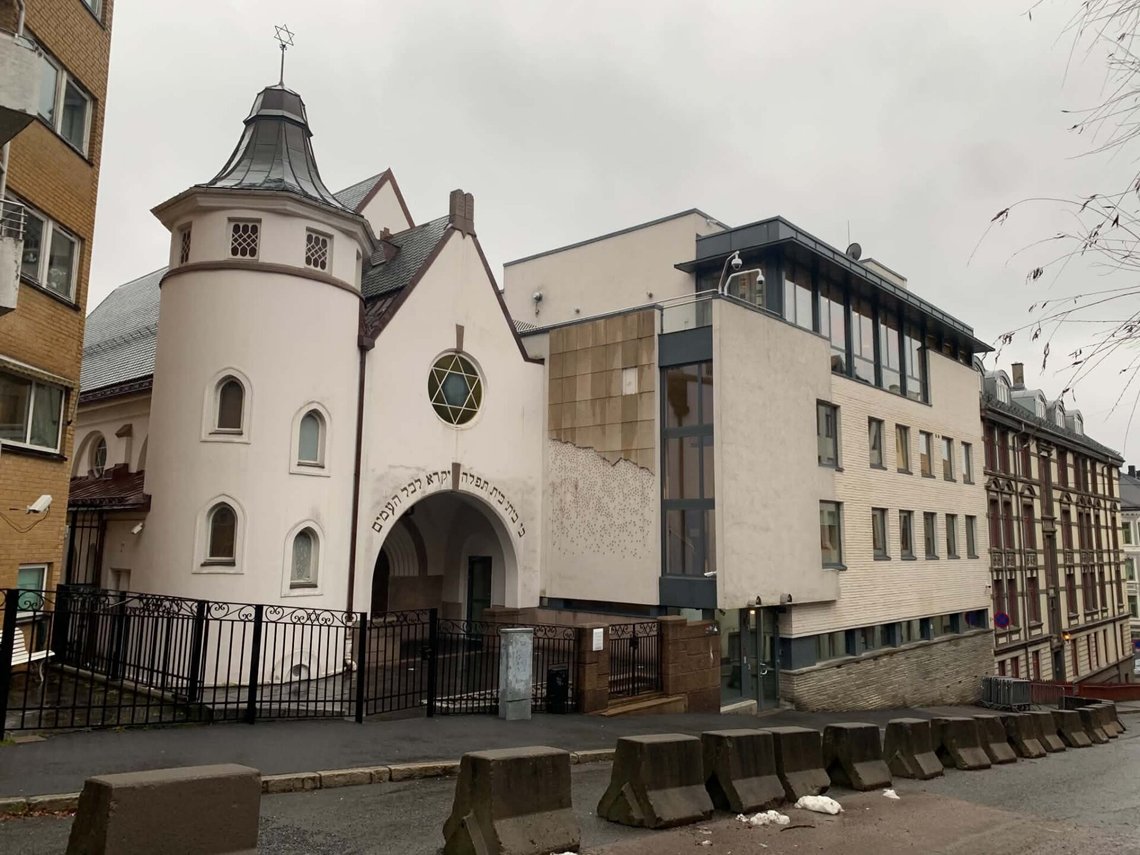
When Prime Minister Jonas Gahr Støre last year chose to speak at the commemoration organised by ARS, Norwegian People’s Aid and the Norwegian Confederation of Trade Unions (LO) in Oslo, which was also supported by, amongst others, the Palestine Committee, and turned his back on the Jewish commemoration in the synagogue, it triggered justified criticism. It was therefore a step in the right direction when he this year chose to take part in the Jewish Community’s own commemoration rather than the alternative event that many Jews do not dare to take part in.
The myth of the geopolitical cause
The causes of negative attitudes towards Jews are not Israel’s forced defensive war against murderous Islamists. Anti-Semitism does not, as a rule, arise as a reaction to specific geopolitical events, but must rather be understood as a result of prejudiced projections and societal complacency. The problem is exacerbated by the failure to draw a clear distinction between legitimate criticism on the one hand, and historical revisionism, the demonisation of Israel and the indirect legitimisation of anti-Semitic terrorism on the other.
Two illustrative and serious examples can be found in the university sector. Here we can mention both NTNU professor Bassam Hussein, who referred to the massacre 7 October 2023 and the murders of innocent Jews as “the most beautiful thing that has happened in our century”, and history professor Stephan Sander-Faes at the University of Bergen, who in a blog comment has claimed that the Nazis did not have their own extermination camps.
It took considerable external pressure before the management at the University of Bergen, led by Vice-Chancellor Margareth Hagen, fully grasped the seriousness of the situation. The result was that history professor Stephan Sander-Faes was relieved of all teaching duties until the summer. However, if this measure is implemented whilst he continues to receive his full salary, it raises serious questions about the preventive effect of this response: Is he, in reality, being granted a research leave which he may use to continue historical revisionist activities from which the University of Bergen can hardly be said to derive any credit?
Both professors have been defended by their respective vice-chancellors on the grounds of freedom of expression. On the one hand, history professor Stephan Sander-Faes appears in practice to be a historical revisionist on a collision course with basic academic and ethical standards, not unlike the form of historical falsification Deborah Lipstadt confronted in David Irving. On the other hand, we see an academic acting as a pure apologist for brutal terror. But he is not alone in this. Even today, NRK avoids calling the Hamas murderers terrorists, whilst uncritically quoting the terrorist group’s own health authorities without distinguishing between combatants and civilian victims. At NRK, it is usually Israel that ‘claims’, whilst Hamas ‘reports’.
However, these attitudes cannot be reduced to isolated incidents; they reflect a far broader societal trend. This calls for a critical examination of which social actors and discourses bear responsibility for the fact that over half the population (51 per cent) agree with the statement that “Israel treats the Palestinians just as badly as the Jews were treated during the Second World War”.
Jewish insecurity in everyday life in Norway
The constant stream of one-sided and distorted information is shaping Norwegian public opinion to such an extent that the distinction between criticism and demonisation is eroding. However, the consequences do not affect the State of Israel alone, but to a very great extent the Jewish minority in Norway. The fear of harassment and physical assault has become a constant part of life. Very few of us dare any longer to wear visible markers of Jewish identity in public spaces. Those who do so expose themselves to a significant and persistent personal risk, a reality we Norwegian Jews are confronted with on a daily basis.
As a minority under pressure, we are currently finding that our scope for living openly as Jews is being dramatically curtailed, forcing us to adopt various defensive survival strategies. For many of us, the solution is strategic invisibility in public life. This means that even our children are subjected to an abnormal culture of caution, where information about where we live, our ethno-religious identity and the observance of religious festivals is kept hidden from the outside world.
Within the minority, there are also extremes: some seek social acceptance by distancing themselves radically and adopting one-sided, anti-Israeli narratives, whilst others conclude that a secure future is only possible by emigrating to Israel.
The most far-reaching consequence for the community, however, is collective self-censorship: fear has led to visible Jewish symbols being almost entirely absent from everyday life, not to mention symbols associated with the Jewish state.
Alongside this, we are experiencing a certain reluctance or silence within society when faced with our challenging situation. Even the most heart-rending expression of this everyday reality, namely that Jewish children spend their days at nursery behind walls and under round-the-clock police protection, seems to be met with silence. There lies a profound paradox in the fact that such a massive security presence has become necessary; not because Jewish children pose any threat to society, but because the children’s lives and safety may be at risk the moment they are no longer shielded by police and barriers.
Attention has been drawn to how this everyday fear is being addressed by politicians. Whilst some representatives, including those from the Christian Democratic Party (KrF), have taken a particular interest in the issue, there are calls for an even broader debate in the Storting on the challenges associated with anti-Semitism.
Without a clear allocation of responsibility, targeted measures against Holocaust denial and inaccuracies in news reporting, the authorities’ measures against anti-Semitism will remain inadequate. If the action plan against anti-Semitism is to have a real impact and achieve its primary objective – to ensure the safety and future existence of the Jewish minority in Norway – official Norway must be willing to address the underlying causes of this development.


