

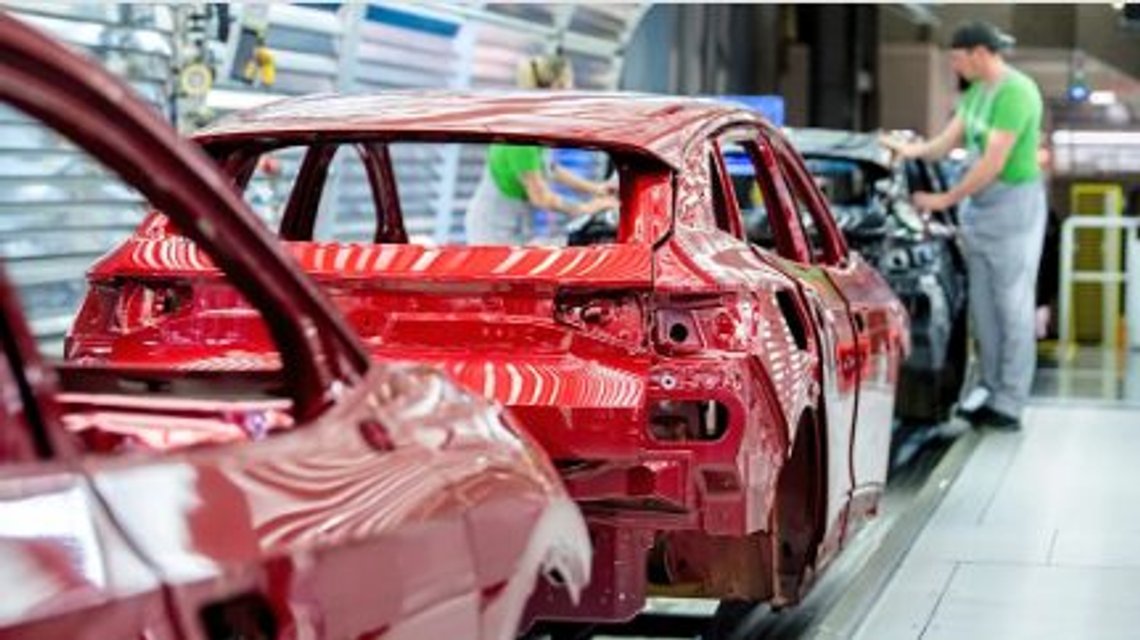


German car manufacturing, one of the nation’s sources of pride, is moving rapidly and steadily towards collapse. The worst outcome for employees will be if the planned ban on internal combustion engines is upheld.
Document has written extensively about developments in the automotive industry and industry in general in Germany. But it is not only the German automotive industry that is losing jobs, relocating car factories abroad and seeing profits decline significantly.
The Fraunhofer Institute for Industrial Engineering expects extensive job losses in the European automotive industry. It appears unlikely that even an EU compromise will save the sector, writes Die Welt.
The researchers fear that the automotive sector is facing a massive loss of jobs. According to their analyses, up to 726,000 manufacturing jobs could disappear by 2040.
Such large losses will naturally have enormously negative consequences for other local businesses as well, including suppliers, car dealers and many others. Municipalities will struggle severely because of major losses in tax revenue while mass immigration continues.
The combination of lost jobs and tax revenues, in addition to continued mass immigration that generates only costs which neither local nor central authorities can afford, is in the process of strangling the economy across large parts of Europe. This is reinforced with every factory that relocates abroad, every business that closes down, and every immigrant who arrives and depends on welfare transfers from the authorities (the taxpayers).
“All scenarios show a significant decline in value creation in Europe by 2035. Without action, Europe risks becoming permanently dependent on third countries for key technologies,” the study concludes.
It could get worse
Negative economic developments have historically tended to reinforce themselves, particularly if the political leadership shows no sign of addressing the underlying problems.
The automotive industry itself has long grumbled about the ban on fossil-fuel-powered cars from 2035 onwards. In addition come the exorbitant costs imposed on businesses operating in Europe, not least because of climate levies that the United States, China and the overwhelming majority of countries outside Europe avoid.
Wage levels in Europe are higher than those of its competitors, but the automotive market is global. This creates an imbalance in competition, unless European workers are so much more efficient and productive than everyone else that we overcome this problem.
That has certainly been the case during parts of history, but is it still true today? And if so: Will we retain this competitive advantage over the next ten, twenty or fifty years, with an entirely new population?
The Chinese authorities subsidise their export-exposed industries, including all these new electric vehicles, which are taking substantial market share from European car manufacturers.
At the same time, European governments subsidise unprofitable industries that face virtually no external competition whatsoever. We may briefly mention offshore wind, carbon capture and storage, and other sectors in which only European politicians believe.
Norwegian politicians who have never held an ordinary job – and some of them possess neither education nor expertise – are strongly driven by the ambition to “save the world”, in more ways than one. Looking after their own population does not appear to interest them.
This is exploited by an army of rent-seekers: individuals or companies who increase their wealth by manipulating the political or economic environment, rather than by creating new value from which both they and society at large benefit.
Today, rent-seekers can easily find themselves dining at the King’s table. A good Norwegian example is furniture manufacturer and Minister of Health and Care Services Jan Christian Vestre.
It is therefore not inconceivable that one million jobs or more could disappear from the European automotive industry, and that does not take into account the effects on all the suppliers and businesses that depend on the spending of those employees.
Alternative jobs are difficult to discern. Whereas a car factory, at least until robots take over completely, may employ well over a thousand workers, a data centre or a battery factory can manage with three or four people. Since the owners are largely foreign, there is no tax revenue to be gained either.
Nevertheless, European politicians appear to be doing everything they can to close car factories and replace them with data centres. In this way, Europeans lose the opportunity to support themselves and their families, while politicians simultaneously ensure that energy prices soar, which in turn affects all other costs as well.
Then we pitiful Europeans are expected to finance millions of immigrants who plague our children, just to rub it in. It is difficult to understand how this can happen unless there is a malicious plan behind it.
Perhaps the explanation is that the car came to be regarded as a gift of freedom. People could travel wherever they wished, whenever they wished, in complete freedom. All they needed was enough money to fill the tank.
Our so-called elite prefer that we move between our pigeonholes, from one 15-minute city to another, without freedom, but with very climate-friendly electric transport that travels in straight lines from start to finish.
The European Commission pretends to take the problems seriously. But if one examines the details of the proposed measures, it seems as though they are trying to extinguish a forest fire by watering a potted plant while setting fire to the Christmas tree.
The compromise presented as part of the EU’s automotive package in December 2025 proposed a 90 per cent reduction in CO₂ emissions instead of a strict ban on internal combustion engines from 2035 onwards.
At the time, the German federal government’s Environment Minister, Carsten Schneider (SPD), expressed support for the European Commission’s proposal. This despite fearing climate change and dreaming of an all-electric future.
“The future of mobility is electric. Electric cars are technically superior, are constantly improving and are becoming more affordable. In ten years’ time, almost all new cars in Europe will be electric.
The additional CO₂ emissions resulting from the increased flexibility must be offset elsewhere.”
His proposal was that manufacturers could compensate for emissions through “green steel” or “renewable” fuels. According to Schneider, this would lead to a sharp increase in demand for European climate-friendly steel. Dream on, I think.
Die Grünen (the Greens) were, naturally, sceptical.
“The automotive package is a major mistake, both from an economic and from a climate policy perspective. By effectively abandoning the 2035 target, planning certainty is destroyed, investments are devalued, and Europe’s climate objectives are pushed even further into the distance,” said Katharina Dröge, parliamentary leader of the Greens.
The Fraunhofer Institute sees no difference between the various labour market scenarios. Jobs disappear regardless of whether the focus is on battery-electric vehicles, hydrogen fuel or green steel.
So what do “nerdy” Germans with an education in the field, who possess both scientific and technical expertise and a solid understanding of the technical and economic challenges in such a situation, make of all this?
One can almost picture some of the German engineers tearing their hair out.


