

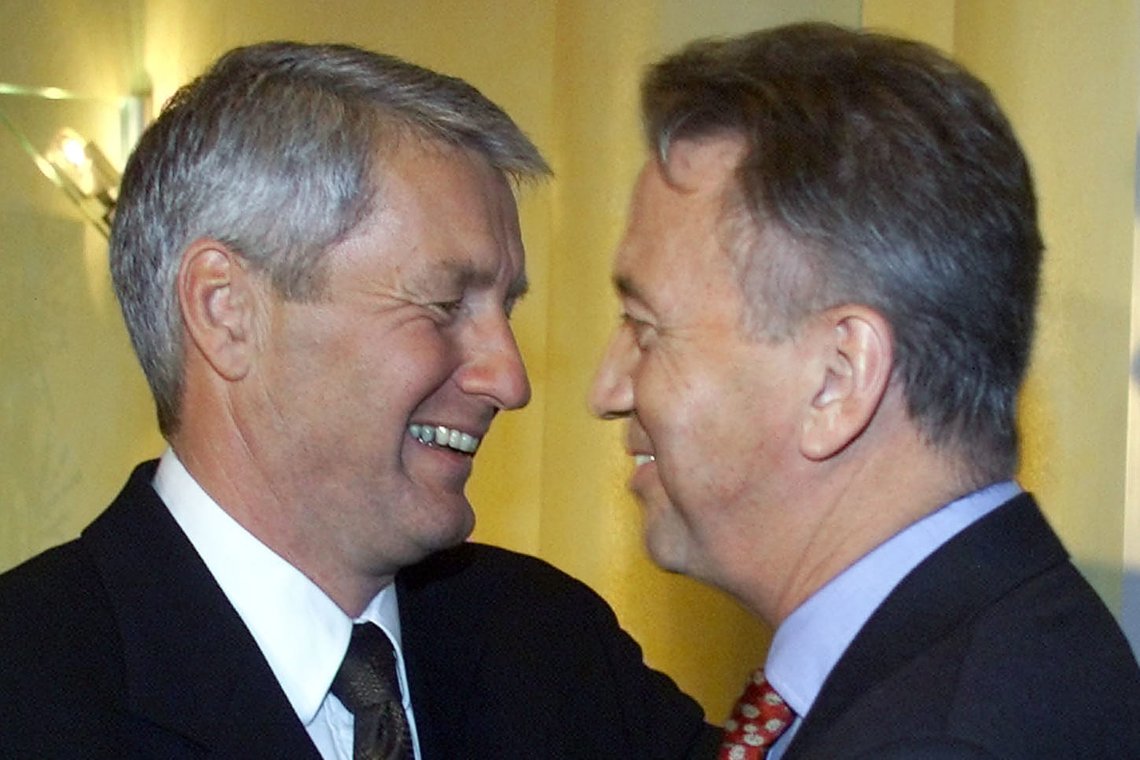
This account may perhaps help to explain some of the background to how things could go so wrong with Terje Rød-Larsen, Thorbjørn Jagland and the many others in the networks behind the privatisation of central parts of Norwegian foreign policy in the 1990s.
It in fact began somewhat earlier, already in the 1980s. It originated in a small milieu centred on the Labour Party (Arbeiderpartiet), the trade union movement and the social science research environments linked to the Levekårsundersøkelsen (Survey of Living Conditions) and the Maktutredningen (Power Study).
The aim of the initiators was to replace party- and membership-governed organisations with private, top-directed associations and networks led by themselves.
Politisk Forum in Oslo Arbeidersamfund was one example. The trade union movement’s research organisation, FAFO, modelled on Per Kleppe’s “think loft” in the Labour Party (Ap) and the Norwegian Confederation of Trade Unions (LO) under Bratteli, was another. The latter was to become central for the shaping of Norwegian Middle East policy.
Gudmund Hernes (Ap) at the University of Bergen was a key figure both in the Maktutredningen and in the Levekårsundersøkelsen. He later became the principal architect behind the disastrous school reform, “Reform 94”. Intoxicated by academic success, the ambitions were, quite literally, boundless.
Ten years earlier, in the autumn of 1984, LO, through FAFO under Gudmund Hernes’ leadership, wished to try its hand on the employers’ side, in order to create jobs in Finnmark. That, too, did not go particularly well.
Together with Shell, which wished to buy goodwill on the Norwegian continental shelf, and the technology company Bird in Bergen, Gudmund Hernes and Terje Rød-Larsen established the fish processing company Fideco.
It ended in failure and a resounding bankruptcy, which cost the taxpayers 80 million kroner and several local fishermen losses amounting to millions.
Terje Rød-Larsen, who had been marketing director at Fideco, could however pocket an option gain of 600,000 kroner, which was redeemed in a questionable manner just before the bankruptcy in 1992.
The matter had an aftermath in 1996. Terje Rød-Larsen escaped with a fine from Økokrim of 50,000 kroner, but had to resign as Minister of Planning in Thorbjørn Jagland’s government after only 35 days, the shortest ministerial career in Norwegian history.
The Fideco fiasco nevertheless put no stop either to Rød-Larsen’s or Gudmund Hernes’ ambitions and drive.
Hernes took the Levekårsundersøkelsen to Eastern Europe, while Rød-Larsen took it to Gaza and the West Bank in order to map the living conditions of the Palestinians.
It is less well known, but at this early stage Gudmund Hernes was Terje Rød-Larsen’s political protector. Hernes, with his academic rhetorical style, had a weighty voice with Gro Harlem Brundtland.
Within the Labour Party’s foreign-policy establishment, however, scepticism towards Hernes was considerable. Hernes was not one of them, just as little as Mrs Brundtland was. They did not come from “the shop floor” as Thorbjørn Jagland and the earlier leadership in the Labour Party had done.
Nor did Terje Rød-Larsen. He too came, like Hernes, from the University of Bergen. He was not a particularly diligent student, but was, like Hernes, rhetorically strong and a charming network-builder.
Ill-tongued observers have said that he might have become a fantastic car salesman. Instead he distinguished himself early in student politics in Bergen with long speeches about Jürgen Habermas.
Better-read students understood that he had not read much of the younger Frankfurt School, if anything at all. And many were surprised when he appeared as head of a new research institute, FAFO, inspired by Gudmund Hernes and financed by LO.
Rød-Larsen obtained an office on the second floor at Youngstorget, above Arbeidernes bokhandel. Initially FAFO received its financing from LO, before LO gradually ensured that they obtained permanent straws directly into the state treasury.
Surveys of living conditions became the brand that brought them to the Middle East, the refugee camps, the peace mediation and the Oslo Process.
Later FAFO acquired a kind of competitor in ECON. It was an offshoot from the period of Kåre Willoch’s government. ECON similarly embraced the idea of privatising several of the state’s traditional administrative areas.
ECON was established as an independent private limited company and took over large parts of the analytical work of Statistics Norway (SSB) and Norges Bank.
Both developments were attempts to replace parts of the state’s own analytical apparatus. They contributed, inter alia, to reducing the Planning Department in the Ministry of Finance almost to nothing, while the meritocratic culture in SSB deteriorated.
In the same way as FAFO, ECON made itself attractive as “development researchers” and thereby also soon entered the budgets of NORAD.
Jens Stoltenberg became the patron of ECON, just as Gudmund Hernes was that of FAFO. And Jonas Gahr Støre, who had carried Gro’s briefcase and had participated in “Scenarier 2000”, became the ‘working’ chairman of ECON.
The present critical focus on FAFO and the networks around FAFO, as a consequence of the Rød-Larsen case, should therefore probably also be directed towards ECON, or now ECON Pöyry, which has the public sector as its principal client.
To a large extent the same networks and the same conflicts of interest are present there.
However, when Johan Jørgen Holst passed away at an opportune moment, Rød-Larsen took over the Oslo Process and carried it forward on his own together with his spouse, Mona Juul.
And with the support of State Secretary Knut Vollebæk (Christian Democratic Party, KrF) in the Bondevik government, he obtained financing through the Ministry of Foreign Affairs (UD), despite the fact that the civil service strongly advised against the project because it “did not reach the threshold when measured against professional development-aid criteria”.
Nevertheless the project was allocated funds the following year as well, this time with Jan Egeland (Ap) as State Secretary. Once again the FAFO project was already approved by the political leadership before the application went to professional evaluation within the civil service. The civil service in the development-aid department in UD was in reality politically overridden.
Thus the privatisation of Middle East policy and central parts of Norwegian development aid and foreign policy became a reality. It was called “engagement policy” (engasjementspolitikk) and had no less an ambition than to build Norway’s reputation as a “humanitarian great power” and leading peace nation.
In this way the entire Oslo Process in reality rested on a private initiative driven by a small extra-parliamentary clique, without anchoring either in the Storting or in the civil service and alongside the parliamentary system. The same became the case for the peace work and the entire development-aid field.
Increasingly large sums were channelled into private NGOs that were neither subject to democratic control nor to normal auditing rules. There was no lack of money that gave access to red carpets and the highest international circles. But the results were as one might expect.
The peace work was driven into the ditch, among other places by Erik Solheim (Socialist Left Party, SV) in Sri Lanka and by Hilde Frafjord Johnson (KrF) in South Sudan and by Terje Rød-Larsen and Mona Juul in Palestine.
Rød-Larsen and Juul obtained a theatre play on Broadway financed by Jeffrey Epstein. Rød-Larsen was eventually dismissed from IPI. Juul was eventually dismissed from UD. Solheim was dismissed from the UN and now works for the Communist Party of China. Johnson was also dismissed from the UN. She now works as a consultant in Brussels.
Billions of Norwegian taxpayers’ hard-earned kroner brought neither peace nor democracy in Palestine, nor anywhere else. It brought only more unrest and more war, and eventually Gaza was flattened by the Israelis after Hamas killed and abducted more than 1200 Israelis from the Nova festival in October 2023.
Partly simultaneously with and partly after the Oslo Process, an ever larger private humanitarian-political complex emerged, with party figures such as Jan Egeland (Ap) and Raymond Johansen (Ap) at the forefront, as secretary-generals of the Norwegian Refugee Council and Norwegian People’s Aid (LO) respectively.
At the same time ever larger sums were channelled into private foreign NGOs, such as the Clinton Foundation and the Gates Foundation, among others. Everything network-based. Everything publicly financed. Everything removed from democratic control. And everything almost entirely without established routines for monitoring, auditing, control and follow-up of results.
The aid, which has now risen to almost 60 billion kroner per year, leaves an enormous hole in the state budget that must be covered by increased taxes. Equally troubling is that no one can account for where all the money goes.
So what can we learn from this?
Do not underestimate the stupidity of politicians. Reason and integrity are often inversely proportional to self-insight and restraint. The Fideco scandal, like the Oslo Process and large parts of the peace mediation, are examples of this.
Do not underestimate the importance of political networks. They incentivise intricate exchanges of reciprocal advantages and services, particularly when it concerns other people’s or the community’s money. The Epstein case is an example of this.
Do not underestimate people’s audacity. Most people intuitively understand conflicts of interest, yet they are continually violated for personal gain when control mechanisms are weak. FAFO’s and ECON’s straws into the aid budget provide many examples of this.
Do not believe that many professional politicians do not violate conflict-of-interest rules. The fact that as many as seven ministers in the Støre government have had to resign as a result of breaches of entirely elementary conflict-of-interest rules and other breaches of trust is an example of this.
Thomas Jefferson said about politicians who had made politics their livelihood: “If serving in an elected office becomes a career, it is only a matter of time before it leads to corruption.”
That may be something for the commission of inquiry that is to review the many Norwegian ramifications of the Epstein revelations to bear in mind.


