

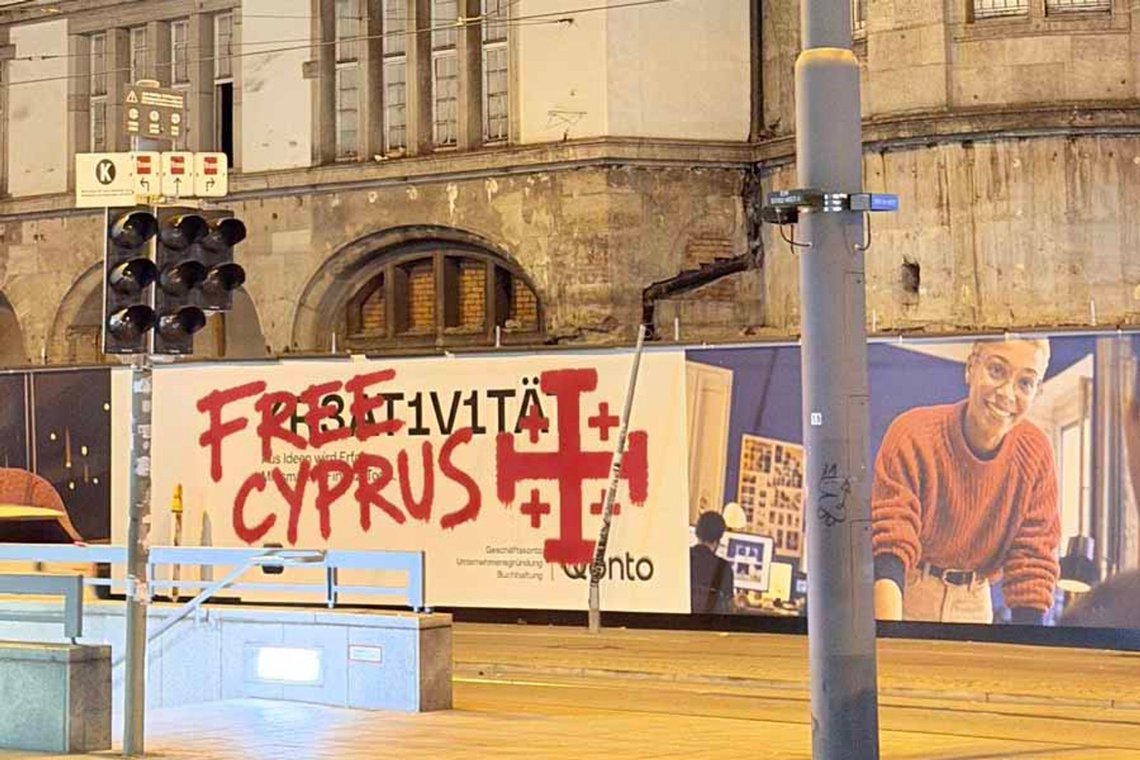


In recent weeks, the slogan ‘Free Cyprus’ has appeared on walls, gates and other surfaces suitable for graffiti in several European cities. Images of the phenomenon – which were first shared via accounts such as Visegrád 24 – show simple, often white spray-painted messages in various locations across Europe.
The phenomenon is attracting attention precisely because it stands out in an urban landscape where ‘Free Palestine’ has been a dominant slogan in recent years. Many who comment on the images point out the contrast: whilst messages of solidarity regarding conflicts outside Europe are highly visible, ‘Free Cyprus’ concerns a European country. Whilst ‘Free Palestine’ is about anti-Semitism and Islamic domination, ‘Free Cyprus’ is about the struggle against Islamic domination and the conquest of Europe.
An ongoing Islamic occupation of a European country
The slogan is linked to the Turkish invasion in 1974 and Turkey’s occupation of the northern part of the island. The internationally recognised Republic of Cyprus, which has been a member of the EU since 2004, controls the southern part, whilst the self-proclaimed ‘Turkish Republic of Northern Cyprus’ is recognised only by Turkey. The UN and the EU also regard the northern part as occupied territory.
The ‘Free Cyprus’ message is interpreted as a demand for reunification, the withdrawal of Turkish forces and the Republic of Cyprus’s full sovereignty over the entire island – a European territory that remains divided, more than half a century after the Turkish invasion.
We need a FREE CONSTANTINOPLE trend as well
— gp (@gigipiou) 10 November 2026
On social media, images of the graffiti have sparked expressions of support and debate about how it can be that the fact that parts of one European country are occupied by another do not receive more attention – why are the cameras focused on distant international conflicts when we have one right here in our midst? The graffiti is also dismissed as a far-right provocation, nationalist propaganda, anti-Islamic, etc.
It is unclear whether this is a coordinated campaign, the work of individuals or loosely organised activists. What is clear is that the message has provided us with a much-needed reminder of a ‘forgotten’, ongoing Islamic occupation of a country in the heart of Europe.


