

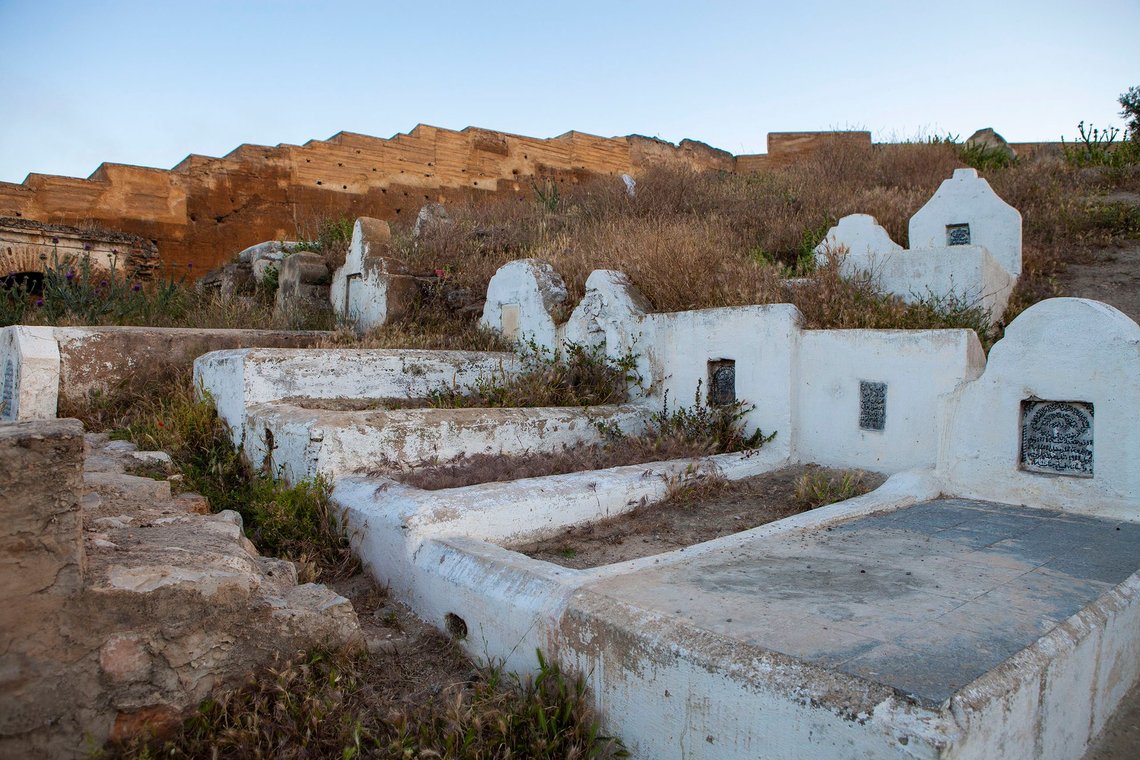
In several European countries, burial practices have become a topic of contention after immigrant Muslims increasingly demand that their dead should not be buried next to non-Muslims. The background is an Islamic understanding that non-Muslims are unclean and inferior, something that follows them into death and eternity.
According to Islamic scholars and fatwas, a Muslim must not enter eternity next to an infidel (“kuffar”). Therefore, a Muslim can no more be buried in an infidel’s burial place than an infidel in a Muslim’s burial place. This is absolute; it also applies to spouses and close family members who are not Muslims. A well-known fatwa from Sheikh Mohamed Ali Ferkous states that it is forbidden to mix the deceased in this way.
Death leads to conflicts in the world of the living
In Denmark, France, Belgium and England such demands have led to conflicts in the world of the living. In officially secular France, which has had religiously neutral burial grounds since 1881, the authorities have had to establish special Muslim sections to accommodate Muslims’ wish for separation from “dirty” heathens.
In Lyon, imam Kamel Kabtane warned in 2020 that the presence of deceased infidels prevented the burial of Muslims. In Belgium, a Muslim family reacted violently when a Christian was buried next to their deceased relative.
Muslim organisations in England also emphasise that Muslims should have their own burial grounds.
Several hundred thousand Muslims live in Berlin. The need for burial places is currently estimated at around 2,000 per year, which is sky-high compared to what is available. This places massive pressure on churchyards that are not adapted to Muslims’ needs. The demand for eternal grave peace clashes with the practice of time-limited grave leases and space-saving cremation.
It is about maintaining an Islamic identity that is segregated from the national and Christian culture, even in death.
Nor can a Muslim be buried next to his or her spouse if she is Christian or Jewish. Shortage of space has in recent years exacerbated the problems and led to a number of families “in protest” sending their deceased back to their country of origin.
Theologically, this is justified by the belief that dead Muslims shall rise on the Day of Judgement without “contamination” from “dirty, unworthy” non-Muslims.
🚨 TERRIFYING – MUSLIM IN CHICAGO: "Islam did not come to co-exist. Islam is always superior. Nothing is above Islam."
"It didn't come to live with these other religions…Islam came to correct all of that. To remove oppression of all those religions. It is the only way to… pic.twitter.com/C23n53KJkL
— War Correspondent (@warDaniel47) April 29, 2026
In Norway, most burial grounds are administered by the Church of Norway, but the municipalities have a duty to provide burial places for all faith and life stance communities. Muslims have been granted their own sections or fields in several public cemeteries, but we also have cemeteries where Christians and Muslims lie next to each other. Where this has been done properly, the Muslims lie with their heads turned towards Mecca and the graves can never be removed; Muslims demand eternal grave peace.
In local politics this is a demanding balancing act. By giving in to Muslims’ demands, the authorities legitimise the idea that Muslims have special rights. It also opens the door to the costs of greater land requirements and reinforces the impression that the native population must yield to foreign cultural demands.
The fact that even institutions such as burial grounds are demanded to be divided according to religious dividing lines shows that parallel societies follow us into eternity.
A Muslim preacher in the UK just claimed that Christianity is “Islamophobia” and that Muslims are offended by Christmas celebrations.
He openly suggested that the UK should ban Christmas because it’s “oppressive” to Muslims. Let that sink in. They don’t want to integrate. They… pic.twitter.com/CBotJfNw1b
— Yossi BenYakar (@YossiBenYakar) May 13, 2026


