

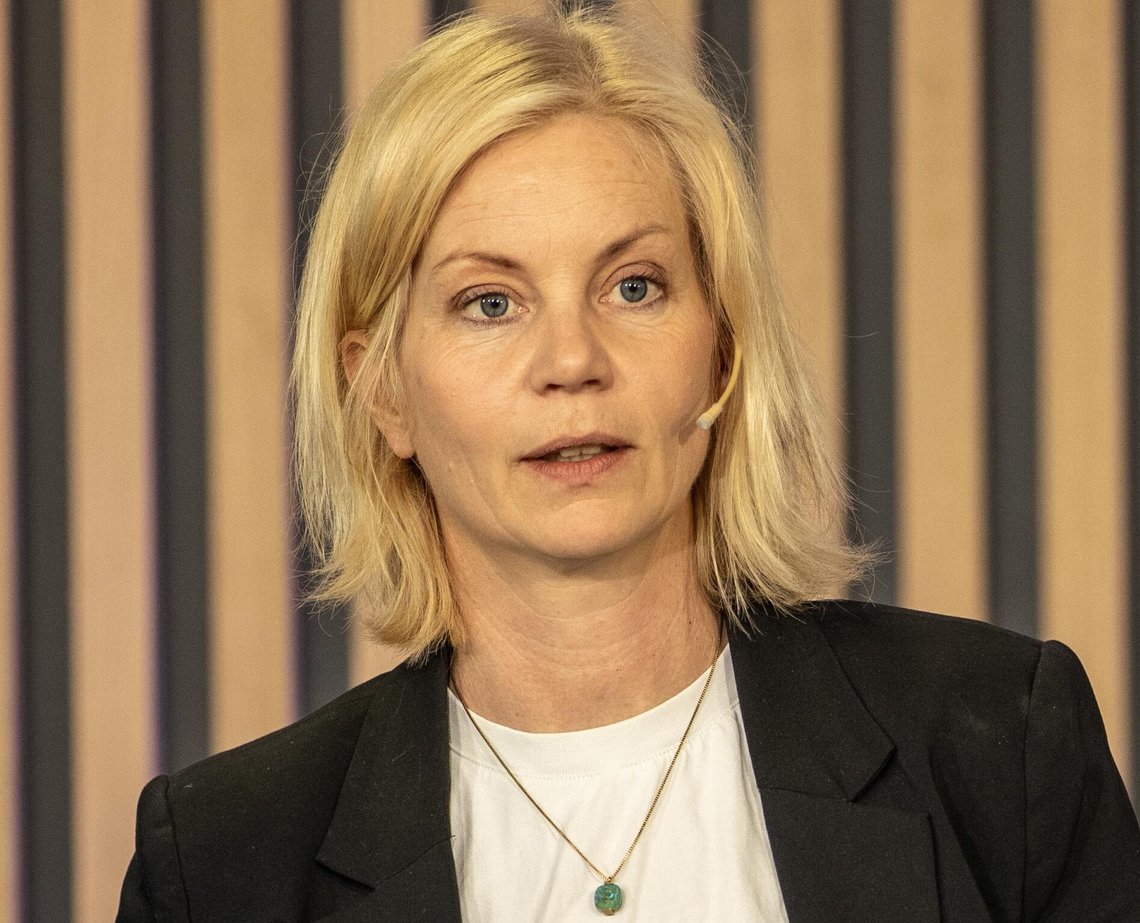
Two businessmen are becoming extremely wealthy from aid money to Somalia. One is married to a government minister, the other to a senior employee at Norad. Their rise up the social ladder has taken them from food shortages to detached houses in the city’s most desirable neighbourhoods.
This concerns the owners of a highly profitable consultancy firm, Ivar Strand and Ian Hawley.
This concerns their wives, Minister of Research and Higher Education Sigrun Aasland (Labour) and senior adviser Jessica Nyman at Norad.
This concerns aid funds from Norway that find their way back.
This concerns how an investment of NOK 30,000 became more than NOK 140 million in 11 years.
This concerns a career path and a rise up the social ladder, from food shortages to a fortune in the tens of millions.
Critics will say that this concerns rent-seeking activity feeding off public budgets that most people have lost track of.
As an aperitif to the story, we quote how Nyman opens the description of herself on her LinkedIn profile, «Passionate about private sector development in emerging and developing markets».
Somalia
It began in 2013, with Somalia, which was in a fragile state but emerging from the civil war and anarchy that had ravaged the country since the 1990s. Poverty, human rights violations and corruption were nevertheless the norm, and the Islamist terrorist group Al-Shabaab was a persistent threat.
But the year before, the country had established a government. It received the seal of approval from the United States and a number of other countries. The World Bank and the International Monetary Fund (IMF) were in place, and the UN expanded its mandate. Everything was set for peace, reconciliation and nation-building. But it cost money – a great deal of money.
Norway has been among the largest donors. The aid is channelled directly or indirectly through the World Bank, the IMF and the UN system. Based on official sources, total Norwegian aid is estimated at NOK 7–8 billion from 2012 to 2025. Up to half is direct aid, while the remainder is channelled mainly through the World Bank.
While the Ministry of Foreign Affairs is responsible for the disbursements, Norad provides the basis for decisions and the professional premises. Norad administers support for non-profit organisations and some long-term development agreements. In addition, it follows up results reporting and independent evaluation.
To an outsider, international aid appears opaque, rather like a labyrinth requiring insight and contacts to find the right entrances and exits, and thus where the money goes in and out, and who decides what.
Abyrint
While the conditions were being put in place for large-scale aid to Somalia, Ivar Strand, Ian Hawley and Jessica Nyman worked at the auditing and advisory firm Price Waterhouse Coopers. All had extensive experience at PwC with auditing, including the auditing of aid. Both Strand and Aasland had also worked at the World Bank. Strand worked as an «Operations officer» for five years before joining PwC. When Nyman left PwC, she worked for a number of non-profit organisations, including Bellona, before becoming a senior adviser at Norad.
Now the opportunity presented itself to strike out on their own – to become entrepreneurs.
On 16 October 2013, the limited company Abyrint AS was incorporated with NOK 30,000 in equity capital. The company’s address was Nonnegata 17 in the Gamle Oslo borough, the same as the residential address of the Strand/Aasland couple.
At the time, Sigrun Aasland was an adviser to the parliamentary group of the Socialist Left Party.
According to the memorandum of association, the company’s purpose is as follows: «Advisory services for public authorities and businesses, as well as everything naturally associated with this, including participation in other companies engaged in similar activities, the purchase and sale of shares, or otherwise acquiring interests in other enterprises.»
The company’s website states that Abyrint is a consultancy firm specialising in war-affected and fragile states. Today, it has seven employees. According to the company itself, they are specialists in combating corruption, for example «ghost workers». They write: «Who are the ghost workers? Who is profiting from the scams? What can be done about it? Don’t blame the ghosts; they may be 100% innocent, and they’re certainly not the ones getting rich.»
On the website, Strand is interviewed by someone called «Aby», where he looks back on the company’s history.
«Engaging in fragile states, and particularly in Somalia, where we started, was, in retrospect, a significant start-up risk. I don’t think we understood how great the risk actually was – either commercially or otherwise.»
That concern can hardly have lasted long. For as soon as Strand and Hawley had each contributed NOK 15,000 in equity capital, money began pouring into the company.
 Managing partner and 50% owner of Abyrint, Ivar Strand, married to Minister of Research and Higher Education Sigrun Aasland.
Photo: Abyrint
 On 2 February 2025, Sigrun Gjerløw Aasland (centre) went from being State Secretary at the Ministry of Climate and Environment to becoming a government minister.
Photo: Lise Åserud / NTB
 Business partner Ian Gerald Hawley owns 50% of Abyrint.
Photo: Facebook
 Maria Jessica Helena Nyman, senior adviser at Norad and married to Ian Gerald Hawley.
Photo: LinkedIn
The gold mine
In its first year of operation, 2014, Abyrint AS had revenues of no less than NOK 31.6 million. After NOK 1.1 million in salaries, Strand and Hawley took out a combined dividend of NOK 6 million.
As early as April 2014, the company moved from the kitchen table at Strand and Aasland’s home to its own office. First to the House of Business entrepreneurial complex at Dronning Eufemias gate 16, and the following year to Dronningens gate 15.
Abyrint AS defies Martin Bech Holte’s description in the book “Landet som ble for rikt” of productivity growth having peaked in 2013 and subsequently declined. Strand and Hawley had struck gold and were raking it in.
As of the end of 2024, Strand and Hawley had received a combined NOK 59 million in dividends. In addition, NOK 72 million had been paid out in salaries. And the company had almost NOK 12 million in cash and retained equity.
Whatever risk Strand sees in retrospect cannot possibly be financial, since an investment of NOK 30,000 has, in just 11 years, yielded more than NOK 140 million in dividends, salaries and reserves. See the following table.

While the millions in aid money were pouring in to her husband, Sigrun Aasland joined the think tank Agenda, where she rose through the ranks and became its director. While there, she switched from the Socialist Left Party to the Labour Party.
After more than six years at Agenda, she became managing director of the ZERO Environmental Foundation, where she remained for almost three years before becoming State Secretary at the Ministry of Climate and Environment. When the Centre Party withdrew from the government in February, Aasland was appointed Minister of Research and Higher Education.
The donors
According to Grok, Abyrint’s three largest clients are:
- Somalia’s Ministry of Planning, Finance and Revenue. This is described as Abyrint’s primary and longest-standing client.
- The World Bank. Strand and Aasland’s former employer, and perhaps a client of PwC. Abyrint is a trusted adviser to the World Bank’s portfolio in Somalia of more than one billion dollars.
- The Multi-Partner Fund for Somalia (MPF), a donor-funded fund that coordinates aid for Somali state-building, supported by Norad, among others.
These constitute the core of Abyrint’s work. In addition, Grok identifies the following names: DFID/UK Aid, now called the FCDO – Foreign, Commonwealth & Development Office, EU aid programmes and USAID.
All these clients have one thing in common. They are all financed by taxpayers in Norway and elsewhere in the world.
Abyrint has been a money-making machine without equal. Its operating margin has averaged 35 per cent. The company ties up no capital, and even with moderate margins of 16–17 per cent in 2023 and 2024, the return on capital exceeded 40 per cent, producing net profits of NOK 2.6 million and NOK 3.4 million respectively, after annual salary payments of more than NOK 7 million.
During his student days, Ivar Strand was very concerned with trust. «What I fear is that institutions will be given greater freedom without being held accountable», he told the university newspaper Uniforum in 2000, regarding the way universities structured their courses, adding: «Many have little confidence in this system».
Document.no has put the following question to Ivar Strand and Sigrun Aasland via the press office at the Ministry of Education and Research:
Many have lost confidence in Norwegian aid policy. What confidence do you have in it?
First, Anders Lundell at the press office of the Ministry of Education and Research confirmed that the enquiry had been received and that they would get back to us. Just over an hour later, Jaber Munir Osman Humed at the press office stated that they declined to comment on the matter. Ivar Strand has not responded to the enquiry.
The rise up the social ladder
Ivar Strand and Sigrun Aasland met while studying in Bergen, where they studied comparative politics, the University of Bergen’s version of political science. They have both since completed Master’s degrees at Johns Hopkins University in the United States.
«I remember demonstrations and activism, the feeling of being very short of money and having to choose between noodles and cigarettes», Aasland said in an interview with the student newspaper Studvest in May, about the journey from «Høyden» (the University of Bergen) to the government quarter.
The previous time she was interviewed by Studvest was in 1999. She was then 21 years old and the newly elected leader of the Norwegian Union of Students. It states that, while growing up in Grimstad, Aasland imbibed socialist ideas with her mother’s milk from her radical parents, and that she was a determined student politician who spent more time on politics than on the curriculum.
“Auntie is an example to follow in almost every respect”, Aasland told Uniforum – the online newspaper of the University of Oslo. She was referring to Socialist Left Party veteran Thora Aasland, who has also served as Minister of Research and Higher Education.
Asked where her commitment came from, she replied: «Life is much more enjoyable when you care about how the world ought to be and want to drive it forwards.»
For Aasland and her husband, the world has also moved upwards. When the adventure with aid money began, they lived at Nonnegata 17, a block of flats in Oslo’s Gamlebyen district.
It is described as part of an urban, green and environmentally friendly housing development, built according to ecological principles and sustainability. The flats have two to four rooms and measure 50–90 square metres. The neighbourhood is described as trendy and vibrant.
But when children approach school age, the school catchment area becomes an important criterion when choosing where to live in Oslo. Nonnegata falls within the catchment area of Gamlebyen school. With Grønland and Tøyen nearby, the proportion of pupils from minority backgrounds at Gamlebyen school was almost 60 per cent at the time.
The cafés of Bjørvika and the short distance to the city centre then had to take second place. In 2017, the Strand/Aasland family moved to a large detached house in Nordstrand. The address falls within the catchment area of Nordseter school. In that school district, the proportion of pupils from minority backgrounds is only 10 per cent.
In the 2024 tax lists, Ivar Strand is recorded as having taxable wealth of NOK 18.3 million. Sigrun Aasland is recorded as having «only» NOK 3.6 million. Had it been the other way round, she would have ranked third among her government colleagues, behind Jan Christian Vestre and Jonas Gahr Støre, but ahead of Jens Stoltenberg.


