

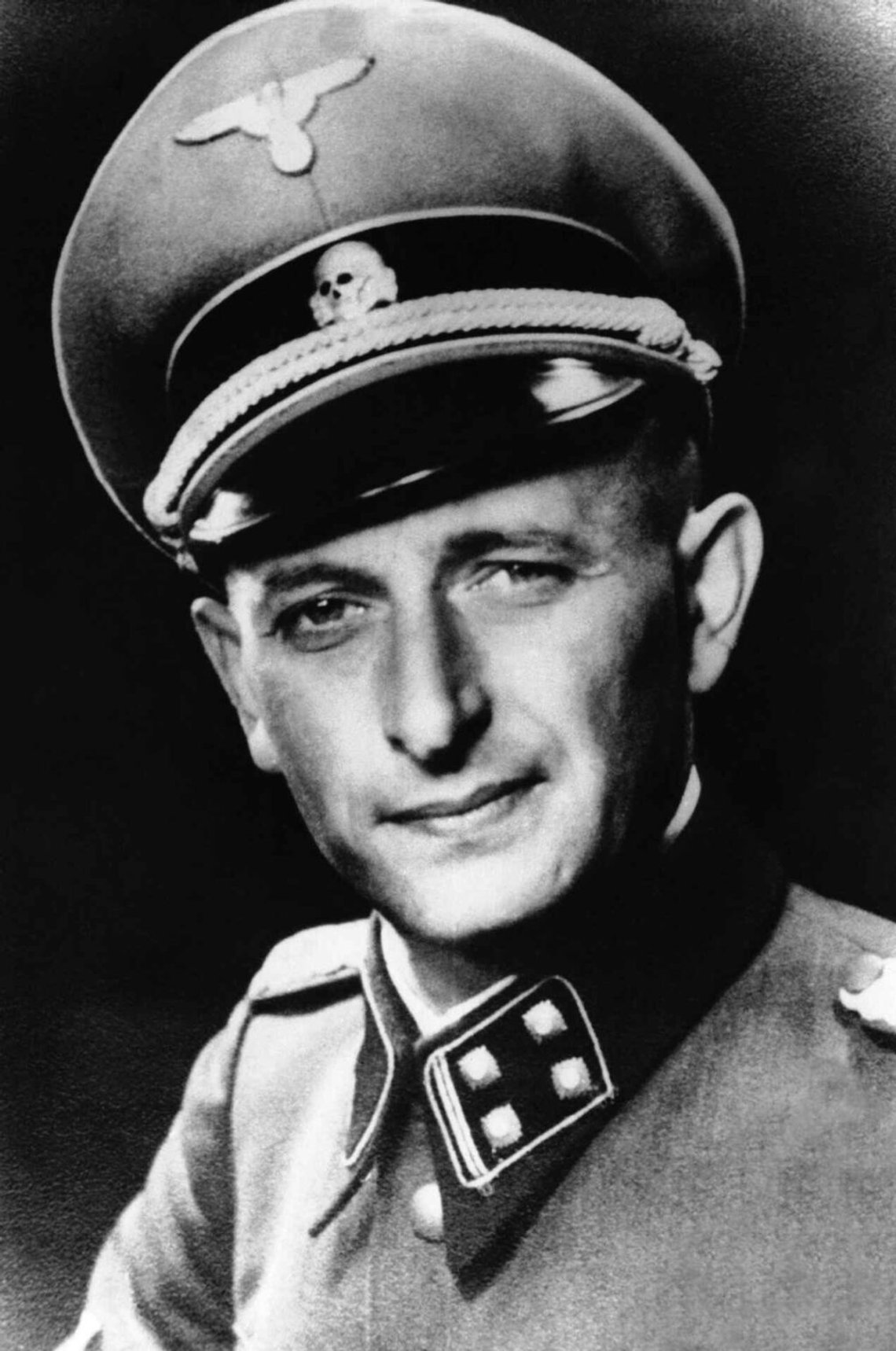
 Shown in an undated photograph of Adolf Eichmann at the height of his power as the Nazi SS Lieutenant Colonel in charge of Hitler’s Jewish bureau. (AP Photo)
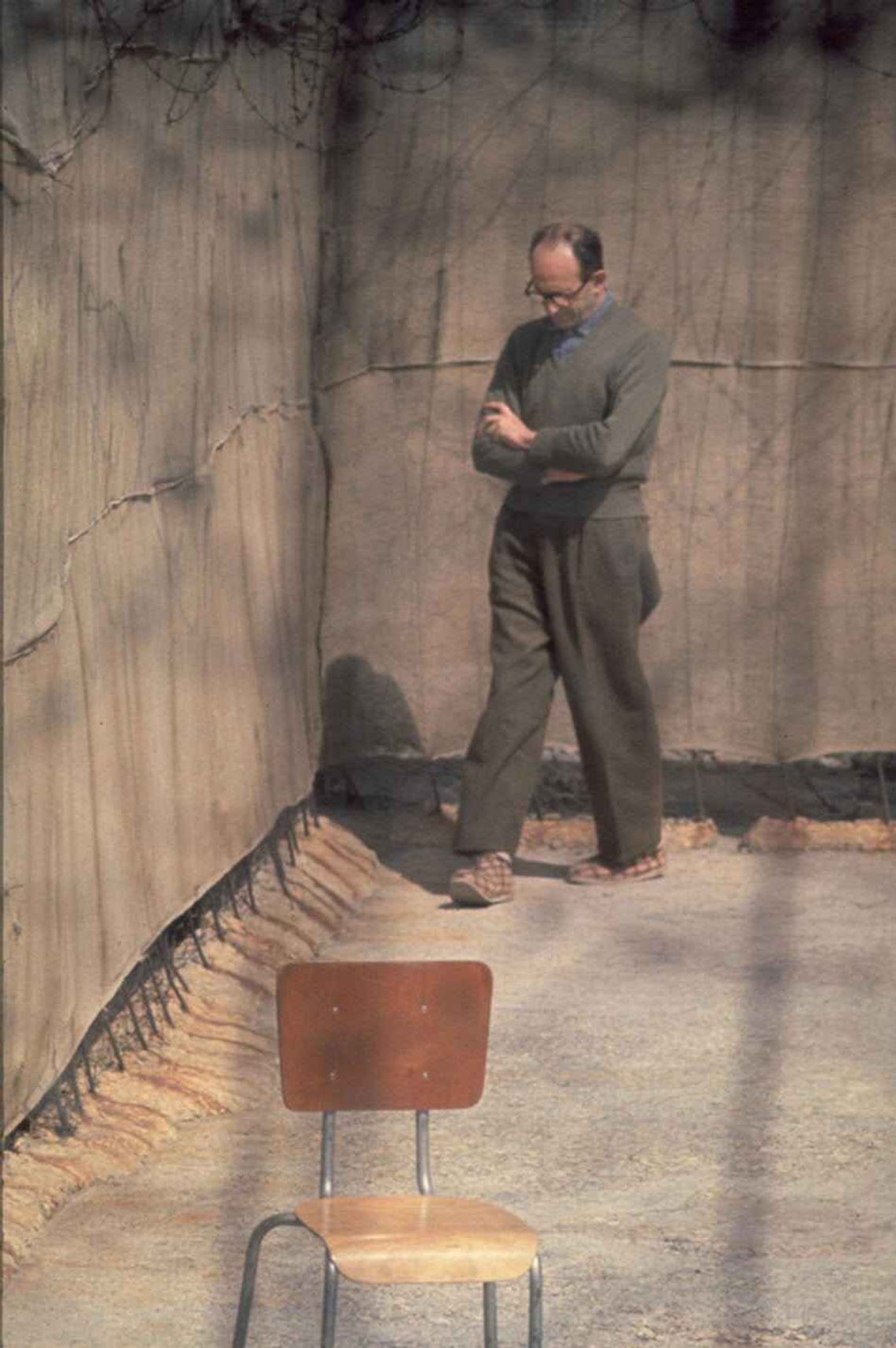 SS Obersturmbannführer Adolf Eichmann in the exercise yard outside his cell in Ramla Prison in 1961.
Adolf Eichmann was a German Nazi SS-Obersturmbannführer (Lieutenant Colonel) and one of the principal organisers of the Holocaust.
Because of his organisational abilities and ideological reliability, Eichmann was tasked by SS-Obergruppenführer Reinhard Heydrich with facilitating and directing the logistics of the mass deportation of Jews to ghettos and extermination camps in German-occupied Eastern Europe.
After the Second World War, he fled to Argentina using a false passport issued by the International Committee of the Red Cross. He lived in Argentina under a false identity and held a number of different jobs until 1960.
He was apprehended by Mossad agents in Argentina and brought to Israel to stand trial on 15 criminal charges, including crimes against humanity and war crimes.
Mossad succeeded in bringing an EL AL aircraft to Buenos Aires to extract Eichmann from Argentina. When the Argentine authorities discovered the real reason the aircraft was in Argentina, they attempted to prevent it from flying back to Israel.
Mossad managed to escape only because they flew directly to Africa to refuel rather than remaining in the Western Hemisphere as they had indicated in their flight plan.
He was found guilty and executed by hanging in 1962. He is the only person ever executed in Israel following a sentence handed down by a civilian court.
Eichmann was hanged shortly before midnight on 31 May 1962 in a prison in Ramla, Israel. His executioner was Shalom Nagar.
The most disturbing aspect of 7 October is not merely that people were killed. Nor is it only the brutality, although that in itself is almost unbearable to comprehend. The most disturbing aspect is that the violence possessed an inner order.
Not a moral order. Not a civilised order. But a diseased order.
For when the testimonies speak of rape, mutilation, laughter, photography, telephone calls home, and an almost triumphant delight in the suffering of the victims, we are not merely confronted with military violence. We are confronted with a violence that has crossed another threshold. It does not kill merely in order to win. It desecrates in order to affirm a worldview.
This is what often disappears when the West attempts to explain Hamas through ordinary political categories. One speaks of occupation, blockade, desperation, poverty, asymmetry, and historical injustice. All of this may illuminate the framework surrounding the conflict. But it does not explain the laughter. It does not explain why dead bodies were mutilated. It does not explain why women were violated after they had become defenceless. It does not explain why the killings were turned into trophies.
To understand this, one must go deeper than politics. One must enter into the view of man.
Hamas is not merely a national liberation movement with weapons. Hamas is an Islamist movement in which the conflict is understood not only territorially, but theologically. The enemy is not merely a political opponent. He is placed within a cosmic narrative. He becomes the bearer of impurity, occupation, godlessness, betrayal, unbelief, and demonised power. The Jew, the Israeli, the “Zionist”, the kafir—these figures merge into one another within the internal propaganda until the concrete human being disappears.
And when the human being disappears, the boundary disappears as well.
It is here that dehumanisation reveals its deepest effect. It does not merely say: This human being is my enemy. It says: This human being is less than human. He does not belong to the same moral order. He does not possess the same value. The claim to protection that ordinarily follows the body, the face, the child, the woman, the elderly person, the wounded person, does not fully apply here.
This is how cruelty becomes possible.
Not because the perpetrator does not see the victim. He sees the victim very clearly. He sees the fear, the pain, the helplessness, the body. But he no longer sees a “you”. He sees an object. A prey. A symbol. A piece of hostile matter that can be used, violated, and destroyed.
In a diseased way, it therefore makes sense. Not moral sense, but internal ideological sense.
It resembles the form of evil one sees in people who abuse animals. Not because the victims are animals, but because the perpetrator has placed them there. Beneath the human. Outside the circle of compassion. Those who abuse animals often display not only aggression, but a particular contempt for the defenceless. It is power over life that cannot answer back. Power over suffering that acquires no moral significance. Power without responsibility.
When a human being has been reduced to something lower than a human being, human suffering can likewise be treated as animal noises. The scream does not stop the act. It confirms it. The crying does not become an appeal to the conscience. It becomes a sign of victory.
Then laughter can arise.
The laughter is therefore not a random psychological reaction. It is revealing. It shows that the barrier has disappeared. It shows that the perpetrator is not merely carrying out an order, but experiences the violation as a confirmation. He sees his own power in the victim’s degradation. He sees his worldview realised in the collapse of the other.
This is the most terrible mechanism of evil: first it deprives the victim of human dignity. Then it treats the victim in accordance with the new image. Finally, it points to the victim’s degradation as proof that the image was true.
Thus a closed circle is created.
This is also why the modern compulsion to explain falls short. For it wishes to make evil into a reaction. It wishes to make atrocities into a product of structures. It wishes to find a before that explains an after. But certain actions cannot be understood solely through chains of causation. They must be understood through the view of man that made the action possible.
For human beings do not act merely on the basis of needs. They act on the basis of ideas. They act on the basis of what they believe the world is. What they believe the enemy is. What they believe the body means. What they believe God permits. What they believe victory consists of.
If the enemy is a human being, there are limits.
If the enemy is an animal, there are fewer.
If the enemy is demonic, impure, unbelieving, historically guilty, and metaphysically legitimate to hate, then even the most monstrous acts can appear as purification, revenge, or a sacred deed.
This is what Hamas’ ideology does. It does not merely bring weapons into the conflict. It brings a particular order into the gaze. It teaches human beings to see the other in a manner that weakens the conscience. It makes it easier to kill, easier to violate, easier to laugh.
And herein lies the connection between ideology and demonic evil.
The demonic need not be chaotic. It can be disciplined. It can march. It can pray. It can quote sacred texts. It can possess a command structure, objectives, slogans, and narratives of martyrdom. The demonic does not always manifest itself as the absence of order, but as an inverted order. An order in which good is called evil, in which evil is called justice, and in which the victim is made guilty of his own destruction.
This is the perverse theology.
When the body is violated, it is not only the body that is violated. Human dignity itself is attacked. When a woman’s genitalia are turned into a battlefield, when the corpse is turned into a trophy, when the child is turned into an instrument of fear, then the violence is not merely physical. It is symbolic. It says: You are not the bearer of inviolable value. You were not created in an image that places obligations upon me. You are something I have the right to use.
For that reason, it is insufficient to call 7 October “terror”. It was terror, but it was more than terror. Terror seeks to frighten. This also sought to desecrate. Terror seeks to produce a political effect. This carried within it a desire to demonstrate that the victim had already been placed outside the community of mankind.
The Nova festival makes this even clearer. It was not a military target. It was a place of youth, music, dance, trust, and openness. In other words, precisely what a life-hostile view of man cannot tolerate. Joy was attacked because it was joy. The body was attacked because it was free. Community was attacked because it showed human beings meeting without fear.
Evil often seeks out that which shines, not because the light is strong, but because it is unbearable to those who have devoted themselves to darkness.
But there is another seriousness here as well. For if the West no longer understands the religious and ideological mechanisms of dehumanisation, then the West will no longer understand what it is confronting. It will continue to treat a civilisational question as a matter of conflict management. It will respond to metaphysical hatred with process. To desecration with seminars. To demonisation with nuance.
Nuance is necessary where reality is complex. But nuance can also become a way of avoiding judgement.
And this is the real danger: that we lose the ability to say that something is evil because it rests upon a view of man that makes evil possible.
Not all evil is inexplicable. On the contrary. Some of the worst evil is precisely explicable. It follows its own logic. It begins with a word, a distinction, a narrative of who is inside and who is outside. Then comes contempt. Then comes distance. Then comes the right to hate. Then comes the right to destroy.
Finally comes the laughter.
It was not only human beings who were killed on 7 October. It was the human being as an idea that was attacked. The notion that even the enemy has a face. That even the stranger possesses a body that cannot be violated without guilt. That even the one whom one hates stands within an order that imposes obligations.
When that order collapses, everything becomes possible.
Then it is no longer enough to ask what Hamas did. One must ask what view of man made it possible to do it with joy.
And then we approach the uncomfortable answer: before the violence came, the victim had already been deprived of his humanity.
The rest was implementation.


