



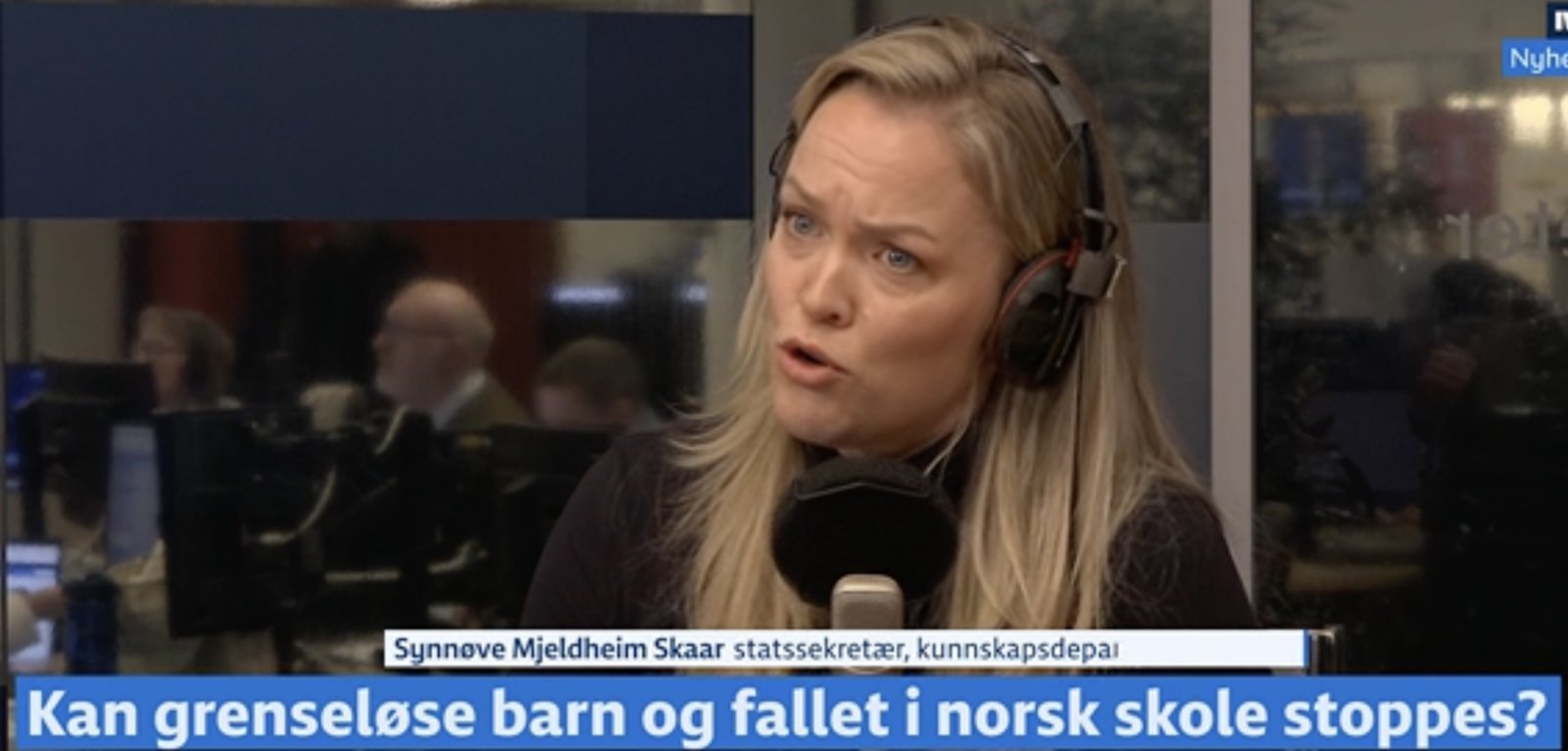
Trond Lydersen is a journalist on *Politisk kvarter* who asks incisive questions. On Thursday, he followed up with the headteachers from Askøy and TV2’s report on school violence. In the studio were State Secretary Synnøve Mjeldheim Skaar and Simen Velle.
The discussion is marred by the fact that the politicians are combative figures intent on winning. The subject is far too serious for that sort of posturing. Simen Velle had set out to demonstrate that the FrP is confident it has the strongest case.
It was the FrP that last week tabled a Dok 8 proposal in the Storting with a comprehensive justification.
The situation is getting worse year on year.
The NIFU report *When schools become unsafe for adults* (NIFU report 2025:14) from 2025 shows that 80 per cent of primary and lower secondary school heads reported violence against staff in the past year, and 88 per cent reported threats. The report further states that the incidents involved punching, kicking, shoving, biting and throwing objects. Special needs teachers and teaching assistants working closely with pupils requiring adapted teaching are particularly at risk.
The scale of the problem remains serious: in 2025, 5,972 incidents of violence and threats were reported at Oslo’s mainstream primary schools. Oslo City Council’s overview shows 4,696 reported incidents in the first half of 2026.
Nyhetsmorgen interviewed a teacher at Bønsmoen Primary School. She said that she is on her own and never knows what will happen. On Wednesday, one pupil had attacked another. The situation had escalated. “What do you do to calm things down?” asks Lydersen. “It often ends with the troublemaker being made to bake buns and given chocolate milk,” replies the teacher.
This is a far cry from the guidelines set out by the FrP, which want to remove such troublemakers from the classroom. But to what end? It is stated that a member of staff must be present to meet the expelled pupil, who is to receive tuition elsewhere.
From August 2025, teachers were granted the right to physically restrain pupils. However, the legislature does not wish to acknowledge that the balance of power in the classroom has already shifted in favour of violent pupils. Teachers live in fear of retaliation if they intervene.
From 1 August 2025, staff were also permitted to intervene physically in cases of psychological abuse and significant disruption to fellow pupils’ education (Education Act, Section 13-4). The conditions are, however, strict: other measures must have proved insufficient, and the intervention must be necessary and proportionate. In *Utdanningsnytt* on 17 September 2026, psychologist Rebecka Mikkelsen describes serious health problems following pupil violence and teachers’ fear of the reactions to their own intervention. The proposers believe this underlines that the current regulations are inadequate: strict conditions can create uncertainty and doubt as to when staff may intervene.
The authorities have long been on the pupils’ side. They have been able to report the teacher under the notorious Section 9a, and the teacher has been unable to defend themselves before the school management. It has been a protracted bureaucratic process in which the teacher must document the situation and justify the use of force.
People are reluctant to intervene if it results in a lot of paperwork and red tape.
The proposers believe the problem is not that schools lack a duty to act, but that the available measures are too limited and too cumbersome to use when the situation calls for swift action. Strict conditions, discretionary assessments and requirements for reporting, documentation and case handling can create uncertainty and delay action.
The Progress Party (FrP) could have been much clearer that this bureaucratisation of teachers’ day-to-day work is destructive. But it is creeping into all areas of society: doctors have long had to fill in forms, as have the self-employed, and from 1 January, farmers must also submit climate accounts!
Dagsnytt discussed whether it was right to let the rich keep more of their money. NRK’s journalists are on the side of ‘the vulnerable’. But the consequence of green policies is that only the big players survive. The small ones are going under.
The Progress Party (FrP) should have addressed the judicialisation of all interpersonal relationships and the desire for detailed regulation. It creates a very specific type of person who follows the rules.
Schools need people with completely different qualifications. But when all one hears from the top is evasion and attempts to redefine and rationalise away issues, it trickles down through the system. No one dares to challenge the system.
That is why there was a sense of resignation about the teacher from Bønsmoen. She had to adapt to the circumstances.
The government won’t admit this, because then it would lose face. Keeping up appearances has become the most important thing in politics.
The Progress Party (FrP) also sees the issue from the perspective of the ‘problem children’. The pupil should be allowed to keep their place in the class based on the need for a sense of belonging.
Why should the needs of a disruptive pupil take precedence over the interests of the whole class?
The school can adapt its teaching and organise pupils into different groups for parts of the curriculum. The pupil should nevertheless belong to a class and receive sufficient teaching there to ensure a sense of social belonging. Permanent, separate teaching or the use of an alternative setting normally requires an expert assessment, consent and a decision on individually adapted teaching. Such an arrangement must be justified by the pupil’s own educational needs, not by the need to protect others. A compulsory change of school is possible when the behaviour seriously jeopardises the safety or learning of fellow pupils, but the decision lies with the local authority or county council, not with the headteacher. A specific number of previous suspensions is not required; the circumstances must be assessed on a case-by-case basis.
The Progress Party (FrP) does not dare to face the consequences of its own proposals. This would mean permanently removing these pupils from mainstream schools and establishing special schools.
Social democracy does not permit discrimination against protected groups.
Støre would rather see the school system collapse than have immigrant children forcibly segregated, as their parents do not agree to their children being discriminated against.
But then Støre must make a choice: if he uses coercion to keep problem children in school, he sacrifices the future of the other children.
There is one voice we hear very little from: the parents of ordinary, normal children. They are subjected to horror stories every single day. It must be a topic of conversation around the dinner table. Yet we hear little or nothing about what they think. This in itself is alarming.
Even the FrP is on the ‘intervention’ track. The use of resources is not being questioned. Disruptive pupils are to be offered support as if they have the same rights as the others. How large a support system is required? Is there any consideration given to balancing the use of resources in relation to ordinary pupils?
When pupils are excluded, it is important to involve the relevant authorities to assess the pupil’s needs and ensure coordinated follow-up. Depending on the situation, this may include the police, child protection services, social services, school nurses, child and adolescent mental health services (BUP), the educational psychology service (PPT) or other relevant agencies. The school should not be left to manage the follow-up of pupils with complex needs on its own.
Put simply: The parents are on benefits, and now the state is to set up a huge apparatus to look after their disruptive children?
Does the FrP think this will go down well with voters?
The immigrant community has caused such major problems that drastic measures are needed. In ‘Poor Norway’, the working class held a moral principle that those who did not work should not eat. It was a saying that concealed a truth: society could not afford freeloaders. It was brutal, but there was a sense of realism in it.
Today’s Storting politicians lack this sense of reality.
The Progress Party does not dare to take decisive action, but says: ‘Yes, thank you to both sides.’ Problem children are to be offered support on their own terms. What will that cost?
The proposers also wish to give headteachers the authority to impose special education outside ordinary classes or schools and ensure access to suitable municipal, inter-municipal or other educational and support services. The measure should be able to continue without a fixed upper time limit, with ongoing assessment of need and a return to mainstream education when it is appropriate. The pupil is to receive targeted support and the necessary education, whilst other pupils and staff are protected. Legal certainty and the best interests of the child must be safeguarded, including for children who are subjected to violence and threats. The Government should clarify the scope for stronger measures provided by the Convention on the Rights of the Child, and how the rights of the pupil in question are to be balanced against other pupils’ rights to safety, protection and education.
It is perfectly obvious: the parents of problem children must be held accountable. They must be told that if they wish to continue receiving benefits, they must accept the consequence that their children will have to attend a special school. The Progress Party (FrP) is proposing such a solution, but does not dare to say so openly.
The FrP’s proposal
Against this background, the following is proposed
Proposal:
The Storting calls on the Government to ensure that teachers are given the authority to exclude pupils from their own lessons and, in the event of violence or serious threats, for the remainder of the school day, and to ensure arrangements are in place for the necessary follow-up of the excluded pupil without disrupting lessons for other pupils.
The Storting calls on the Government to ensure that schools include clear procedures in their contingency plans for following up on pupils who are removed from the classroom. These procedures must cover situations where pupils are removed immediately or for short periods, and clarify responsibilities, whereabouts, supervision and follow-up, so that lessons for the other pupils can continue.
The Storting requests that the Government put forward a proposal to grant headteachers the authority to expel pupils, who shall have no right to education during the period of expulsion, for up to ten school days in the event of violence, serious threats or other particularly serious breaches of the rules, with the possibility of one extension of up to five school days. The school authority and the school shall follow up on the pupil through discussions with the pupil and their parents, as well as by planning their return to school or further measures.
The Storting calls on the Government to grant headteachers the authority to impose, without requiring parental consent, special education outside the regular class or school in the event of serious or repeated problematic behaviour, in order to provide the pupil with the necessary support and prevent further negative developments, whilst safeguarding the safety, learning environment and rights of other pupils and staff. The measure shall be able to remain in place for as long as necessary, without a fixed upper time limit, with ongoing assessment of the need and a return to the regular setting when it is appropriate.
The Storting calls on the Government to ensure that local authorities and county councils have access to specialised training and support services for pupils with serious or repeated behavioural problems, including through municipal, inter-municipal or other suitable services.
The Storting calls on the Government to introduce a national minimum standard ensuring that violence and serious threats against pupils or staff shall always constitute grounds for suspension, and to enshrine in law the duty of schools to report serious violence and serious threats against pupils or staff to the police. The Government is asked to draw up national guidelines for the practical implementation of the duty to report. Local authorities and county councils retain the power to set other school rules and determine local responses within the framework of the national minimum standard.
The Storting requests that the Government put forward a proposal to remove the requirement that other measures must be insufficient before staff may intervene physically under Section 13-4 of the Education Act, and to ensure that this is replaced with a requirement that the intervention must be necessary and proportionate. The Government is also requested to simplify the reporting and documentation requirements for less serious interventions.
Watch the debate on ‘Politisk kvarter’ here.


