

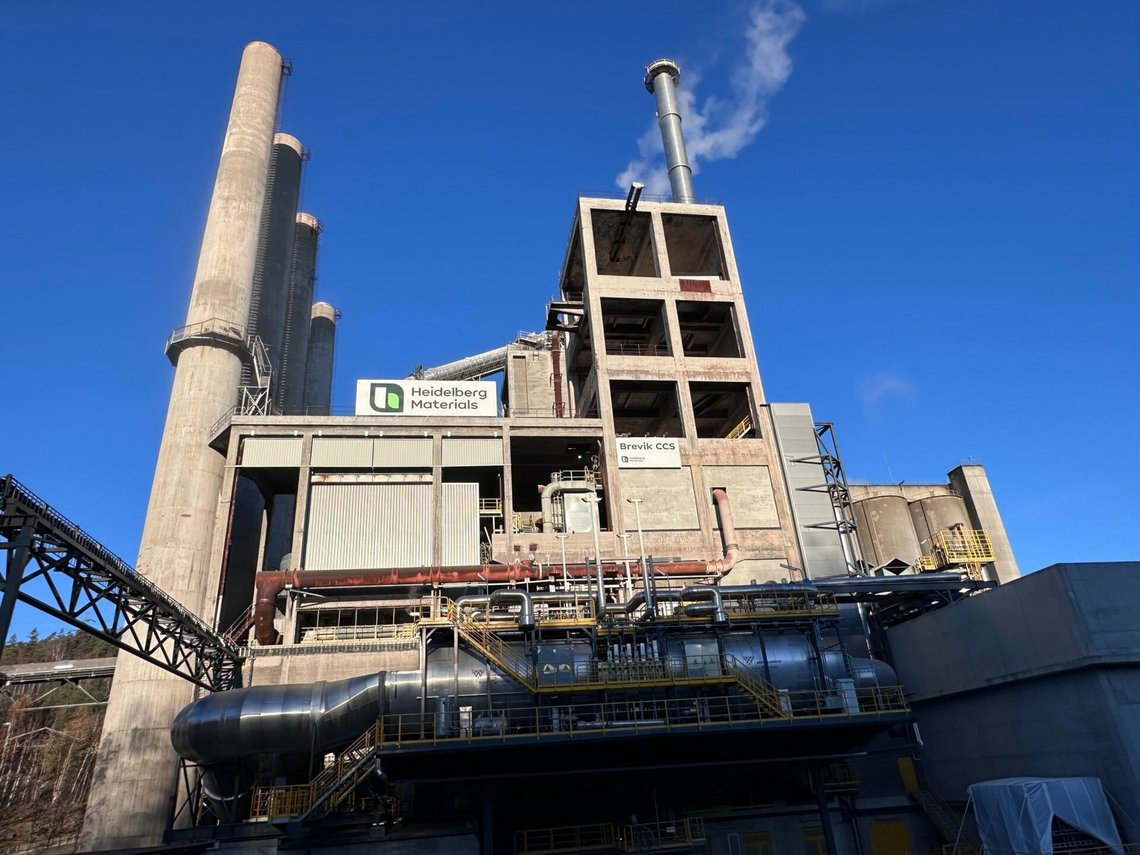


NRK has visited the cement factory in Brevik, owned by Heidelberg Materials and known for its NOK 3.3 billion carbon capture plant – which forms part of Erna Solberg’s flagship climate initiative known as «Langskip», costing 34 billion kroner. This is the first cement factory in the world to use carbon capture and storage (CCS) in its production, and this “climate cement” is sold under the name “evoZero”. The company also offers the ‘climate-reduced’ product range ‘evoBuild’, which is said to have a ‘carbon footprint’ that is at least 30 per cent lower. Doesn’t that sound fantastic?
Unsurprisingly, the journalist-activists from NRK are on the verge of a climate orgasm with excitement, and naturally do not have a single critical question about anything whatsoever. Instead, NRK is acting as a PR department for Heidelberg Materials, which is bound to use this ‘journalism’ in its advertising. The cement factory is, in fact, portrayed as a ‘tourist office’ for thousands of visitors in delegations from India, Germany, the USA, Japan and South America, who will come to Brevik to be inspired. Everyone wants to build something grand!
– It’s a bit un-Norwegian to pat ourselves on the back and look at ourselves, but here we’ve actually achieved something that no one else has managed. Why not tell people about it?”, says Pia Prestmo, head of public affairs for Heidelberg Materials in Norway, to NRK.
The Langskip project involves capturing CO2, liquefying it and transporting it by ship to Øygarden in Western Norway at enormous cost and energy consumption. There, the plant material is pumped through pipes out onto the North Sea shelf and stored beneath the seabed at even greater cost and energy consumption. All that is achieved is the capture of a paltry 400,000 tonnes of CO2 per year, and there is no revenue in this ‘value chain’, which took 20 years to realise. Now the whole world is queuing up to copy this madness, according to Heidelberg Materials and NRK. It is worth a closer look.
What NRK won’t tell anyone
The first red flag comes from Asbjørn Torvanger at Cicero, the Centre for Climate Research, who admits to NRK that the solution from Brevik is of interest to other countries, but that CCS will never become a primary means of reducing CO2. The second red flag is that, if this costly solution is to have a real impact on global emissions, more rapid expansion is required.
“For carbon capture to be worthwhile, it must therefore become more expensive for companies to emit CO2,” he tells NRK – as if this were smart, necessary or beneficial to society.
Anyone who has completed first-year economics understands that this has nothing to do with normal business economics. Imposing enormous costs on companies through levies in order to force them to spend vast sums to avoid those levies is not industrial policy. It is sabotage. NRK also fails to mention the operating costs of the plant, which uses as much electricity as 7,000 households. So just carry on “saving electricity”, won’t you, so that others can waste as much as possible. And it doesn’t stop there.
It isn’t Heidelberg Materials that has paid for this marvellous project. It is you who have done so through state aid of around 23 billion, which is the expected direct state aid for construction and up to ten years of operation. And the CCS plant can only capture around 50 per cent of the CO2 emissions from cement production. So how can they market the “evoZero” cement as if it were actually carbon-neutral?
Creative climate accounting
Heidelberg Materials achieves this through a ‘climate accounting principle’ called ‘mass balance with free allocation’, which in turn is linked to a digital ‘carbon bank’. Confused? Let me explain: rather than distributing the 50 per cent of captured CO2 evenly across all the cement produced, they aggregate the entire emissions reduction on paper and link it to half the production volume – which they then sell as the climate-neutral cement ‘evoZero’. Still confused?
You see: the cement factory in Brevik does not have two production lines, one for ordinary cement and one for ‘climate cement’. All the cement produced in Brevik is exactly the same. Heidelberg Materials records every tonne of CO2 captured and stored in the North Sea in the ‘Heidelberg Materials Carbon Bank’, which is verified by the third party, Det Norske Veritas. Half of the cement from Brevik is sold as standard cement, in which case the ‘emissions quota’ from the entire capture plant can be transferred to the evoZero cement.
The important thing to understand here is that ‘climate cement’ is exactly like any other cement – from any other cement factory in the world. There is no method for verifying that a cement powder has been produced without CO2 emissions. It is all a marketing ploy known as a ‘meta-value’. In other words, pure fantasy. And it is worth noting that the price of this green cement is kept secret and depends on contracts and volume. And that opens the door to even more creativity:
An expensive bureaucratic monster paid for by taxpayers
Because the CO2 reduction itself is digitally tracked via blockchain technology and linked to the customer’s order, they also sell the evoZero Carbon Captured variant from other European factories. (!) The physical cement is produced locally, but the ‘carbon footprint’ is offset by means of CO2 capture in Brevik. You heard right. Brevik’s cement factory is subject to quota obligations under the EU’s taxonomy and the Norwegian Climate Act of 2019, and reduces its emissions through verified permanent storage and the EU’s Emissions Trading System (ETS).
Through the EU ETS, ‘climate certificates’ are issued which are used in the cement factory’s product accounts, because the taxonomy requires that CO2 reductions be treated with the same seriousness as accounting figures. German-produced cement can thus be marketed with a calculated carbon footprint of zero, even though emissions from the German cement plant remain completely unchanged, simply because there is a CCS plant in Norway. In other words, your 23 billion in taxpayers’ money is being used by a private company for greenwashing and creative accounting to satisfy the “climate ambitions” and meaningless ‘climate targets’.
It’s hard to understand, and it has nothing to do with the climate
If you’ve lost track of this bureaucratic madness, you’re not alone, and that’s fine: The aim is simply for readers to get a sense of just how vast, extreme and insane climate measures have become, and what a cost-and-fraud merry-go-round this actually is. Climate hysteria has gone from a mental short-circuit fuelled by fear of the end of the world – disconnected from facts, maths and science – to making the ‘solutions’, i.e. the ‘climate measures’, legally binding. And there is no science behind these climate measures. They are merely political inventions. So what is to stop cement manufacturers from selling ordinary cement in bags labelled ‘climate-neutral cement’ to make more money? Nothing. It is impossible to control.
The mistake of turning climate hysteria into legislation (the 2015 Paris Agreement) has created a costly and enormous bureaucratic monster that is completely out of control. It now has a life of its own and is growing unchecked because even climate politicians have lost track of and insight into what they have created. And since climate measures were never designed to work, the bureaucracy, hypocrisy, fraud and corruption simply grow as everything fails. One failed regulation merely leads to more failed regulations. But never mind, one thing is certain: the most adaptable will survive.
Heidelberg Materials are, in fact, ‘survivors’. They are not transitioning to ‘net zero’. They are cynics who are adapting to the growing climate bureaucracy. Even though there are only costs and no value in this ‘value chain’, they are actively managing the damage. By any means necessary, they are minimising damage through creative climate accounting, higher prices, carbon trading and public subsidies, but they are 100 per cent dependent on one factor: that this destructive ‘value chain’ of legislation, bureaucracy, hypocrisy, fraud, madness and creative accounting continues ad infinitum.
No one must stop the money train!
Politicians must continue with the climate madness and must continue to pour taxpayers’ money into the bottomless green abyss in order to achieve their self-imposed climate targets, which have never been achievable. This is what the cement manufacturer is banking on. Just like the wind power mafia. And so media outlets like NRK must continue to act as mouthpieces, telling the public just how important, correct and successful these climate measures are, and just how dangerous Trump is for scrapping climate legislation as quickly as possible.
The Heidelberg Materials Group has a global turnover of around 21.5 billion euros. We shouldn’t feel sorry for them just because they own the factory in Brevik. That’s small change for them. They’re using Brevik as a lifeline, because they know that Norwegian politicians are the most climate-hysterical in the world, and have endless amounts of money to pour into their political pipe dreams.
Unlike NRK and Heidelberg Materials, Document does not have billions to splash out on telling the truth. And we are losing the battle: since the climate targets are unachievable yet still legally binding, it also becomes a legal obligation to pour endless amounts of money into attempts to achieve them. It is a death spiral for Europe, but it offers hope and opportunities for every honest and dishonest climate profiteer around the world.


