

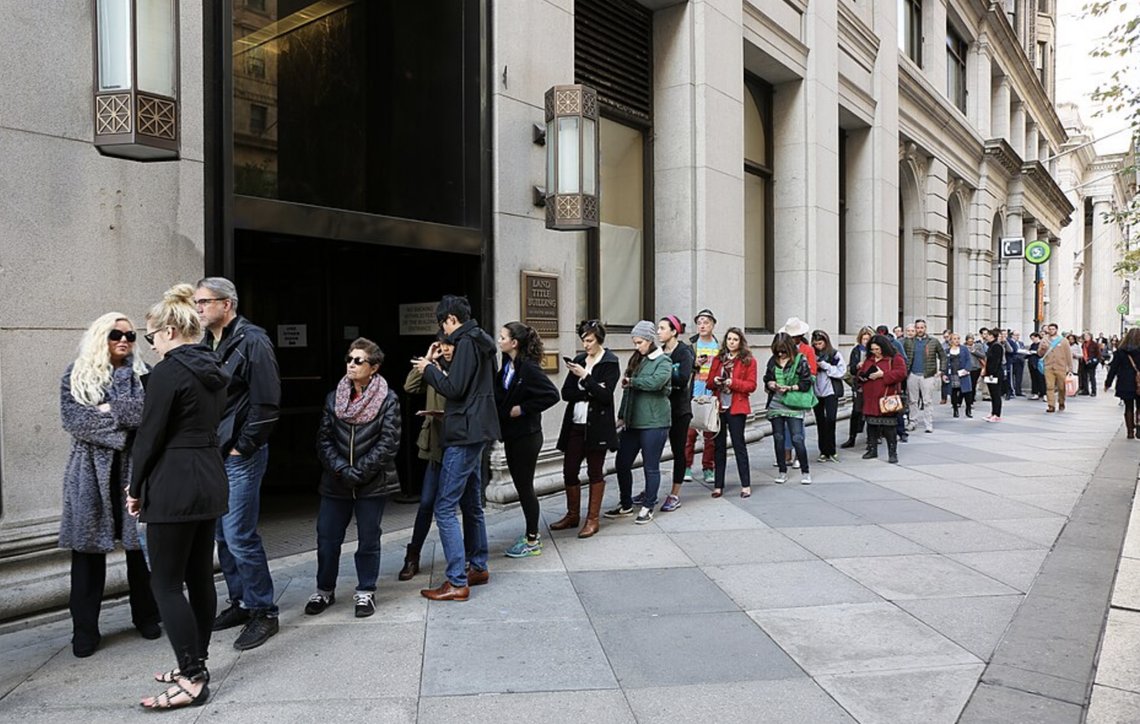


In the mid-term elections, the Democrats achieved a strong result. There was jubilation in the American and Danish media, as it now seemed the Trump era and his ‘conservative golden age’ were coming to an end. But that is a hasty conclusion.
Trump may well soon be a thing of the past, but it is by no means certain that Americans will vote the Democrats’ left wing into power or reject conservatism. Americans are moderate in economic policy, but remain value-conservative.
A more accurate picture can be gained by looking at the last presidential election, as Musa al-Gharbi has done in a highly comprehensive 2024 analysis of the election’s overarching trends.
A presidential election not only tells us more about the next presidential election than a mid-term election – which goes without saying – but it also reveals something about voters’ support for the two parties.
Voter turnout is usually relatively low in mid-term elections, and the Democrats perform better than the opinion polls suggest when few voters turn out, whilst the Republicans, on the other hand, perform better when many do. One reason is that regular voters are better educated and more affluent. They are increasingly leaning towards the Democrats.
Analyst David Shor has estimated that, with full turnout in 2024, Trump would have won by around 5 percentage points instead of 1.4. With low turnout at 2022 levels, Harris might have won. Mid-term elections have thus become the Democrats’ home ground.
Furthermore, the recent mid-term election was largely a vote against Trump. For good reasons, this will not be the case in the next presidential election.
Admittedly, the Republicans lost some of the voters they had won over in 2024, particularly amongst minorities (generally speaking, Republican voters from 2024 stayed at home during the mid-term elections, whilst new, angry voters voted for the Democrats), but it is the Democrats who have lost non-white voters and working-class voters in every election since 2010. In 2024, the party achieved its weakest result among Black voters in roughly half a century, and among Latin American women, the margin shifted by 26 percentagein the Republicans’ favour from 2020 to 2024.
According to al-Gharbi, the Democrats’ corevoters have become the ‘symbolic capitalists’, that is, people in the media, at universities, in the financialsector and in culturallife. If the Democrats were on the far left in 2024 – Kamala Harris, for example, was perceived by voters as more extreme than Trump – they will be no less so in 2028, if the party follows the current trend and selects a ‘Democratic Socialist’ as its presidential candidate in the mould of Mamdani and El-Sayed. In other words, ‘Third Worldism’, Islamo-leftism and hard-line socialism. The campus Marxists, the Tesla socialists and the moralised upper-class children.
Up until 2024, the Democrats had been rather extreme when it came to identity politics, to which they gave a great deal of prominence – race, gender, sexuality, ‘defund the police’, gun control, open borders and climate change – but post-election opinion polls showed precisely that voters felt the party had talked too much about identity politics and too little about the cost of living, growth, crime and illegal immigration.
Even education, which has otherwise been a safe political ground for the Democrats, has now increasingly become a losing issue associated with lowered standards and political propaganda in the classroom.
Finally, there was the disconnect with voters: Harris turned down an appearance on Joe Rogan’s podcast (11 million listeners per episode) out of consideration for staff members who would not have approved. Similarly, the Democrats remained unpopular as measured by the flow of funds to the party. According to Forbes, 83 billionaires supported Kamala Harris, but only just over 50 supported Trump. Wealthy voters are now voting for the Democrats to a greater extent, and the Democrats raised roughly twice as much money during the presidential election. Yet they still lost.
In Berlingske, Professor Peter Kurrild-Klitgaard criticised my interpretation of the 2024 election. According to the election-day poll, it was primarily dissatisfaction with the economy that caused voters to turn their backs on Biden and Harris, he writes. That is true, but the Democrats have been losing ground amongst workers, religious voters and non-white voters in every single election since 2010. That’s eight elections with changing candidates and changing issues at the top of the agenda.
The election-day polls, Klitgaard emphasises, show what voters were thinking on election day. A trend spanning a decade and a half suggests something deeper. Voters may well have turned against Trump whilst at the same time holding on to conservative values.
Kurrild-Klitgaard sees a typical pattern for mid-term elections and a reaction to the current economic situation. I see a cultural conservatism that has been present for more than a decade, and which Trump failed to manage effectively.
Well, if the Democrats field a moderate presidential candidate, the situation is, of course, entirely different. In that case, they’ll have a good chance of winning the presidential election. But that would only confirm the point: Americans are pragmatic and centrist when it comes to the economy, and conservative when it comes to culture and values.
The mid-term elections may tempt the Democrats to believe that a left-leaning course is the right one. That is unlikely to be a good strategy.


