

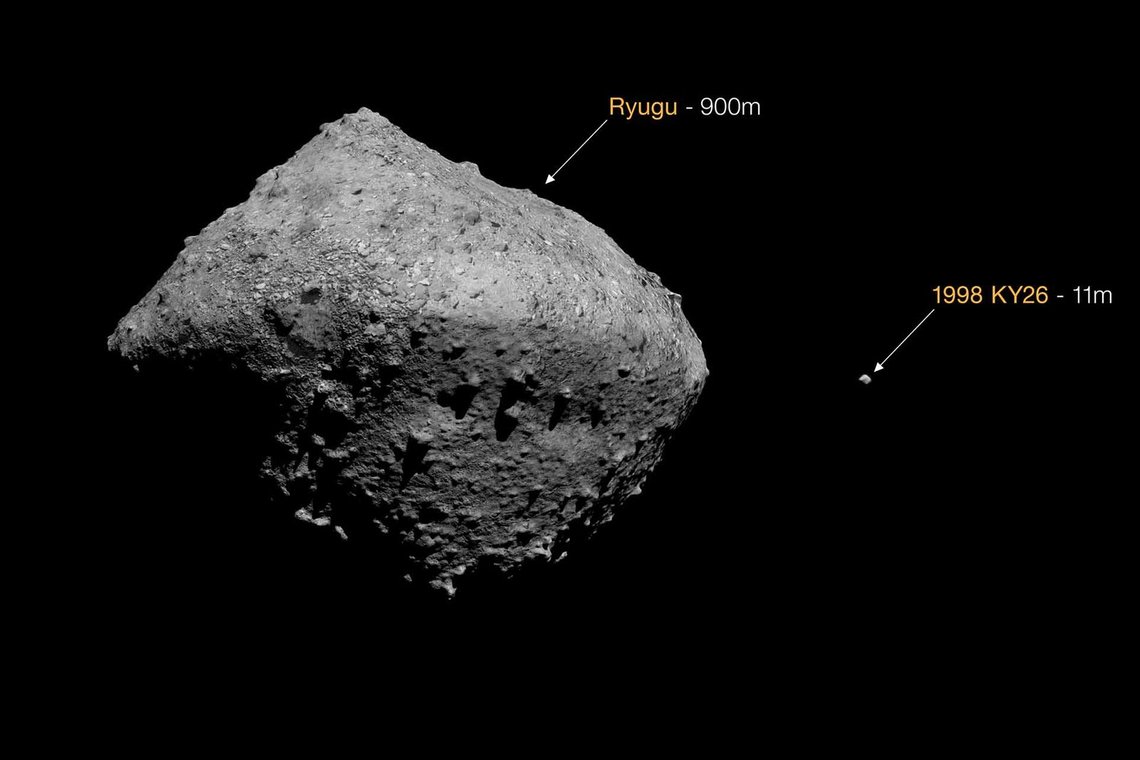


A small celestial body known as ‘1998 KY26’ is giving astronomers a headache. A rock with a diameter of around 11 metres rotates every five minutes and is accelerating in an inexplicable manner.
The object is located around 300 million kilometres from Earth and is classified as a near-Earth asteroid. What is unusual is the so-called non-gravitational acceleration – an extra ‘nudge’ that affects its orbit.
Has Phobos 1 risen from the dead?
One theory is that 1998 KY26 is a so-called ‘dark comet’. That is, a rocky body containing hidden ice which sublates into gas, producing a slight thrust without forming a comet’s tail.
However, research at the Georgia Institute of Technology casts doubt on this explanation. Using detailed temperature models, the researchers conclude that the object is too warm to retain buried ice over a long period of time. Even the coldest areas have temperatures that would cause ice to disappear within a few decades – not billions of years, as one would expect from a good old-fashioned asteroid.
They conclude that 1998 KY26 is most likely a dried-out asteroid, but this does not answer the question of what is propelling it. Possible explanations include solar radiation pressure and thermal forces; sunlight striking the surface and creating a slight thrust.
A more sensational hypothesis comes from the astrophysicist Avi Loeb at Harvard. He believes the object may be the missing Soviet probe Phobos 1, which was launched in 1988 to study Mars’ moon Phobos but vanished into space. According to them, its size, reflectivity and orbit match the old probe surprisingly well. Sunlight striking solar panels or metallic surfaces could, in theory, explain the extra acceleration.
🚨 MYSTERIOUS ASTEROID COULD ACTUALLY BE ALIEN SPACECRAFT! 👀🛸
A mysterious 36-foot object known as 1998 KY26 is accelerating through space in a way that gravity alone cannot explain.
Harvard astrophysicist Avi Loeb and colleagues have proposed an extraordinary theory: it could be… pic.twitter.com/KzGbvvOIex
— UNIVERSE Now (@UniverseNow00) 13 November 2026
NASA’s chief, Jared Isaacman, has commented on the speculation and emphasised that there is currently no evidence to suggest that the object is anything other than an asteroid.
Japan’s Hayabusa2 space probe is scheduled to encounter 1998 KY26 in July 2031. This will give researchers the opportunity to study the object at close quarters and, hopefully, determine what is causing its strange acceleration.
For the time being, 1998 KY26 remains one of the solar system’s most enigmatic objects – a small, rapidly spinning mystery that defies all known explanatory models.


