

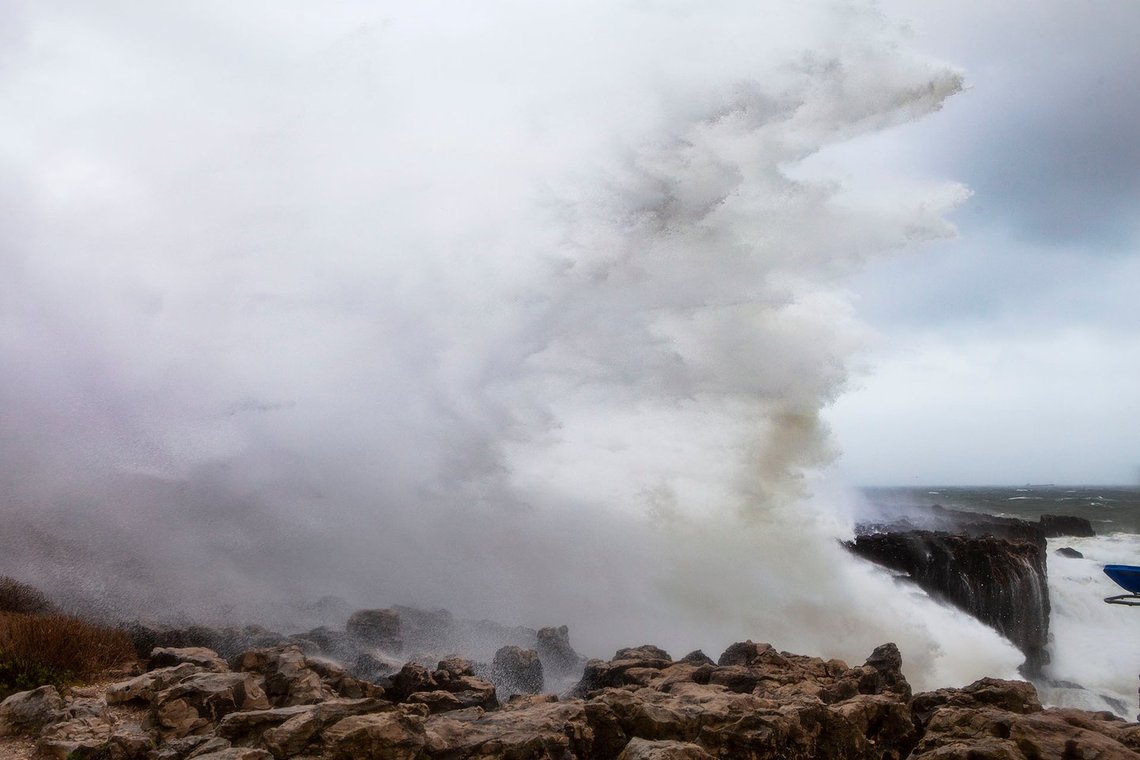


Over the past week, Portugal experienced a nationwide lockdown due to a forecast storm, described on social media as ‘the world’s first climate lockdown’.
Climate change was not, however, the official reason for the lockdown; it was Storm ‘Charles’. Once ‘Charles’ had passed, the damage on the mainland was nowhere near the cost of the lockdown.
No new confirmation of ‘man-made climate change’
The storm was ‘promoted’ with red triangles and warnings of extreme danger. The measures implemented bore many similarities to the Covid lockdowns:
The whole country was put on hold. Around 8,000 schools were closed. Non-essential public services remained closed. Events were cancelled, public transport was restricted and air traffic was suspended. Shops and restaurants were closed, and the authorities urged people to stay at home. This is the first time such measures have been taken nationwide due to a storm warning.
The government’s decision came following warnings of heavy rainfall, gusts of wind that could reach 120 kilometres per hour, as well as the possibility of a rare meteorological phenomenon known as a sting jet; hurricane-force gusts. Flooding, fallen trees, damage to buildings and power cuts were forecast. Eight districts were placed on the highest alert level.
🇵🇹 | Portugal has just caused a global controversy after allegedly implementing the world’s “first climate lockdown”.
The Portuguese Government closed schools and public services and urged all its citizens to stay indoors during a “normal” storm. pic.twitter.com/bYXSjmS65B
— Questiona-te (@questiona_te) 12 November 2026
It soon became apparent that there was a huge gap between the authorities’ worst-case scenario and the reality on the ground.
There was no denying the rainfall; in a single day, around one-eighth of the area’s average annual rainfall fell. The storm, however, lost its strength; it split into two low-pressure centres over the Atlantic and refused to develop in line with the meteorologists’ models. Some flooding, traffic problems and other weather-related incidents were reported, but we received no new ‘confirmation’ of ‘man-made climate change’. The red warning triangles were replaced, initially with yellow ones, and these were quickly removed when the sun reappeared from behind the clouds.
No mercy on social media: – Authoritarian, arbitrary and simplistic
Portugal has a population of around ten million. The decision affected families, workplaces, transport, trade, education and a range of public services.
Over 300 flights were cancelled. Pingo Doce, one of the country’s largest supermarket chains, closed all its stores. Web Summit in Lisbon, with 70,000 participants from around the world, cancelled all activities for the day.
On social media, the government’s lockdown is being described as an authoritarian, arbitrary and simplistic approach based on a single weather model. The government is alleged to have failed by doing too little in response to Storm ‘Kristin’, as well as the power cuts and forest fires in 2025. Now it has failed by doing too much, by choosing the easiest solution: to shut the country down.
Reference is made to the Covid lockdown, and it is claimed that this normalised extraordinary restrictions: – Now the government is ready to experiment further.
The most common criticism is that …
- the economic burdens are being passed on to the private sector.
- the costs are social, institutional and democratic.
- closing schools means depriving children of the opportunity to learn.
- suspending hospital operations means postponing operations for up to several months.
- closing the courts means postponing legal proceedings.
- Another serious cost is citizens’ rights, freedoms and safeguards.
🌪️🇵🇹 THE FIRST MAJOR CLIMATE LOCKDOWN IN PORTUGAL
👉🏻The authoritarian, indiscriminate and lax manner in which the Government shut down services and suspended activities on the basis of a single weather forecast is unacceptable.
⚠️ The Government failed with Kristin, with the blackout, with the… pic.twitter.com/XnOlKdKCBo
— JOANA AMARAL DIAS (@joanamaraldias) 12 November 2026


